CELPIP Reading Practice Test 112
By Iris
A complete CELPIP Reading practice test: all 4 parts and 38 questions in the real test order. Set a timer for 55–60 minutes and do all four parts in one sitting. Check your answers at the bottom of the page to see your score and an estimated CLB.
Download as PDF with answer key
In this test
- Part 1: Reading Correspondence, “A Lost Bag and a Long Drive” (questions 1–11) · practise this part alone
- Part 2: Reading to Apply a Diagram, “Volunteering at a Penticton Music Festival” (questions 12–19) · practise this part alone
- Part 3: Reading for Information, “The Last Spike and the Railway to the Pacific” (questions 20–28) · practise this part alone
- Part 4: Reading for Viewpoints, “Taking Down the Carrow Mills Dam Debate” (questions 29–38) · practise this part alone
Part 1: Reading Correspondence
Dear Mr. MacLeod,
I hope this letter finds you and Moira well. We arrived home in Red Deer on Tuesday, and I promised myself that the first thing I would do was write to you properly. A quick thank-you on the doorstep of the inn hardly seemed enough.
I’m still embarrassed when I think about that afternoon. Dad and I had stopped to rest on a bench near the Charlottetown waterfront, and somehow, while we were busy watching the sailboats, we walked off without his canvas bag. We didn’t notice it was missing until we reached the inn, forty minutes away, and by then I was sure we would never see it again. You can imagine our relief when you appeared at the door that evening with the bag in one hand and a tin of Moira’s oatcakes in the other.
I don’t think you realized how much you had returned to us. The spare hearing aids could have been replaced, though not cheaply. The photo album could not. It holds the only copies of the pictures of my mother from their early years together, and since she passed away, Dad has not gone anywhere without it. When he saw it, he had to sit down on the steps, and he couldn’t speak for a minute.
I was also impressed by your detective work. There was no name or phone number anywhere in the bag, and if you hadn’t noticed the inn’s receipt tucked inside the album, I don’t know how you would ever have found us.
When I tried to give you something for your trouble, you refused and said that anyone would have done the same. I’m not sure that’s true, but I respect your wishes. Instead, I’ve made a donation to the volunteer fire department you’ve served with for so many years. I hope you’ll accept that as our thanks.
Dad has told the story to everyone at his seniors’ residence at least twice, and the other residents have started calling you “the Island detective.” He has also bought a luggage tag for every bag he owns.
I’ve enclosed a photo of the two of you on the inn’s porch. Please also thank Moira for the oatcakes. They lasted us halfway home.
If you ever find yourselves in Alberta, there will always be a room for you in our home.
With heartfelt thanks,
Sunita Rao
Why did Sunita write this letter?
Where was the bag left behind?
What mattered most to Sunita’s father?
How did Mr. MacLeod find Sunita and her father?
What did Sunita do instead of giving Mr. MacLeod a reward?
What can we infer about Sunita’s father since he returned home?
Here is a response to the message. Complete the response by filling in the blanks. Select the best choice for each blank from the drop-down menu.
Dear Sunita,
What a kind letter. Moira and I were glad to hear you both made it home safely, and she was tickled that her baking .
I must say that your gift to the was far too generous, though everyone there was thrilled. It will go toward new equipment.
Please tell your father I’m flattered by my new nickname, but I’m no detective. If that hadn’t fallen out when I opened the album, I would have had to take the bag to the police.
I was sorry to read about your mother. I could see how much those pictures meant to your dad when he .
And I’m pleased to hear that he has , though I hope he never needs them.
All the best,
Ewan MacLeod
Part 2: Reading to Apply a Diagram
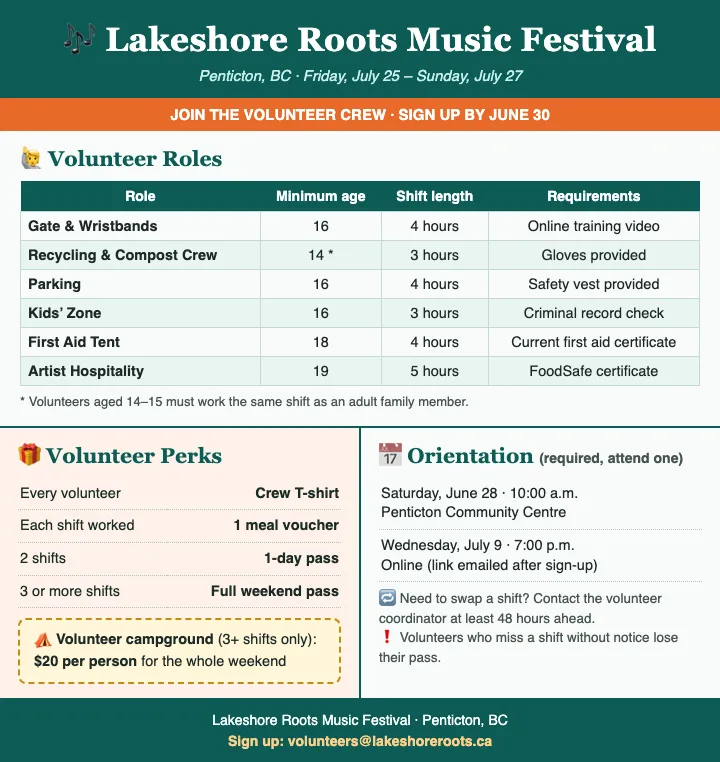
Read the following email message about the diagram on the left. Complete the email by filling in the blanks. Select the best choice for each blank from the drop-down menu.
Subject: Festival this summer?
To: Mateo Rossi
From: Jasmine Kaur
Hi Mateo,
Remember how we were grumbling on our break on Monday that festival tickets had gone up again? I think I’ve found a way around it. The festival is looking for volunteers, and the perks are pretty good.
Since you just renewed your first aid certificate, you could help out at the . I’m going to sign up for the recycling crew, mostly because my brother Arjun wants to come along. He’s only fifteen, so that’s the only job open to him, and he can do it only .
Here’s the best part. If we each do at least shifts, we get a pass for the whole weekend, not just one day. Camping at the volunteer site is also , so we wouldn’t have to drive home at midnight.
The only catch is the orientation. We’re both on the schedule at the store on Saturday the 28th, so we’d have to go to the session instead. I’ll also ask Mr. Dhillon tomorrow whether he can give us both the festival Friday off.
Honestly, it’s a no-brainer. Let me know before the sign-up deadline at the end of the month!
Jasmine
Jasmine and Mateo know each other because they
Why does Jasmine suggest volunteering?
When Jasmine says signing up is “a no-brainer,” she means that it is
Part 3: Reading for Information
Paragraph A
When British Columbia joined Confederation in 1871, it did so on one key condition: within ten years, a railway would link it to the rest of the country. At the time, the idea seemed almost impossible. The line would have to cross thousands of kilometres of rock, forest, prairie and mountains, through land with very few settlers, and many critics argued that the cost was far too high for such a young country. Political scandal and economic trouble delayed the project, and the ten-year deadline passed with little track laid. Serious construction began only in 1881, when the Canadian Pacific Railway company took on the job. It hired William Van Horne, an experienced American railway manager, to lead the work, and progress soon sped up dramatically.
Paragraph B
The route presented enormous challenges. North of Lake Superior, crews had to blast through the hard rock of the Canadian Shield and lay track across swampy muskeg that sometimes swallowed sections of the line. In the West, the railway had to climb through steep mountain passes in the Rockies and the Selkirks. Much of the most dangerous work in British Columbia was done by thousands of Chinese labourers, who were paid less than other workers and given the riskiest jobs. Many died from accidents, rockslides and illness, and their contribution was long left out of the official story. In 1885, the year the line was finished, the federal government imposed a head tax on Chinese immigrants, and in 2006 it formally apologized for that tax.
Paragraph C
The tracks being built from the east and the west finally met at Craigellachie, in the mountains of British Columbia, on November 7, 1885. Donald Smith, one of the company’s main financial backers, was given the honour of driving the last spike. According to most accounts, his first blow bent the spike, which had to be replaced before he could finish the job. Unlike the gold spikes used at some American railway ceremonies, it was a plain iron one. Van Horne, who was present, was asked to make a speech and kept it to a single sentence, saying that the work had been well done in every way. A photograph of the moment, showing a crowd of men in dark coats gathered around Smith, became one of the best-known images in Canadian history. The railway had been completed years ahead of the deadline set in the company’s contract.
Paragraph D
The first scheduled passenger train set out from the East in June 1886 and reached Port Moody, on the Pacific coast, less than a week later. The railway transformed the country. It carried settlers and supplies to the Prairies, moved grain to eastern markets and helped tie the distant provinces together. New towns sprang up along the line, many of them built around a station. To earn money from passengers, the company also built grand hotels in the mountains, encouraging tourists to come and admire the scenery. Today, the line is used mainly for freight, but the story of the last spike remains a symbol of national ambition.
Decide which paragraph, A to D, has the information given in each statement below. Select E if the information is not given in any of the paragraphs.
- A promise made to one province was not kept on time.
- A government later expressed regret for its treatment of one group of people.
- The final step of the project did not go smoothly at first.
- The company built places to stay in order to attract visitors.
- The idea of the railway was first suggested by a British Columbia premier.
- Some sections of the route crossed ground that was hard to build on.
- The man who drove the last spike was born in the United States.
- The work was finished earlier than the company had agreed to.
- Crossing the country by train took only a matter of days.
Part 4: Reading for Viewpoints
For nearly 150 years, a dam has restrained the Carrow River in the heart of Carrow Mills, creating the millpond that gives the community its postcard view. A recent engineering inspection, however, discovered serious cracks in the concrete spillway, and councillors must soon choose between repairing the structure and dismantling it.
Public works director Raymond Osei has tabulated the alternatives without advocating either. Restoring the dam to current safety standards would demand an estimated $4.2 million, with no assistance available. Removal would require about $1.6 million, sixty percent of it recoverable through a provincial and federal river restoration grant, provided the application arrives before next March. “Inaction is unavailable. The spillway won’t survive another decade,” he warns, and crews have already lowered the pond slightly as a precaution.
Fisheries biologist Leah Morrissette finds the choice self-evident. The barrier denies brook trout and American eels many kilometres of upstream habitat, the shallow pond overheats beyond what trout tolerate, and removal would eliminate the danger of a catastrophic failure during spring flooding. Comparable rivers have rebounded within a few years. “Residents should nevertheless brace themselves for a season or two of exposed mud along the former pond bottom before grasses and shrubs recolonize the valley,” she cautions.
Gord Halvorsen, who has overlooked the millpond for thirty-one years, has no appetite for a river valley. “Removal would reduce my waterfront to a muddy creek bank and eliminate the water where my grandchildren swim and paddle,” he says, and he suspects it would depress property values along the shore. Accepting that the spillway cannot remain as it is, he insists that the municipality find the money for repairs. “People move here for that pond,” he declares.
Eileen Thibodeau, president of the historical society, sees the dam as the final link to the grist mill that named the community. The society proposes extracting the failing concrete section while retaining the original stone wall on the east bank and the wheel pit as a heritage site, maintained through its own fundraising. This compromise, she allows, would also drain the pond. “We can’t save everything,” she reasons, “but we shouldn’t erase our history either.”
Besides Halvorsen, who resists the dam’s complete removal?
What follows from Osei’s figures?
Why does Morrissette mention exposed mud?
Which statement holds for everyone taking a side?
An apt title would be
The following is a comment by a visitor to the website page. Complete the comment by choosing the best option to fill in each blank.
I grew up swimming in that millpond, and my own children learned to paddle there, so this debate pains me. Even so, Mr. Osei’s numbers settle it: repair would , a considerable imposition on a community our size. Dr. Morrissette is upfront that , and residents deserve such candour.
Ms. Thibodeau’s proposal also appeals to me, because retaining those old stones while the river runs free. Mr. Halvorsen’s distress about is one I would share in his place, but millions cannot be spent protecting a view.
Councillors should not dawdle: delay, and , making removal far costlier as well.
Answer key
Count your correct answers, then find your estimated CLB:
Show all 38 answers
- Why did Sunita write this letter? D. to thank Mr. MacLeod more fully than before
- Where was the bag left behind? B. on a seat by the harbour
- What mattered most to Sunita’s father? D. photos of his late wife
- How did Mr. MacLeod find Sunita and her father? B. He spotted a clue inside the bag.
- What did Sunita do instead of giving Mr. MacLeod a reward? C. She donated to an organization he belongs to.
- What can we infer about Sunita’s father since he returned home? C. He is taking more care of his belongings.
- D. fed you for much of the drive
- C. local firefighters
- D. slip of paper from the inn
- D. needed to sit and recover
- A. put tags on all of his bags
- C. First Aid Tent
- C. alongside an adult relative
- A. three
- A. only $20 each for the whole weekend
- B. Wednesday evening online
- Jasmine and Mateo know each other because they D. work at the same store.
- Why does Jasmine suggest volunteering? A. to see the festival without paying for tickets
- When Jasmine says signing up is “a no-brainer,” she means that it is A. an easy choice.
- A promise made to one province was not kept on time. A
- A government later expressed regret for its treatment of one group of people. B
- The final step of the project did not go smoothly at first. C
- The company built places to stay in order to attract visitors. D
- The idea of the railway was first suggested by a British Columbia premier. E
- Some sections of the route crossed ground that was hard to build on. B
- The man who drove the last spike was born in the United States. E
- The work was finished earlier than the company had agreed to. C
- Crossing the country by train took only a matter of days. D
- Besides Halvorsen, who resists the dam’s complete removal? A. Eileen Thibodeau
- What follows from Osei’s figures? B. Removal is the cheaper course.
- Why does Morrissette mention exposed mud? B. to admit temporary ugliness
- Which statement holds for everyone taking a side? C. None wants the dam unchanged.
- An apt title would be A. “Carrow Mills’ Dam: Mend It or End It?”
- B. cost far more, with no outside help
- A. the valley will look worse first
- C. salvages part of our past
- D. the water at his doorstep
- B. the grant will lapse
What does your score mean? See the CELPIP Reading score chart.
Free CELPIP practice test · Free CELPIP Listening practice tests · CELPIP sample tests by part
CELPass is an independent practice platform and is not affiliated with Paragon Testing Enterprises. CELPIP is a trademark of Paragon Testing Enterprises. Check the official CELPIP website and IRCC for current test rules and requirements.