CELPIP Reading Practice Test 113
By Iris
A complete CELPIP Reading practice test: all 4 parts and 38 questions in the real test order. Set a timer for 55–60 minutes and do all four parts in one sitting. Check your answers at the bottom of the page to see your score and an estimated CLB.
Download as PDF with answer key
In this test
- Part 1: Reading Correspondence, “Leaving My Bees in Good Hands” (questions 1–11) · practise this part alone
- Part 2: Reading to Apply a Diagram, “A Long Weekend at Birchmere Lake” (questions 12–19) · practise this part alone
- Part 3: Reading for Information, “The Avro Arrow: Canada’s Lost Jet” (questions 20–28) · practise this part alone
- Part 4: Reading for Viewpoints, “Overnight ER Closure in Marlow Falls Debate” (questions 29–38) · practise this part alone
Part 1: Reading Correspondence
Dear Tomasz,
I hope you and Irena are enjoying your retirement. I’ve been meaning to come over and ask you something in person, but every time I see you working in the garden, I lose my nerve. So I’m putting it in writing instead.
As Irena may have told you, my company is transferring me to its Winnipeg office at the end of April. It’s a promotion, and I’m excited about it, but it means selling the house, and the hardest part is leaving my two beehives. I did look into taking them with me, but the hives would have to travel more than twelve hundred kilometres in the back of a truck, and the people at my bee club warned me that few colonies survive a trip like that in early spring.
You’ve told me more than once that your apple trees have never produced as much fruit as they have since my bees arrived. That got me thinking. Would you be willing to take the hives over? They could stay exactly where they are, in the corner of my yard by your fence, because the new owners have agreed to let them remain until the fall. After that, they would need to move a few metres onto your side.
I know you have never kept bees, but honestly, they need far less attention than people imagine. From May to September, each hive should be checked about once every ten days, which takes less than an hour. In winter, they mostly look after themselves. I would leave you my suit, gloves, smoker and tools, as well as my notebook, which records everything I’ve learned over six years, including my mistakes. My friend Priya from the Thompson Valley Beekeepers has also offered to come by twice in May to show you the basics, free of charge.
Of course, any honey would be yours. Last year, the two hives produced nearly forty kilograms, far more than I could ever eat. I gave most of it away, so half the street will probably come knocking on your door.
Please don’t feel obliged to say yes. If it isn’t for you, Priya says the club can find the bees another home, and I’ll understand completely. I just know they would be happiest next to your orchard. Could you let me know by the end of March, so I have time to make other arrangements if necessary?
Warm regards,
Marguerite
Why did Marguerite write instead of speaking to Tomasz?
Why won’t Marguerite take the hives with her?
What does Marguerite suggest about Tomasz’s apple trees?
What will happen to the hives after the fall?
According to Marguerite, keeping bees
What can we infer about Marguerite’s honey?
Here is a response to the message. Complete the response by filling in the blanks. Select the best choice for each blank from the drop-down menu.
Dear Marguerite,
Congratulations on your promotion! Irena and I will miss you, though I wish you had simply knocked on our door. We don’t bite.
You’re right that my apple trees have since your hives arrived, and I’d hate to lose the bees that made it possible. So yes, I’ll take them.
I was worried about the time involved, but if it really is only an hour during the summer, I think I can manage.
I’ll gladly accept your equipment, and I’m especially grateful for . It sounds more useful than any book I could buy.
I’d also welcome , since I would rather not learn everything by trial and error.
As for the honey, I suspect you’re right that . I’ll be sure to save a jar for you.
Warm wishes,
Tomasz
Part 2: Reading to Apply a Diagram
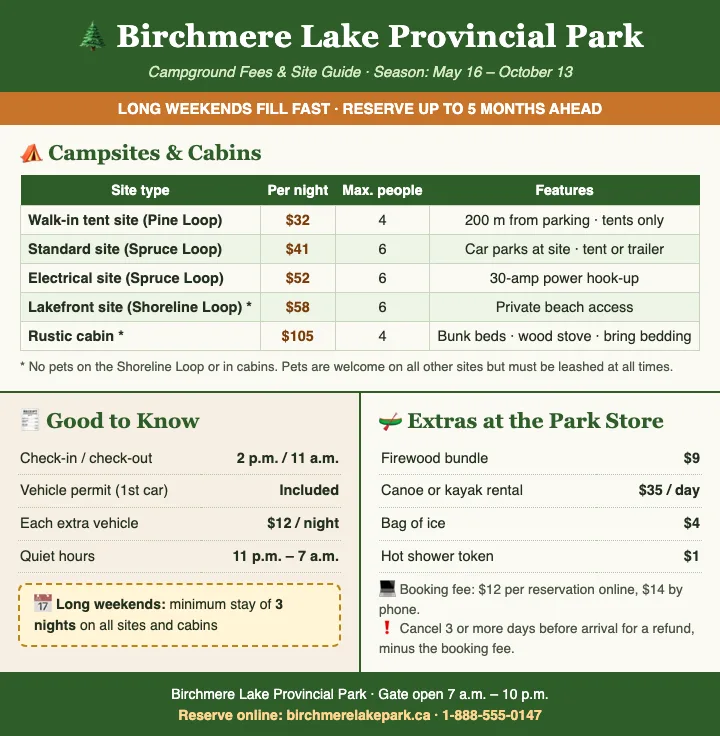
Read the following email message about the diagram on the left. Complete the email by filling in the blanks. Select the best choice for each blank from the drop-down menu.
Subject: August long weekend?
To: Kevin Tran
From: Daniel Okoye
Hi Kevin,
Good news: I finally got the August long weekend off, so let’s make that camping trip happen this year! I’ve been looking at Birchmere Lake, which is only about two hours from both of us.
Since we’re bringing Biscuit, the lakefront sites are out, unfortunately, and so are . With the kids, there will be six of us, which also rules out the walk-in sites, because they only allow .
Mira wants to bring the little fridge for our baby’s bottles, so I think we should book a site . Because it’s a long weekend, we’ll have to stay at least , so let’s plan on arriving Friday afternoon and leaving Monday before lunch. The site costs a night, and we can split it. Since you’re driving up separately, don’t forget there’s a small nightly charge for a second car.
Mira says hi, by the way. She wants to know whether her big brother still remembers how to paddle a canoe. If so, we can rent one there for a day.
Long-weekend sites go fast, so the ball is in your court. Let me know by Friday, and I’ll book it that night.
Daniel
Daniel and Kevin are most likely
What does Daniel ask Kevin to do?
When Daniel says “the ball is in your court,” he means that
Part 3: Reading for Information
Paragraph A
In the early 1950s, as tensions between the West and the Soviet Union grew, the Royal Canadian Air Force began looking for a new kind of fighter. Military planners feared that Soviet long-range bombers could one day fly over the North Pole and across the Canadian Arctic, and they wanted an aircraft fast enough to intercept them far from Canada’s cities. The job went to Avro Canada, a company based in Malton, Ontario, near Toronto. Its engineers designed the CF-105 Arrow, a large two-seat jet with a triangular delta wing. The design was extremely ambitious for its time. Among other advances, the Arrow used an early electronic flight control system, in which the pilot’s movements reached the controls as electrical signals rather than purely through mechanical links.
Paragraph B
The first Arrow was rolled out of its hangar before a large crowd of workers, officials and reporters on October 4, 1957. Unfortunately for Avro, the Soviet Union launched Sputnik, the first artificial satellite, on the very same day, and the news from space quickly pushed the new jet off the front pages. The Arrow first flew on March 25, 1958, with test pilot Janusz Żurakowski at the controls. During later test flights, it reached speeds approaching twice the speed of sound. Remarkably, it did so with American-built engines that had been fitted only as a temporary measure. A more powerful Canadian engine, the Orenda Iroquois, was being developed for the production aircraft, but it was never installed in an Arrow that flew.
Paragraph C
The project, however, was becoming very expensive. Each aircraft was costing far more than first planned, and some defence experts argued that guided missiles, rather than fighter planes, would be the best protection against future attacks. On February 20, 1959, Prime Minister John Diefenbaker announced that the program was cancelled. Avro sent thousands of employees home that same afternoon, and roughly 14,000 people at the company lost their jobs, along with many more at its suppliers. The government then ordered that the finished aircraft, the tools used to build them and the technical drawings be destroyed. The day became known to many Canadians as “Black Friday.”
Paragraph D
The cancellation had lasting effects. With little work left for them in Canada, many of Avro’s best engineers moved to the United States, and a group of them joined NASA, where they worked on the American human spaceflight program, including the missions that took astronauts to the Moon. Historians still debate whether the government made the right decision. Only a few pieces of the Arrow survived, among them the nose section of one aircraft, now displayed at a museum in Ottawa. In recent years, searchers have also recovered some of the scale models that were launched over Lake Ontario during testing. For many Canadians, the Arrow remains a symbol of what the country might have achieved, and its story has been told in books, documentaries and a 1997 television miniseries.
Decide which paragraph, A to D, has the information given in each statement below. Select E if the information is not given in any of the paragraphs.
- The Arrow’s first public appearance received less attention than expected because of another event.
- The aircraft was meant to stop enemy planes long before they reached populated areas.
- The Arrow set a world speed record during its test flights.
- Many employees learned on the day of the announcement that their work had ended.
- Some of the people who designed the Arrow later helped send astronauts into space.
- Some experts believed a different kind of weapon would protect the country better.
- The prime minister later admitted that cancelling the program had been a mistake.
- Objects linked to the Arrow’s testing have been found underwater.
- The aircraft that flew were not powered by the engine planned for the final version.
Part 4: Reading for Viewpoints
Marlow Falls Hospital has staffed its emergency department around the clock for over sixty years. The regional health authority now proposes closing it nightly from 8 p.m. to 8 a.m. for a twelve-month trial, diverting overnight patients to Halstead General, a 45-minute drive away. The prospect, open to public comment until May 15 with a final decision due in June, has polarized a population of about 6,000, many of whom live on farms well outside town.
Corinne Bélanger, vice-president of rural services, attributes the proposal to staffing, not finances. Three of seven emergency physicians have departed within eighteen months, and the remaining four cover a schedule normally requiring twice that number. Already the department shuts on a few hours’ notice whenever someone falls ill. “A fixed timetable is safer, because patients could at least plan,” she reasons. Only about four patients arrive nightly, she adds, and any savings would finance recruitment.
Dr. Samuel Achterberg, one of the remaining four, admits the schedule is unsustainable, having worked over seventy hours last week. Still, nightly averages strike him as treacherous. “Arithmetic is no comfort to whichever of those four is having a heart attack.” Instead of locked doors, he advocates an overnight nurse on site, with a physician accessible by video link and prepared to attend the gravest cases, an arrangement reportedly successful at several small hospitals elsewhere.
Paramedic Luis Ferreira, representing regional ambulance crews, professes no objection in principle but identifies a dangerous omission. Marlow Falls has only two ambulances, and each round trip to Halstead occupies one for close to two hours. He wants one thing first: “Put a third vehicle here before anyone locks a door.”
Wendy Gaudet, a trucking operator for twenty years, finds no conditions acceptable. Her drivers and the sawmill’s night shift are precisely those likeliest to need care after dark, and winter can shut the Halstead highway for hours. The trial’s promised twelve-month limit draws only a dry laugh from her. “What young physician would settle beside half a hospital?” she asks.
Who, like Dr. Achterberg, asks for added overnight coverage?
Bélanger cites present closures to argue that
Why does Ferreira want a third vehicle?
What can be inferred from the article?
The best headline would be
The following is a comment by a visitor to the website page. Complete the comment by choosing the best option to fill in each blank.
A lifelong Marlow Falls resident, I cannot support this plan as written. The authority keeps saying “trial,” but I suspect . Ms. Bélanger’s observation that only is offered as though it settled the matter. It doesn’t.
Averages conceal . The plan would also , a risk nobody has explained away. We live well outside town, so the drive alone already frightens us, and winter makes it worse. My neighbours feel much the same, whatever they think of the authority’s figures.
Our exhausted doctors are blameless, and something must change, but the authority should first . If it succeeded elsewhere, why not here?
Answer key
Count your correct answers, then find your estimated CLB:
Show all 38 answers
- Why did Marguerite write instead of speaking to Tomasz? C. She felt too shy to ask him face to face.
- Why won’t Marguerite take the hives with her? A. The bees might not survive the long drive.
- What does Marguerite suggest about Tomasz’s apple trees? D. They have benefited from her bees.
- What will happen to the hives after the fall? B. They will be moved onto Tomasz’s property.
- According to Marguerite, keeping bees C. takes less time than most people expect.
- What can we infer about Marguerite’s honey? D. Many of her neighbours have already received some.
- B. been at their most productive
- A. about three times a month
- C. all your notes from six years
- D. a couple of lessons from Priya
- B. the neighbours will come asking for it
- D. the cabins
- A. four people
- C. with a power hook-up
- B. three nights
- C. $52
- Daniel and Kevin are most likely D. brothers-in-law.
- What does Daniel ask Kevin to do? A. give him an answer by Friday
- When Daniel says “the ball is in your court,” he means that C. Kevin must decide what happens next.
- The Arrow’s first public appearance received less attention than expected because of another event. B
- The aircraft was meant to stop enemy planes long before they reached populated areas. A
- The Arrow set a world speed record during its test flights. E
- Many employees learned on the day of the announcement that their work had ended. C
- Some of the people who designed the Arrow later helped send astronauts into space. D
- Some experts believed a different kind of weapon would protect the country better. C
- The prime minister later admitted that cancelling the program had been a mistake. E
- Objects linked to the Arrow’s testing have been found underwater. D
- The aircraft that flew were not powered by the engine planned for the final version. B
- Who, like Dr. Achterberg, asks for added overnight coverage? A. Luis Ferreira
- Bélanger cites present closures to argue that C. planned closures are safer
- Why does Ferreira want a third vehicle? B. Local calls could go unanswered.
- What can be inferred from the article? D. Keeping physicians has been hard.
- The best headline would be B. “Marlow Falls Weighs Shutting Its ER After Dark”
- D. the doors will stay locked
- A. a few patients arrive overnight
- C. the life-threatening cases
- B. strip the area of cover
- D. test a night nurse and video doctor
What does your score mean? See the CELPIP Reading score chart.
Free CELPIP practice test · Free CELPIP Listening practice tests · CELPIP sample tests by part
CELPass is an independent practice platform and is not affiliated with Paragon Testing Enterprises. CELPIP is a trademark of Paragon Testing Enterprises. Check the official CELPIP website and IRCC for current test rules and requirements.