CELPIP Reading Practice Test 87
By Iris
A complete CELPIP Reading practice test: all 4 parts and 38 questions in the real test order. Set a timer for 55–60 minutes and do all four parts in one sitting. Check your answers at the bottom of the page to see your score and an estimated CLB.
Download as PDF with answer key
In this test
- Part 1: Reading Correspondence, “Proposing a Job Share in Payroll” (questions 1–11) · practise this part alone
- Part 2: Reading to Apply a Diagram, “Renting Gear for a Labour Day Canoe Trip” (questions 12–19) · practise this part alone
- Part 3: Reading for Information, “Till and McCulloch: The Discovery of Stem Cells” (questions 20–28) · practise this part alone
- Part 4: Reading for Viewpoints, “Stormwater Fee On Paved Surfaces Debate” (questions 29–38) · practise this part alone
Part 1: Reading Correspondence
Dear Ms. Okafor,
I am writing to ask whether Harbourline would consider letting me share my position as payroll coordinator with a colleague, starting in January. I have already discussed the idea with my supervisor, Martin Lachance. He thinks it could work, but he explained that a change of this kind has to be approved by Human Resources.
Some background may help. This fall I was accepted into a part-time accounting diploma at Eastview College. Classes are held on Thursday and Friday mornings, and the program runs for two years. My first thought was to ask for unpaid leave, but after six years here I am not ready to walk away from a job I enjoy, especially with the new timekeeping system being introduced next spring.
That is where Kenji Mori comes in. As you know, Kenji works two days a week in accounts receivable, and he has told me he would happily move to payroll for three days a week, although he does not want a full-time schedule. Before joining us, he spent four years handling payroll for a hospital in Saint John, and he looked after my desk during both of my vacations last year without a single error.
Under my plan, I would work Monday to Wednesday and Kenji would work Wednesday to Friday. Our staff are paid every second Friday, and the payroll file must reach the bank by noon the day before, so Kenji would handle those deadlines, while I would take care of the month-end reports, which are always due early in the week. We would both be in the office on Wednesdays so that nothing slips through the cracks when one of us hands over to the other.
My one concern is benefits. I understand that employees who work fewer than 30 hours a week are not automatically covered by our health and dental plan. Since my husband is self-employed, our family relies on my coverage, so I would like to know whether I could pay part of the premium myself in order to stay on the plan.
I would suggest trying the arrangement for six months. If it does not meet the company’s needs, I would return to full-time hours in July and find another way to complete my studies. I have attached a sample weekly schedule, and I would be glad to meet with you any afternoon next week.
Sincerely,
Danielle Fortin
What is the main purpose of Danielle’s letter?
Why does Danielle want to change her work schedule?
It can be inferred that Danielle decided against unpaid leave partly because
What can be inferred about Kenji?
Why would Danielle and Kenji both work on Wednesdays?
Danielle’s supervisor
Here is a response to the message. Complete the response by filling in the blanks. Select the best choice for each blank from the drop-down menu.
Dear Danielle,
Thank you for such a well-organized proposal, and congratulations on . I know how hard it can be to balance a job with coursework.
Job sharing would be new for Harbourline, but your plan is more convincing because Kenji already knows our own system, having . I also see the logic in asking him to look after , since those deadlines fall late in the week.
You were right to raise the question of benefits. At the hours you have proposed, you would , but I believe we can arrange for you to contribute toward the premium so that your family stays covered.
Finally, I like the idea of . If the arrangement doesn’t work out, we can go back to the current setup in July with no hard feelings on either side.
Could you and Kenji come to my office next Tuesday at 2:00?
Best regards,
Gail Okafor
Part 2: Reading to Apply a Diagram
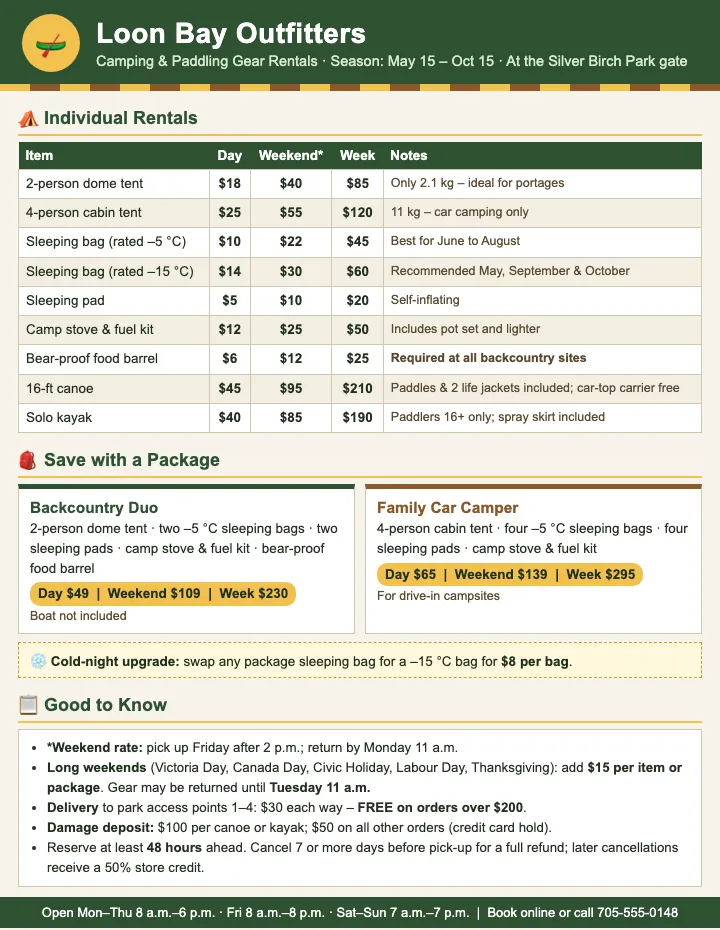
Read the following email message about the diagram on the left. Complete the email by filling in the blanks. Select the best choice for each blank from the drop-down menu.
Subject: Gear for our Labour Day canoe trip
To: Hana Sato
From: Rachel Dubois
Hi Hana,
I picked up the rental sheet from Loon Bay Outfitters today. Since you sold all your camping gear when you moved to Toronto, we’ll need to rent almost everything.
We have two portages to reach our site, so a heavy tent is out of the question. I think the makes the most sense, because it includes the light tent and the food container we’re required to have in the backcountry. The only change I’d make is to switch to . The sheet recommends them for this time of year, and the swap adds only $16 for the two of us. That’s a drop in the bucket compared to a sleepless night.
Because it’s a holiday weekend, everything will cost , but on the bright side we can keep it all until instead of the usual deadline.
We’ll need a canoe too. With the canoe added, our order comes to more than $200, so . No strapping a canoe to my tiny car, not after what happened on our first-year residence camping trip!
If this works for you, I’ll book it this week. I’d rather not leave it to the last minute, since the long weekend always gets busy.
Rachel
Rachel and Hana know each other because
Why does Rachel want to book the gear this week?
When Rachel says the extra cost is “a drop in the bucket,” she means that it is
Part 3: Reading for Information
Paragraph A
In the early 1960s, two researchers at the Ontario Cancer Institute in Toronto made a discovery that would reshape modern medicine. James Till, a biophysicist who had grown up in Saskatchewan, and Ernest McCulloch, a physician who specialized in blood diseases, made an unlikely pair. Till brought a physicist’s habit of precise measurement and careful statistics, while McCulloch contributed a doctor’s understanding of how the human body works and what can go wrong with it. Their partnership is often held up as an example of what can be achieved when scientists from different fields work side by side rather than in separate departments.
Paragraph B
Their research grew out of a pressing question of the time: how does radiation damage living things? After the atomic bombs of 1945, and amid widespread fears of nuclear war, scientists were eager to understand why large doses of radiation were so deadly. One known cause was damage to bone marrow, the soft tissue inside bones where blood cells are made, yet little was known about which cells in the marrow actually produced new blood. To study this, Till and McCulloch exposed laboratory mice to radiation and then injected them with marrow cells taken from healthy mice. Their aim was to measure how sensitive these cells were to radiation and how well they could restore the animals’ blood supply.
Paragraph C
The breakthrough came from a detail that could easily have been dismissed. About ten days after the injections, small lumps appeared on the spleens of the treated mice. Instead of treating them as a curiosity, the researchers counted them and found that the number of lumps rose in step with the number of marrow cells injected. For the first time, scientists had a way to count these elusive cells directly. Further experiments showed that each lump had grown from a single cell, and that the lumps contained several different types of blood cells. Some of the cells inside them could even produce new lumps of their own. In other words, one cell could both copy itself and give rise to many kinds of specialized cells, the defining feature of what is now called a stem cell.
Paragraph D
The impact of the discovery is still felt today. By showing that blood-forming stem cells exist and can be measured, Till and McCulloch helped explain why bone marrow transplants work, and such transplants are now widely used to treat leukemia and other blood cancers. Their work also opened an entire field of research into how stem cells might one day be used to repair damaged tissue, and stem cells from marrow, blood and other sources are now studied in laboratories around the world. Some recognition came early, including a Gairdner award in 1969, but the highest honours arrived only decades later: both men were named to the Canadian Medical Hall of Fame, and in 2005 they shared the Lasker Award, one of the most prestigious prizes in medical research.
Decide which paragraph, A to D, has the information given in each statement below. Select E if the information is not given in any of the paragraphs.
- Fears about weapons helped create interest in the scientists’ research topic.
- The researchers were the first to perform a bone marrow transplant on a human patient.
- The two scientists approached their work with very different kinds of training.
- The amount of material the animals received affected what the researchers observed.
- The animals in the study were given cells that came from other animals.
- Some scientists at first doubted that the lumps had any real importance.
- Major honours came many years after the discovery was made.
- The researchers took a closer look at something that seemed unimportant.
- A treatment for certain cancers relies on knowledge the pair helped establish.
Part 4: Reading for Viewpoints
Fairhaven residents have long financed the city’s storm sewers unknowingly, the cost buried in their property taxes. Council is weighing a plan to replace that with a separate fee calculated on how much of each property is sealed under roofs, driveways and parking lots, impermeable surfaces that send rain cascading into the pipes. After two summers of flash floods that forced sewage into hundreds of basements, the question is hardly academic.
City engineer Lorraine Vachon regards the existing arrangement as misdirected. “Property tax tracks what a building’s worth, not how much water it discharges. A bungalow on a leafy lot can contribute more than a discount warehouse encircled by four acres of asphalt.” Rain gardens, permeable paving or underground cisterns could reduce an owner’s fee by up to 40 percent. The intention is to reward those who keep water where it falls.
Gary Pelletier, who owns an east-side shopping plaza, acknowledges the runoff problem but bristles at the remedy. His estimated $18,000 annual charge is roughly triple his current contribution, although the lot was built to municipal standards thirty years ago. He might install permeable paving, but only if the municipality shares the expense of tearing up serviceable pavement. “Otherwise, the burden will fall on my tenants, mostly small family businesses,” he warns.
The fee would also reach organizations that have never received a municipal bill. Grace Community Church, a registered charity exempt from property tax, would owe roughly $3,200 a year. Board chair Margaret Osei raises no quarrel with the principle: “Rain doesn’t care whether it runs off a church or a casino.” She asks only for a five-year phase-in, allowing the congregation to budget or seek grants.
Councillor Raj Bhatt of the finance committee concedes that property tax is a clumsy instrument for funding drainage, yet he remains wary. “A fee is a tax by another name, one that can be raised quietly without the scrutiny a tax increase attracts.” His support hinges on the revenue being legally reserved for stormwater projects and property taxes falling by the full amount collected. “Otherwise, residents would pay twice for identical pipes.”
Osei would most likely agree with Vachon that
Pelletier’s objection would soften if the city
Bhatt’s “tax by another name” suggests that
Which conclusion does the article best support?
The most suitable headline is
The following is a comment by a visitor to the website page. Complete the comment by choosing the best option to fill in each blank.
Sewage flooded my basement both summers, so I welcome a council that finally asks who . Under today’s system my bungalow, with its enormous backyard, pays more than , which has never made sense to me. I would gladly dig a rain garden for a smaller bill.
I can sympathize with , because an organization that has never paid the city a cent needs time to plan. I am far less moved by the plaza owner’s threat to ; thirty-year-old asphalt is no excuse for overloading the sewers. As for the councillor’s fear of a cash grab, the cure is simple: .
Answer key
Count your correct answers, then find your estimated CLB:
Show all 38 answers
- What is the main purpose of Danielle’s letter? C. to propose dividing her job with a co-worker
- Why does Danielle want to change her work schedule? A. She has enrolled in a program of study.
- It can be inferred that Danielle decided against unpaid leave partly because D. she wants to be involved in an upcoming project.
- What can be inferred about Kenji? B. He is already familiar with Danielle’s work.
- Why would Danielle and Kenji both work on Wednesdays? D. to make sure no tasks are overlooked
- Danielle’s supervisor A. is open to the idea but cannot approve it himself.
- B. your place in the accounting program
- C. covered for you last year
- A. sending pay data to the bank
- D. no longer be covered automatically
- B. testing the plan before committing
- C. Backcountry Duo
- A. the warmer sleeping bags
- D. $15 more per item or package
- B. Tuesday at 11 a.m.
- D. the shop will deliver it all for free
- Rachel and Hana know each other because B. they lived in residence as students.
- Why does Rachel want to book the gear this week? C. She expects the shop to be busy then.
- When Rachel says the extra cost is “a drop in the bucket,” she means that it is A. small compared to the benefit.
- Fears about weapons helped create interest in the scientists’ research topic. B
- The researchers were the first to perform a bone marrow transplant on a human patient. E
- The two scientists approached their work with very different kinds of training. A
- The amount of material the animals received affected what the researchers observed. C
- The animals in the study were given cells that came from other animals. B
- Some scientists at first doubted that the lumps had any real importance. E
- Major honours came many years after the discovery was made. D
- The researchers took a closer look at something that seemed unimportant. C
- A treatment for certain cancers relies on knowledge the pair helped establish. D
- Osei would most likely agree with Vachon that C. each property should pay for runoff.
- Pelletier’s objection would soften if the city B. helped pay to replace his pavement.
- Bhatt’s “tax by another name” suggests that A. it could rise with little scrutiny.
- Which conclusion does the article best support? D. Paved properties would pay a larger share.
- The most suitable headline is B. “Who Pays When the Rain Runs Off?”
- A. fills the sewers most
- D. a store ringed by parking
- C. the church board chair
- B. pass the charge down
- C. tie council down
What does your score mean? See the CELPIP Reading score chart.
Free CELPIP practice test · Free CELPIP Listening practice tests · CELPIP sample tests by part
CELPass is an independent practice platform and is not affiliated with Paragon Testing Enterprises. CELPIP is a trademark of Paragon Testing Enterprises. Check the official CELPIP website and IRCC for current test rules and requirements.