CELPIP Reading Practice Test 88
By Iris
A complete CELPIP Reading practice test: all 4 parts and 38 questions in the real test order. Set a timer for 55–60 minutes and do all four parts in one sitting. Check your answers at the bottom of the page to see your score and an estimated CLB.
Download as PDF with answer key
In this test
- Part 1: Reading Correspondence, “Advice on Buying a Pottery Wheel” (questions 1–11) · practise this part alone
- Part 2: Reading to Apply a Diagram, “Fall Tutoring for a Niece and Nephew” (questions 12–19) · practise this part alone
- Part 3: Reading for Information, “Inuksuit: Stone Messengers of the Arctic” (questions 20–28) · practise this part alone
- Part 4: Reading for Viewpoints, “Shrinkflation Shelf Notices Debate” (questions 29–38) · practise this part alone
Part 1: Reading Correspondence
Dear Teresa,
I hope the fall craft fair went well. Mom told me your mugs were gone by noon on the first day, which doesn’t surprise me one bit.
I’m writing because I need your honest advice. As you know, I’ve been taking the Tuesday evening pottery class at the community centre since January. What started as a way to meet people after the move has turned into something I think about all week. The problem is that the class gives us only two hours, and I spend half of that waiting for the one wheel that doesn’t wobble. Last month, my instructor mentioned that a retiring member is selling her whole setup: a wheel, a small electric kiln, and about forty kilograms of clay, all for $2,200. A brand-new wheel alone costs nearly that much, so it sounds like a bargain.
Still, I have my doubts. First, there’s the question of space. The only spot I can think of is the corner of the basement beside the laundry room, but it has no window, and I’m not sure the wiring could handle a kiln. Gary says the kiln would need its own circuit, and an electrician would charge at least a few hundred dollars to install one. Second, I’m worried I’ll lose interest. You remember the sewing machine I bought three years ago? It’s still in its box in the hall closet. Gary hasn’t said a word about it, but he raised an eyebrow when I mentioned the price of this setup.
There is another option. The studio on Maple Street rents shelf space and wheel time to members for $95 a month, and they fire your pieces in their own kiln. That would add up to more than $1,100 a year, but I wouldn’t be tied to anything. On the other hand, the studio is a forty-minute drive away, and I know myself well enough to admit that I won’t make that trip on a snowy evening.
The seller has given me until the end of the month, and she says another student has asked about it too. Would you have time to come over one weekend and look at the basement with me? You’d know right away whether it would work. I’ll bake that lemon cake you like, and if you think I’m being foolish, I promise I’ll listen.
Warmly,
Danielle
What is the main purpose of Danielle’s letter?
It can be inferred that Teresa
What frustrates Danielle about her current class?
Danielle mentions the sewing machine to show that
What is one drawback of the Maple Street studio?
Danielle needs Teresa’s help soon because
Here is a response to the message. Complete the response by filling in the blanks. Select the best choice for each blank from the drop-down menu.
Dear Danielle,
The fair was a success, thank you! I’d be happy to come over on Saturday the 18th, and I’ll hold you to that lemon cake.
Honestly, $2,200 for all of that is a fair price, but before you get excited, I want to see the . A kiln gives off a lot of heat, and a space could become uncomfortable, or even unsafe. Please have the electrician take a look before you hand over any money.
As for the sewing machine, I wouldn’t worry too much. You’ve stuck with pottery for , which is longer than you ever lasted with sewing. Still, if you’d like to test your commitment first, for a few months wouldn’t hurt, as long as you’re honest with yourself about the drive.
Whatever you decide, don’t let push you into a choice you’ll regret. There will always be other wheels.
Hugs,
Teresa
Part 2: Reading to Apply a Diagram
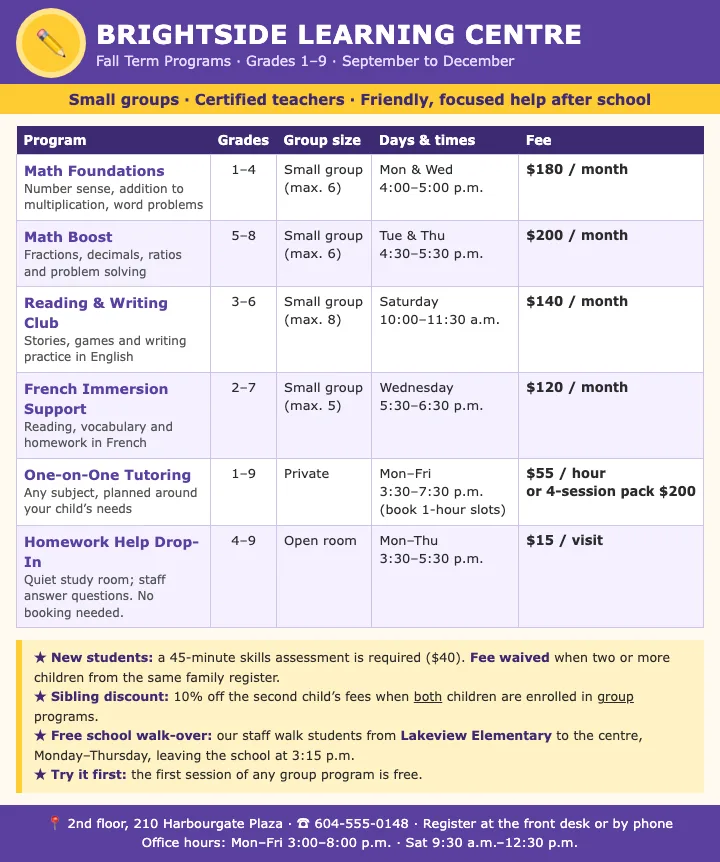
Read the following email message about the diagram on the left. Complete the email by filling in the blanks. Select the best choice for each blank from the drop-down menu.
Subject: Fall tutoring for the kids
To: Priya Raman
From: Leena Shah
Hi Priya,
I picked up Brightside’s fall schedule on my way home. I know Arjun would rather do anything than hit the books, but his Grade 5 teacher is right that he can’t fall further behind with fractions. He needs someone sitting beside him working through problems, not just a quiet room, so I’d go with . Math Boost would have suited him, but it clashes with hockey practice on Tuesdays. If you buy , you’ll save five dollars an hour.
As for my niece, who’s in Grade 4 at Lakeview with her brother, her teacher says her French reading needs work, and you know how much she loves being around other kids, so looks ideal. Since you’re registering both of them, the assessments are free. Sadly, the sibling discount won’t help, because .
As you don’t finish work until 5:30, it’s handy that , so Arjun could book a 3:30 slot. I’m off on Wednesdays now, so I’d be glad to drive Maya to her class and take her for dinner afterward.
Remember how Dad drilled us on our times tables at the kitchen table every night? Let’s hope Brightside is more fun!
Love,
Leena
Leena and Priya know each other because
What does Leena offer to do?
When Leena says Arjun would rather do anything than “hit the books,” she means that he
Part 3: Reading for Information
Paragraph A
Across the treeless tundra of Canada’s Arctic, travellers may come upon a pile of stones standing alone on a ridge or a shoreline. These structures, known as inuksuit (singular: inuksuk), have been built by Inuit and their ancestors for centuries, and they are found across the Arctic from Alaska to Greenland. The name comes from Inuktitut and is often translated as “to act in the capacity of a human.” The meaning makes sense in a landscape with few natural landmarks: an inuksuk stands in for a person, telling those who pass that someone has been there before them. Most are made from whatever rocks lie close at hand, stacked carefully without mortar, and they range from a few small stones to structures taller than a person.
Paragraph B
Inuksuit served many practical purposes. Some marked travel routes or pointed toward a safe crossing, while others showed where fish were plentiful or where meat had been stored for later. Hunters also built lines of them to help steer herds of caribou toward places where other hunters were waiting. Because each inuksuk was placed with a purpose, people who grew up on the land learned to read them, and the way the stones were arranged could carry a message for those who understood it. Not every inuksuk was practical, however. Some marked places of spiritual importance, and certain sites were approached only with great respect.
Paragraph C
Many people outside the North picture an inuksuk as a stone figure with legs and outstretched arms. Strictly speaking, that human-shaped figure has its own name, inunnguaq, meaning “in the likeness of a person,” and it is only one of many forms. It is, however, the form that has become most familiar to the wider world, and large versions now stand in parks and on waterfronts in southern cities. When Vancouver hosted the 2010 Winter Olympics, the Games’ emblem, a figure named Ilanaaq, the Inuktitut word for “friend,” was based on this shape. Not everyone welcomed the choice. Some Inuit felt that the design confused an inunnguaq with a true inuksuk and turned a meaningful structure into a logo.
Paragraph D
Today, the inuksuk has become a symbol of the North itself. When the territory of Nunavut was created in 1999, an inuksuk was placed at the centre of its flag. Its popularity has brought new problems, though. Hikers in parks across the country now stack their own small stone figures along trails, sometimes by the dozen. Park staff often take these down, partly because they can lead other hikers astray and partly because moving rocks disturbs the plants and small creatures that live beneath them. Many Inuit elders also stress that old inuksuit should never be knocked down or rebuilt, since doing so can erase information that guided people for generations.
Decide which paragraph, A to D, has the information given in each statement below. Select E if the information is not given in any of the paragraphs.
- Some of these markers were meant to influence where animals went.
- The best-known version of the structure is, technically, a separate category.
- Builders relied on materials found at the site rather than bringing them from elsewhere.
- The 2010 Olympic emblem was designed by an Inuit artist.
- Copying the traditional structure for fun can harm the natural environment.
- Some traditional inuksuit served a purpose beyond helping people survive.
- The structures reassured people that they were not the first to cross a place.
- Some people were unhappy about how a traditional form was used for publicity.
- A northern territory adopted the structure as part of an official symbol.
Part 4: Reading for Viewpoints
When Doris Leclair opened her customary box of crackers last spring, it seemed to hold more air. The box and the price were unchanged; the contents had quietly fallen from 250 to 200 grams. Economists call the practice “shrinkflation,” and a bill before the legislature aims to expose it. Grocery stores would have to post a shelf notice beside any product whose contents have shrunk without a corresponding price reduction. The notice would state both quantities and remain for 90 days.
The legislation originated with Rachel Okafor’s Fair Basket Coalition, whose volunteers spent eighteen months recording the weight or volume of 400 common items every month. One in seven had diminished. “Shoppers scrutinize prices but almost never weigh their cereal,” Okafor observes. “A company that trims contents is raising its price without admitting it.” A notice, in her view, merely informs consumers what they are purchasing.
Martin Gagnon, spokesperson for an association of independent grocers, endorses the goal while deploring the method. Manufacturers, not retailers, determine what goes into a box, yet a family-run store with five employees would have to monitor size changes across 8,000 products, paperwork whose cost would ultimately surface in shelf prices. “Besides, tags already display a unit price, such as the cost per 100 grams,” he notes.
Economist Helen Mbeki shares Gagnon’s preference for unit pricing, though not in its current form. Properly done, unit prices would expose shrinkflation permanently, not just for 90 days. “In practice, one tag quotes the price per 100 grams, its neighbour the price per kilogram, both in minuscule type that few shoppers can decipher in a crowded aisle.” She favours mandating a single standard unit and a minimum print size; a temporary notice, she argues, treats the symptom while the underlying confusion persists.
Leclair, a retired bookkeeper on a fixed income, sympathizes with Okafor but doubts she would ever spot a shelf notice. If a manufacturer shrinks a box, she reasons, the box itself should announce it in large letters for as long as that size is sold. “Why should the corner store take the blame?”
Among the amendments before the legislature’s committee is one exempting stores with fewer than ten employees.
Leclair would most likely agree with Gagnon that
Unlike Okafor, Mbeki believes that
What can reasonably be concluded?
How did the coalition detect what shoppers miss?
Which title best captures the article?
The following is a comment by a visitor to the website page. Complete the comment by choosing the best option to fill in each blank.
Count me among Ms. Okafor’s typical shoppers: I scrutinize prices weekly, yet I only discovered my dish soap had shrunk when a bottle . Nor would a shelf notice have rescued me; by design it is , and a bottle lasts me four months.
I was surprised to find myself siding with Mr. Gagnon, since the couple who run my corner store are surely here. In the end, though, Dr. Mbeki’s remedy seems the most practical. If every tag used , I could compare two bottles at a glance, whether or not either had shrunk. Ms. Leclair’s idea of announcing the change goes further still, and I would gladly support that too.
Answer key
Count your correct answers, then find your estimated CLB:
Show all 38 answers
- What is the main purpose of Danielle’s letter? B. to get a friend’s view before a big purchase
- It can be inferred that Teresa D. has experience with pottery equipment.
- What frustrates Danielle about her current class? A. She has to share the best wheel with others.
- Danielle mentions the sewing machine to show that C. she has given up on hobbies before.
- What is one drawback of the Maple Street studio? B. Getting there would be hard in bad weather.
- Danielle needs Teresa’s help soon because D. she could lose the chance to buy the setup.
- C. corner you have in mind
- A. without any way to let air in
- D. most of the year
- B. paying for studio time
- C. talk of another buyer
- A. one-on-one tutoring
- C. the four-session pack
- D. French Immersion Support
- B. both kids must be in group programs
- B. staff walk kids over from school
- Leena and Priya know each other because A. they are sisters.
- What does Leena offer to do? D. take her niece to a weekly class
- When Leena says Arjun would rather do anything than “hit the books,” she means that he C. doesn’t enjoy studying.
- Some of these markers were meant to influence where animals went. B
- The best-known version of the structure is, technically, a separate category. C
- Builders relied on materials found at the site rather than bringing them from elsewhere. A
- The 2010 Olympic emblem was designed by an Inuit artist. E
- Copying the traditional structure for fun can harm the natural environment. D
- Some traditional inuksuit served a purpose beyond helping people survive. B
- The structures reassured people that they were not the first to cross a place. A
- Some people were unhappy about how a traditional form was used for publicity. C
- A northern territory adopted the structure as part of an official symbol. D
- Leclair would most likely agree with Gagnon that C. the bill targets the wrong party.
- Unlike Okafor, Mbeki believes that A. a temporary notice isn’t enough.
- What can reasonably be concluded? D. One amendment answers Gagnon’s concern.
- How did the coalition detect what shoppers miss? B. It tracked item sizes every month.
- Which title best captures the article? A. “Shrinking Boxes: Who Should Tell Shoppers?”
- C. ran out sooner than usual
- B. temporary
- D. the wrong target
- A. the same unit of measure
- B. on the label itself
What does your score mean? See the CELPIP Reading score chart.
Free CELPIP practice test · Free CELPIP Listening practice tests · CELPIP sample tests by part
CELPass is an independent practice platform and is not affiliated with Paragon Testing Enterprises. CELPIP is a trademark of Paragon Testing Enterprises. Check the official CELPIP website and IRCC for current test rules and requirements.