CELPIP Vocabulary Course
Twenty-seven short lessons on the words CELPIP Writing and Speaking reward. The first twelve teach the skills raters score: natural word partners, word forms, precise words, paraphrase, tone and linking. The other fifteen are word kits for the situations the test writes about, from renting and work to health, money and public services. Each lesson has quick checks, word lists and graded exercises you can check on the page.
- 27 lessons
- 3 h 38 min
- 81 quizzes
- All levels · CLB 5 to 10
By CELPass Editorial Team · Updated
This course includes
- 27 short text lessons in 2 units
- 81 quizzes checked on the page
- 108 exercises (621 questions) checked on the page
- Read on any device, no video
- Free, no account needed
What you'll learn
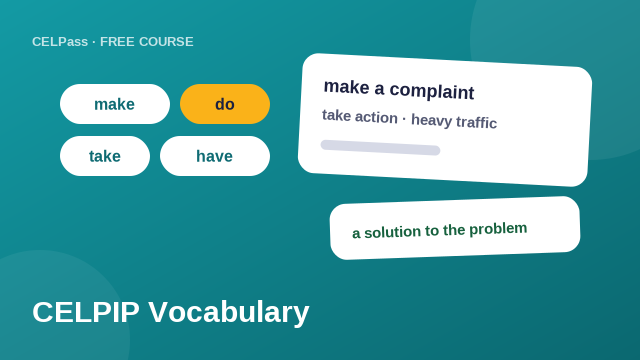
- Use words with their natural partners: make a complaint, heavy traffic, a solution to a problem.
- Change a word's form to paraphrase a question without copying it.
- Replace very, good and bad with precise words that show range.
- Match your words to the reader: formal, neutral or friendly.
- Describe housing, work, health, money and travel problems with the exact word.
Course content
2 units · 27 lessons · 3 h 38 min1How words raise your score
Collocations, word forms, precision, paraphrase, tone and linking: the skills raters score.
12 lessons · 1 h 34 min
- 1. Collocations: Learn Words in ChunksIn this lesson: why CELPIP raters notice word partners, the four collocation patterns, and the chunks that make a Writing Task 1 email sound natural. 3 quizzes 8 min
- 2. Make, Do, Take, Get and HaveIn this lesson: which nouns go with make, do, take, get and have, the translation traps learners fall into, and when to swap an overused verb for a more precise one in Speaking Task 1. 3 quizzes 8 min
- 3. Meaning from Context, Tone and AttitudeIn this lesson: how to work out an unknown word from the sentence around it, the words that name a speaker's tone and attitude, and how to sound the right way in Speaking Task 6. 3 quizzes 7 min
- 4. Word Families: Change the Form, Keep the MeaningIn this lesson: how suffixes change a word's part of speech, how prefixes change its meaning, and how one word family gives you four ways to say the same idea in a Writing Task 2 survey response. 3 quizzes 7 min
- 5. Precise Words: Upgrade Common WordsIn this lesson: how to replace very, good, bad and nice with words that say exactly what you mean, which adverbs go with strong adjectives, and how precise description helps in Speaking Task 8. 3 quizzes 7 min
- 6. Paraphrase: Say It Again in New WordsIn this lesson: three ways to say the same idea in new words (synonyms, a new word form, a new sentence shape), how to restate a Writing Task 2 survey without copying it, and how Reading answers hide behind paraphrase. 3 quizzes 8 min
- 7. Tone and Register: Formal, Neutral, FriendlyIn this lesson: how to match your words to the reader of a Writing Task 1 email, the openings, requests and closings for each register, and the words that make an email too casual or too stiff. 3 quizzes 8 min
- 8. Linking Words That Hold an Answer TogetherIn this lesson: the linking words for adding, contrasting, giving reasons and results, giving examples and ordering ideas, the grammar each one needs, and how to use them in a Speaking Task 7 opinion. 3 quizzes 8 min
- 9. Numbers, Amounts and TrendsIn this lesson: how to talk about amounts, give approximate numbers and describe change with trend verbs and adjectives, so a Writing Task 2 answer can support its reasons with clear figures. 3 quizzes 7 min
- 10. Phrasal Verbs and Safe IdiomsIn this lesson: how phrasal verbs work, which everyday idioms are safe to use, where they make a Speaking Task 2 story sound natural, and when to swap them for a single word in a formal email. 3 quizzes 8 min
- 11. Describing People, Places and PicturesIn this lesson: position words, action verbs and describing chunks that let you walk a listener through a scene in Speaking Task 3 and set up a prediction in Task 4. 3 quizzes 9 min
- 12. Opinions, Reasons and PersuasionIn this lesson: the words for stating a view, backing it up, admitting the other side and recommending a choice, for Speaking Tasks 5 and 7 and the Writing Task 2 survey. 3 quizzes 9 min
2Words for Canadian life
The words and chunks for the situations CELPIP writes about, from renting to public services.
15 lessons · 2 h 4 min
- 13. Housing and RentingIn this lesson: a collocation kit for renting in Canada: the verbs, describing words and fixed phrases for leases, deposits, repairs and moving, ready for a Writing Task 1 email to a landlord or property manager. 3 quizzes 9 min
- 14. Neighbourhood and CommunityIn this lesson: a collocation kit for local life: the words for community projects, city decisions, volunteering and safety, ready for a Writing Task 2 survey about your neighbourhood. 3 quizzes 9 min
- 15. Work and the WorkplaceIn this lesson: a collocation kit for the job you already have: shifts, time off, workload, meetings and feedback, ready for a Writing Task 1 email to a supervisor or colleague. 3 quizzes 8 min
- 16. Job Search and CareersIn this lesson: a collocation kit for finding work in Canada: résumés, applications, interviews and offers, ready for giving a friend practical advice in Speaking Task 1. 3 quizzes 8 min
- 17. Shopping, Returns and Customer ServiceIn this lesson: a collocation kit for buying, returning and complaining: refunds, exchanges, warranties and orders, ready for a Writing Task 1 email to a store. 3 quizzes 8 min
- 18. Money, Banking and BudgetsIn this lesson: a collocation kit for everyday money: budgets, bills, loans, accounts and saving, ready for comparing two costly options and persuading someone in Speaking Task 5. 3 quizzes 9 min
- 19. Getting Around: Transit and DrivingIn this lesson: a collocation kit for buses, trains, cars and bikes: commutes, delays, breakdowns and rides, ready for explaining a difficult choice in Speaking Task 6. 3 quizzes 9 min
- 20. Health and Medical AppointmentsIn this lesson: the word partners for clinics, symptoms and prescriptions, and how to use them in a clear Writing Task 1 email about a health problem. 3 quizzes 8 min
- 21. School, Courses and LearningIn this lesson: the word partners for courses, studying and children's school, and how to use them when you give advice in Speaking Task 1. 3 quizzes 8 min
- 22. Family, Friends and RelationshipsIn this lesson: the word partners for family events, friendships and small conflicts, and how to use them to explain a hard choice kindly in Speaking Task 6. 3 quizzes 8 min
- 23. Food, Cooking and Eating OutIn this lesson: the word partners for restaurants, cooking and describing food, and how to use them to tell a clear story about a meal in Speaking Task 2. 3 quizzes 8 min
- 24. Weather, Seasons and the EnvironmentIn this lesson: the word partners for Canadian weather, environmental problems and green choices, and how to use them to support your choice in a Writing Task 2 survey response. 3 quizzes 8 min
- 25. Technology and Online LifeIn this lesson: the word partners for devices, online safety and screen habits, and how to use them to support an opinion in Speaking Task 7. 3 quizzes 8 min
- 26. Travel, Events and Free TimeIn this lesson: the word partners for trips, outdoor events and weekend plans, and how to use them to make clear predictions about a scene in Speaking Task 4. 3 quizzes 8 min
- 27. News, Public Services and Canadian LifeIn this lesson: the language of local news and public services, everyday Canadian English words, and how to use them in a Writing Task 2 survey response about a city decision. 3 quizzes 8 min
CELPass is an independent practice platform and is not affiliated with Paragon Testing Enterprises. CELPIP is a trademark of Paragon Testing Enterprises. Check the official CELPIP website and IRCC for current test rules and requirements.