Unit 2: Words for Canadian life · Lesson 19 of 27
Getting Around: Transit and Driving
- 9 min read
- 3 quizzes
- 4 exercises · 23 questions
By CELPass Editorial Team · Updated
In this lesson: a collocation kit for buses, trains, cars and bikes: commutes, delays, breakdowns and rides, ready for explaining a difficult choice in Speaking Task 6.
1Three patterns for getting around
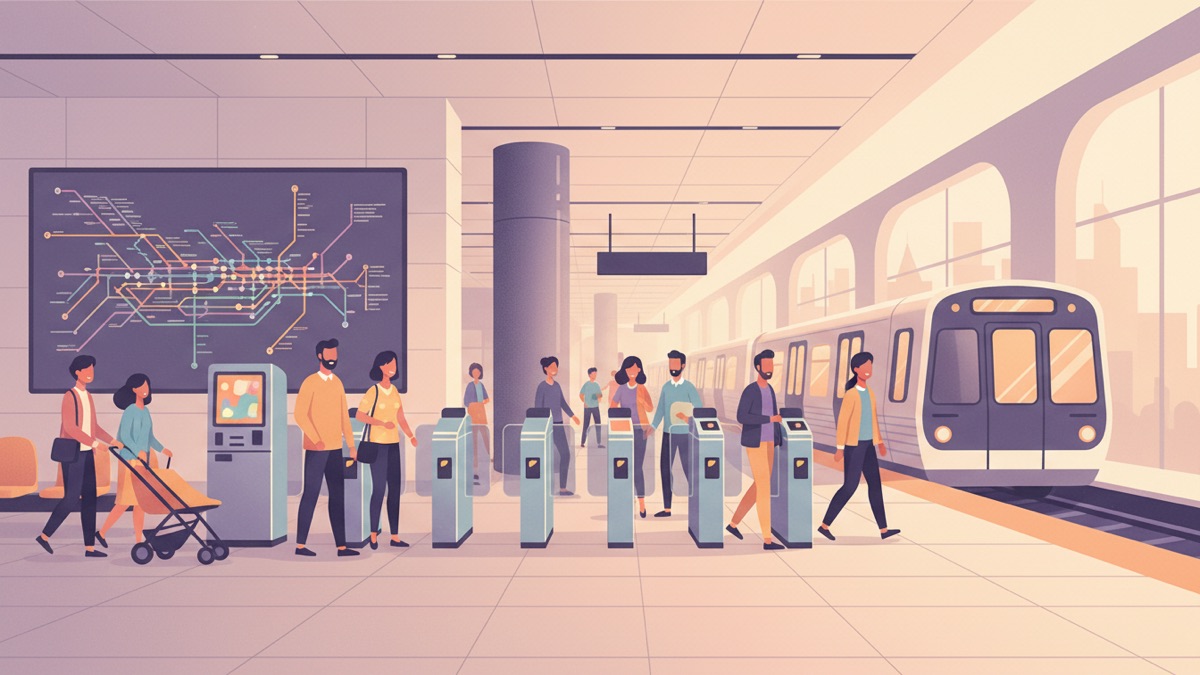
Transportation problems are everywhere in CELPIP: a car that breaks down before an important trip, a bus that never comes, a road closure on the way to an interview. In Speaking Task 6 you face a difficult situation, choose one of two options and explain it to someone. Precise transit and driving words make that explanation clear and believable.
| Pattern | Examples | How it works |
|---|---|---|
| Verb + noun: moving around | catch the bus, miss a connection, take a detour, give someone a ride, top up a transit card | You catch or take a bus, and miss it when you are late. A driver gives you a ride (or a lift); you get a ride from them. You ride a bike and drive a car; you park in a lot and get a parking ticket. |
| Adjective + noun: describing the trip | a long commute, rush-hour traffic, a crowded platform, a slow detour | A commute is long, short or daily; traffic is bumper-to-bumper at rush hour. Platforms and buses are crowded or packed; routes are direct or indirect. In winter, roads are icy or slippery, and many drivers switch to winter tires. |
| Fixed phrases for problems | break down, get stuck in traffic, be running late, a road closure | A car breaks down; a tow truck takes it to a garage. You get stuck in traffic and are running late. Construction, a road closure or an accident can cause a delay. |
2How to use transit words in Speaking Task 6
- Explain the problem: Speaking Task 6 gives you a problem and two options; say what happened first. Use a fixed phrase for the problem: my car broke down, the line is closed, I missed my connection. Add the consequence: "so I can't give you a ride tonight."
- Present your choice: Name the option precisely: a ride-share, the airport train, a taxi, carpooling. Give a practical reason with a transit word: the fare, the schedule, the connection. Mention one weakness of the other option: "with your suitcases, changing trains would be hard."
- Keep the relationship: Apologize sincerely, especially if the problem affects the other person. Offer help: pay the fare, check the schedule, send the route. End warmly: "Text me when you get there."
3Three transportation word mistakes
| Mistake | Why it costs marks | Say instead |
|---|---|---|
| "I lost the bus" | Lose means you cannot find something; when you are too late for a bus, you miss it. | I missed the bus; I missed my connection |
| "My car broke on the highway" | A machine that stops working on the road breaks down; "broke" alone sounds like it cracked. | My car broke down on the highway |
| "I drove my bike", "Can you make me a ride?" | Bikes and buses take ride; rides are given, not made. | I rode my bike; can you give me a ride? |
4Ready chunks for getting around
| When you need to | Useful chunks |
|---|---|
| Public transit | buy a monthly transit pass, the bus route was changed, miss my connection |
| Driving | get stuck in traffic, take a detour because of a road closure, find street parking |
| Car trouble | my car broke down, call a tow truck, the car is at the garage until tomorrow |
| Sharing a ride | give you a ride, carpool with a colleague, book a ride-share |
5Quick check
Check yourself: choose one answer
Which chunk means a car stopped working during a trip?
Machines and vehicles break down. Break up is for relationships, and break out is for fires or illnesses.
Check yourself: choose one answer
Which sentence is correct?
When you arrive too late for a bus or train, you miss it.
Check yourself: choose one answer
In Speaking Task 6, what should you do after explaining the problem?
Task 6 asks you to choose one option, so name it clearly and explain why it works best.
6Words for this lesson
The words this lesson builds on, with their meanings and an example each. Say each one aloud in a sentence about your own life.
| Word | Meaning | Example |
|---|---|---|
| commute | The trip to and from work. | My commute takes forty minutes by bus. |
| public transit | Buses, trains and subways for everyone. | Public transit is cheaper than parking downtown. |
| transit pass | A card for unlimited trips for a period. | A monthly transit pass saves money if you ride every day. |
| fare | The price of a trip. | The bus fare went up in January. |
| rush hour | The busiest travel times. | Avoid the highway at rush hour. |
| detour | A different route around a closed road. | Follow the detour signs on Main Street. |
| road closure | A road blocked to traffic. | Expect road closures during the marathon. |
| carpool | To share a car to work or school with other people. | Four of us carpool to save on gas. |
| ride-share | A paid trip booked in an app. | I took a ride-share home after the concert. |
| connection | A change from one bus or train to another. | I missed my connection because of the delay. |
| bike lane | Part of a road for bicycles. | The new bike lane makes cycling safer. |
| break down | For a vehicle or machine, to stop working. | My car broke down on the way to work. |
| tow truck | A truck that pulls broken cars. | We waited two hours for a tow truck. |
| winter tires | Tires made for snow and ice. | Put your winter tires on before the first snowfall. |
7Use the words in a real answer
Words stick when you use them under time pressure. Try this lesson's chunks in Speaking Task 6, the task they fit best.
- In your preparation time, choose one fixed phrase for the problem (broke down, stuck in traffic) and one transit word for your reason.
- Name your choice exactly and say one practical weakness of the other option.
Key takeaways
- Verb + noun: moving around — catch the bus, miss a connection, take a detour, give someone a ride, top up a transit card
- Adjective + noun: describing the trip — a long commute, rush-hour traffic, a crowded platform, a slow detour
- Fixed phrases for problems: break down, get stuck in traffic, be running late, a road closure
- In your preparation time, choose one fixed phrase for the problem (broke down, stuck in traffic) and one transit word for your reason.
- Name your choice exactly and say one practical weakness of the other option.
Exercises
Type or choose your answers, then check them. The first ones start with a worked example; the last asks for your own sentences.
Choose the word that fits naturally.
I missed my connection at the station, so I had to wait 30 minutes for the next train.
- 2
The bridge is closed, so buses are taking a ___ through downtown.
- 3
My ___ to work takes about an hour each way.
- 4
Before the first snowfall, many drivers switch to winter ___.
- 5
We got ___ in traffic for an hour because of an accident.
- 6
You need a valid driver's ___ to rent a car.
- 7
Let's ___ to work: we live on the same street and could share the cost of gas.
- 8
Cyclists should use the bike ___ on Main Street.
Speaking Task 6: you promised to drive your friend Tom to the airport tonight, but your car broke down. You can book him a ride-share or suggest he take the bus and the airport train. Choose one and explain it to Tom. Fill each gap with one word from the box: brake, broke, connection, fare, give, hour, lend, pass, pedestrian, ride-share, take, tow. 4 words are not used.
My car broke down on the highway this morning, and a tow truck just took it to the garage.
- 2My car broke down on the highway this morning, and a truck just took it to the garage.
- 3It won't be ready until tomorrow, so I can't you a ride to the airport tonight.
- 4I've thought about it, and I think a is your best option.
- 5I'll pay the , since this is my fault.
- 6I know the airport train is cheaper, but you'd have to a bus to the station first, and with your two big suitcases, the connection could be really stressful during rush hour.
- 7I know the airport train is cheaper, but you'd have to take a bus to the station first, and with your two big suitcases, the could be really stressful during rush hour.
- 8I know the airport train is cheaper, but you'd have to take a bus to the station first, and with your two big suitcases, the connection could be really stressful during rush .
Each sentence comes from a learner's Speaking answer or email about getting around. One word or chunk in each is wrong. Type the natural word or chunk for each gap.
I missed the bus this morning, so I was late for my shift. (not "lost the bus": verb + noun)
- 2My car on the highway, so I called a tow truck. (not "broke": phrasal verb)
- 3The in my city is cheap and reliable. (not "transport public": word order)
- 4I parked in the wrong spot and got a . (not "ticket of parking": noun + noun)
- 5When the weather is nice, I to work. (not "drive my bike": verb + noun)
- 6Could you to the station tomorrow morning? (not "make me a ride": verb + noun)
Now use the chunks in sentences of your own, then compare with the example.
- 1
Public transit: write one sentence about your own life with buy a monthly transit pass, the bus route was changed or miss my connection.
- 2
Driving: write one sentence about your own life with get stuck in traffic, take a detour because of a road closure or find street parking.
- 3
Car trouble: write one sentence about your own life with my car broke down, call a tow truck or the car is at the garage until tomorrow.
- 4
Sharing a ride: write one sentence about your own life with give you a ride, carpool with a colleague or book a ride-share.
Practise with free questions
Free questions in the CELPIP format, with answers and no account needed. Try a few now, while the lesson is fresh.
CELPass is an independent practice platform and is not affiliated with Paragon Testing Enterprises. CELPIP is a trademark of Paragon Testing Enterprises. Check the official CELPIP website and IRCC for current test rules and requirements.