Unit 2: Words for Canadian life · Lesson 22 of 27
Family, Friends and Relationships
- 8 min read
- 3 quizzes
- 4 exercises · 23 questions
By CELPass Editorial Team · Updated
In this lesson: the word partners for family events, friendships and small conflicts, and how to use them to explain a hard choice kindly in Speaking Task 6.
1Three patterns for family and friends
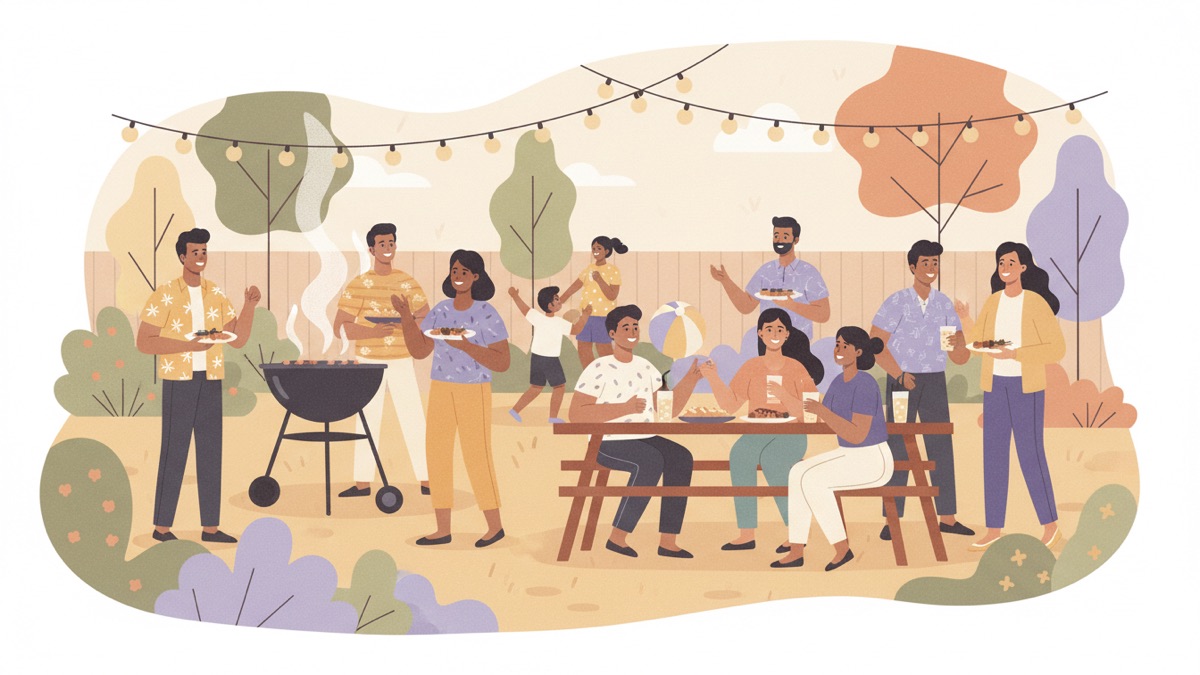
Speaking Task 6 often puts you between two people you care about: a sister who needs a babysitter, a friend's party on the night of a family dinner. To sound natural you need words for the people (relatives, in-laws, a close friend), the events (a potluck, a get-together) and the feelings in between (let someone down, reach a compromise). Most of them are fixed chunks, so learn them whole.
| Pattern | Examples | How it works |
|---|---|---|
| Verb + noun | host a get-together, turn down an invitation, reach a compromise | Events: host a potluck, accept or turn down an invitation, RSVP by Friday. Help: do someone a favour, keep a promise, look after the kids. Problems: have a disagreement, reach a compromise, make it up to someone. |
| Adjective + noun | a close friend, a supportive partner, a minor disagreement | Closeness: a close friend, an old friend, a casual acquaintance. Family: extended family, a busy household, distant relatives. Size of a problem: a minor disagreement, a serious argument. |
| Phrases with a fixed small word | get along with, catch up with, let someone down | Get along with your in-laws, rely on your siblings. Catch up with an old friend: talk about what has happened since you last met. Let someone down (disappoint them), make it up to someone (do something nice to fix it). |
2Using these words in a Speaking Task 6 answer
- Opening: Name the person and thank them or show you care: "Thank you so much for the invitation." Soften the news: "I hate to let you down, but I'm afraid I can't make it."
- Explaining your choice: Give the real reason with precise words: "my parents' anniversary", "my in-laws are visiting". Add why it matters: "Some relatives are flying in, and my mom would be hurt if I missed it." Stay with one choice; don't change your mind in the middle.
- Offering something back: Suggest a compromise: another day, a smaller way to help, a call to catch up. End warmly: "I'll make it up to you." "Our friendship means a lot to me."
3Three relationship word mistakes
| Mistake | Why it costs marks | Say instead |
|---|---|---|
| "All my parents came to the wedding." (meaning aunts, uncles and cousins) | In English, parents means only your mother and father. In Spanish and French the similar word means relatives. | All my relatives came to the wedding. |
| "She is my near friend." | Near is about distance in space. For a strong friendship English uses close. | She is my close friend. |
| "Can you make me a favour?" | The verb is translated. The fixed chunk uses do. | Can you do me a favour? |
4Chunks for family and friends
| When you need to | Useful chunks |
|---|---|
| Saying no gently | I'm afraid I can't make it, I hate to let you down, I wish I could, but |
| Explaining a family reason | my in-laws are visiting from, a family get-together, it means a lot to my parents |
| Offering a compromise | how about we meet on Sunday instead, I'll make it up to you, at least let me help with |
| Family events | host a potluck, RSVP by Friday, catch up with old friends |
5Quick check
Check yourself: choose one answer
What does "let someone down" mean?
If you let someone down, you disappoint them. It is a useful chunk for Task 6.
Check yourself: choose one answer
Which sentence talks about aunts, uncles and cousins?
Relatives are all the people in your family. Parents are only your mother and father.
Check yourself: choose one answer
What is a good way to end a Speaking Task 6 answer?
A compromise and a warm closing show you care about the person, which is the point of the task.
6Words for this lesson
The words this lesson builds on, with their meanings and an example each. Say each one aloud in a sentence about your own life.
| Word | Meaning | Example |
|---|---|---|
| relative | A family member. | Several relatives are visiting for the holidays. |
| sibling | A brother or sister. | I have two siblings. |
| in-laws | Your husband's or wife's family. | My in-laws are staying with us this month. |
| babysitter | A person paid to watch children. | We need a babysitter for Saturday night. |
| get-together | An informal meeting of friends. | We're having a small get-together on Friday. |
| potluck | A meal where everyone brings a dish. | I'm bringing a salad to the potluck. |
| invitation | A request to come to an event. | Thanks for the invitation. |
| RSVP | To reply to say whether you will come. | Please RSVP by June 1. |
| host | The person who holds an event. | The host made us feel welcome. |
| catch up | To talk with someone about recent news. | Let's catch up over coffee. |
| close friend | A friend you trust very much. | She's been a close friend since high school. |
| disagreement | A difference of opinion. | We had a disagreement about the holiday plans. |
| compromise | An agreement where each side gives a little. | We reached a compromise: one weekend each. |
| supportive | Helpful and encouraging. | My family was very supportive when I moved here. |
7Use the words in a real answer
Words stick when you use them under time pressure. Try this lesson's chunks in Speaking Task 6, the task they fit best.
- In your preparation time, choose your option, then note one chunk to soften the news and one to offer a compromise.
- Talk to the person directly ("you"), as if they were in front of you.
Key takeaways
- Verb + noun: host a get-together, turn down an invitation, reach a compromise
- Adjective + noun: a close friend, a supportive partner, a minor disagreement
- Phrases with a fixed small word: get along with, catch up with, let someone down
- In your preparation time, choose your option, then note one chunk to soften the news and one to offer a compromise.
- Talk to the person directly ("you"), as if they were in front of you.
Exercises
Type or choose your answers, then check them. The first ones start with a worked example; the last asks for your own sentences.
Choose the word that fits naturally.
My cousin and I get along really well, even though we are very different.
- 2
Could you ___ me a favour and water my plants this weekend?
- 3
Thanks for the invitation, but I'm afraid I can't ___ it on Saturday.
- 4
Lina is my ___ friend; we have known each other since grade school.
- 5
My aunt and uncle are ___ a potluck for the long weekend.
- 6
After a long talk, my brother and I finally reached a ___.
- 7
My husband's parents are my ___.
- 8
I haven't seen Priya since the summer, so we're meeting for coffee to catch ___.
Speaking Task 6. Your close friend Jenna's housewarming party and your parents' anniversary dinner are on the same Saturday evening. You have decided to go to the family dinner. Talk to Jenna. Fill each gap with one word from the box: anniversary, birthday, catch, close, down, familiars, hold, hosting, invitation, make, near, relatives. 4 words are not used.
Hi Jenna, thank you so much for the invitation to your housewarming party.
- 2I was really looking forward to it, so I hate to let you , but I'm afraid I can't make it on Saturday.
- 3I was really looking forward to it, so I hate to let you down, but I'm afraid I can't it on Saturday.
- 4It turns out that my parents' fortieth wedding is the same night, and my brother is hosting a dinner for the whole family.
- 5It turns out that my parents' fortieth wedding anniversary is the same night, and my brother is a dinner for the whole family.
- 6Some are flying in from Winnipeg, and my mom would be really hurt if I missed it.
- 7You're my friend, and I don't want this to change anything.
- 8Then we could up properly, and I'll bring dessert to make it up to you.
Each sentence comes from a learner's Speaking answer about family or friends. One word or chunk in each is wrong. Type the natural word or chunk for each gap.
All my relatives came to my cousin's wedding, even my great-aunt from Halifax. (not "parents": false friend)
- 2Could you and pick up my son from daycare? (not "make me a favour": verb + noun)
- 3To be honest, I don't really my brother-in-law. (not "get along to": verb + preposition)
- 4Sara is my ; we've known each other for twenty years. (not "near friend": adjective + noun)
- 5We need to about who hosts Thanksgiving this year. (not "do a compromise": verb + noun)
- 6I'm sorry I missed your party. I promise I'll next weekend. (not "do it up to you": fixed phrase)
Now use the chunks in sentences of your own, then compare with the example.
- 1
Saying no gently: write one sentence about your own life with I'm afraid I can't make it, I hate to let you down or I wish I could, but.
- 2
Explaining a family reason: write one sentence about your own life with my in-laws are visiting from, a family get-together or it means a lot to my parents.
- 3
Offering a compromise: write one sentence about your own life with how about we meet on Sunday instead, I'll make it up to you or at least let me help with.
- 4
Family events: write one sentence about your own life with host a potluck, RSVP by Friday or catch up with old friends.
Practise with free questions
Free questions in the CELPIP format, with answers and no account needed. Try a few now, while the lesson is fresh.
CELPass is an independent practice platform and is not affiliated with Paragon Testing Enterprises. CELPIP is a trademark of Paragon Testing Enterprises. Check the official CELPIP website and IRCC for current test rules and requirements.