Task 4 practice course: Making Predictions
Say what will most probably happen next in the picture, and why you think so from what you can see. Work through six short steps, from how the task works to a timed answer, about 30 minutes in all. New to this task? Read the Task 4 format and strategy first.
Learn the task
How to organise your answer, what to do with your time, common mistakes and useful phrases, then a quick check.
Predictions with a reason you can point to
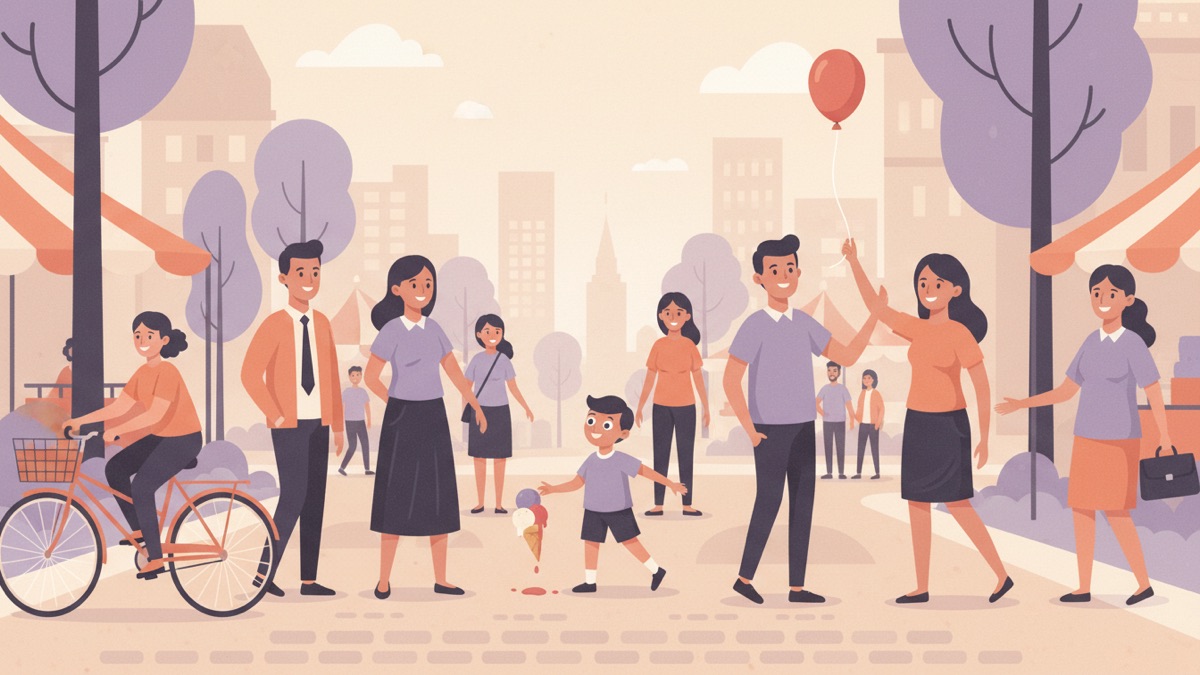
Task 4 uses the same picture as Task 3. Don't describe it again: start from what is about to happen. Every prediction needs a "because" from the picture, and they should follow each other in time.
A box is tipping off a stack someone is carrying.
- The next few seconds: what falls, breaks or spills
- How the main person reacts
- Who comes to help, and how
- How it ends
A child has fallen and two people are running over.
- What the helpers will do first
- How the person will feel
- What the people around will do
- What happens in the end
A busy street with three small stories going on.
- The main story's next step
- A second group and what they'll do
- A third, if there's time
- One sentence on how the scene will look later
Task 4 cheat sheet
The key points of the course on one screen, to read again just before your test.
Your 30 seconds and 60 seconds
- Remember your Task 3 description: you know the picture already.
- Pick 3-4 people or things that are about to change.
- For each, note what will happen and the clue that tells you.
- Start with the most obvious prediction, the one in the centre.
- Give the clue each time: "...is already tipping, so it's going to..."
- Change how sure you sound: will, will probably, might, could.
- End with how the whole thing works out: "In the end, I imagine..."
- Stop when you've closed; don't start a new prediction with 3 seconds left.
Three mistakes that keep scores at CLB 7
- Describing the picture again. Name a person in a few words and go straight to what they will do.
- Guesses with no reason. Tie every prediction to something visible: "Because the dog is charging toward them..."
- Only "will". Mix will, will probably, will most likely, might, could and there's a good chance.
Phrases for predicting
- Very likely: “...is going to... any second.”, “I'd say the first thing she'll do is...”, “...will most likely...”
- Possible: “...might...”, “...could...”, “There's a good chance that...”
- Giving the clue: “Since he's already..., he'll...”, “Because the stack is blocking his view,...”, “Judging by..., I think...”
- Order: “First,...”, “Meanwhile,...”, “Once he's..., ...”, “After that,...”
- Ending: “In the end, I imagine...”, “By the end of the afternoon,...”
Questions about Task 4
How do I organise a CELPIP Speaking Task 4 answer?
Task 4 uses the same picture as Task 3. Don't describe it again: start from what is about to happen. Every prediction needs a "because" from the picture, and they should follow each other in time. Something is about to go wrong: The next few seconds: what falls, breaks or spills; How the main person reacts; Who comes to help, and how; How it ends. Someone needs help: What the helpers will do first; How the person will feel; What the people around will do; What happens in the end. Several things at once: The main story's next step; A second group and what they'll do; A third, if there's time; One sentence on how the scene will look later.
How should I use my time in CELPIP Speaking Task 4?
Before you speak (30 s): Remember your Task 3 description: you know the picture already. Pick 3-4 people or things that are about to change. For each, note what will happen and the clue that tells you. While you speak (60 s): Start with the most obvious prediction, the one in the centre. Give the clue each time: "...is already tipping, so it's going to..." Change how sure you sound: will, will probably, might, could. Finishing: End with how the whole thing works out: "In the end, I imagine..." Stop when you've closed; don't start a new prediction with 3 seconds left.
What mistakes lower a CELPIP Speaking Task 4 score?
Describing the picture again. Task 4 is scored on predictions. Repeating Task 3 uses your time on something that earns nothing here. Instead: Name a person in a few words and go straight to what they will do. Guesses with no reason. "He will be rich" with no clue in the picture sounds random. Instead: Tie every prediction to something visible: "Because the dog is charging toward them..." Only "will". Saying "will" ten times sounds certain and repetitive. Instead: Mix will, will probably, will most likely, might, could and there's a good chance.
Is this Task 4 course free?
Yes. Every step is free and needs no account; nothing you type or record leaves your browser. With a free CELPass account you can also answer new questions and get an AI score.
Keep practising Task 4
- Task 4 sample answers at three levels, with notes on what each one does
- Task 4 vocabulary: words and phrases for making predictions
- Task 4 format and strategy
More free practice courses
- Speaking Task 1: Giving Advice
- Speaking Task 2: Talking about a Personal Experience
- Speaking Task 3: Describing a Scene
- Speaking Task 5: Comparing and Persuading
- Speaking Task 6: Dealing with a Difficult Situation
- Speaking Task 7: Expressing Opinions
- Speaking Task 8: Describing an Unusual Situation
- Writing Task 1: Writing an Email
- Writing Task 2: Responding to Survey Questions
- Reading Part 1: Reading Correspondence
- Reading Part 2: Reading to Apply a Diagram
- Reading Part 3: Reading for Information
- Reading Part 4: Reading for Viewpoints
- Listening Part 1: Listening to Problem Solving
- Listening Part 2: Listening to a Daily Life Conversation
- Listening Part 3: Listening for Information
- Listening Part 4: Listening to a News Item
- Listening Part 5: Listening to a Discussion
- Listening Part 6: Listening to Viewpoints
CELPass is an independent practice platform and is not affiliated with Paragon Testing Enterprises. CELPIP is a trademark of Paragon Testing Enterprises. Check the official CELPIP website and IRCC for current test rules and requirements.