Unit 5: Describing words and prepositions · Lesson 21 of 38
Adjectives: Order and Comparison
- 4 min read
- 1 diagram
- 4 quizzes
- 5 exercises · 24 questions
By CELPass Editorial Team · Updated
Speaking Tasks 3 and 5 ask you to describe a scene and compare two options, and survey answers compare too. Precise adjectives and correct comparisons make those answers clear.

1Order before a noun
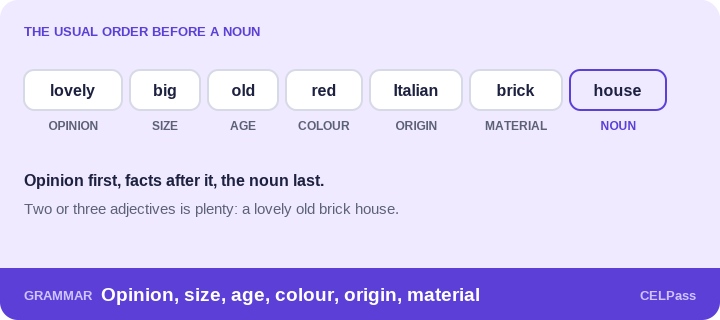
Adjectives don't take a plural -s: "three expensive tickets", not "expensives". After be, seem and look they come after the verb: "The room looks bright."
Check yourself: choose one answer
Choose the natural order.
Size comes before shape, and material comes last before the noun.
2Comparatives and superlatives
| Adjective | Comparative | Superlative |
|---|---|---|
| cheap (one syllable) | cheaper than | the cheapest |
| busy (ends in -y) | busier than | the busiest |
| convenient (long) | more convenient than | the most convenient |
| good / bad / far | better / worse / farther | the best / the worst / the farthest |
Never double up: "more cheaper" and "most easiest" are errors. To say two things are equal, use as + adjective + as: "The bus is as fast as the train."
Check yourself: choose one answer
Task 5: "The apartment downtown is ___ the house in the suburbs."
Small is one syllable, so add -er, with no more.
Check yourself: choose one answer
"This is ___ winter I have ever experienced."
Bad is irregular: bad, worse, the worst.
3-ed or -ing?
-ed adjectives describe how a person feels; -ing adjectives describe what causes the feeling. "I was bored. The meeting was boring." "The children are excited about the trip. It's an exciting trip."
Check yourself: choose one answer
"The new bylaw is very ___ for residents."
The bylaw causes the confusion, so use -ing; the residents feel confused.
Key takeaways
- Opinion, size, age, shape, colour, origin, material, then the noun.
- Short adjectives take -er/-est; long ones take more/most; never both.
- Learn the irregulars: good–better–best, bad–worse–worst, far–farther–farthest.
- -ed for feelings, -ing for the cause.
Exercises
Type or choose your answers, then check them. The first ones start with a worked example; the last asks for your own sentences.
Write the comparative or superlative of the adjective in brackets.
The train is faster (fast) than the bus.
- 2This is the (busy) street in the neighbourhood.
- 3The new clinic is (convenient) than the old one.
- 4That was the (bad) storm we've had in years.
- 5Of the three apartments, the one downtown is (expensive).
- 6My new commute is (good) than my old one.
Put the adjectives in brackets in the usual order before the noun.
She bought a new black leather jacket. (leather / black / new / jacket)
- 2We sat at a . (wooden / round / small / table)
- 3They live in a . (brick / lovely / old / house)
- 4He was wearing a . (wool / red / big / scarf)
- 5My uncle drives a . (Japanese / white / reliable / car)
- 6I found a at the yard sale. (plastic / blue / cheap / chair)
Choose the correct comparison.
The bus is as fast as the train. (as / than)
- 2
Option A is ___ than Option B.
- 3
This is the ___ route to the airport.
- 4
The park is as ___ as a football field.
- 5
My new job is ___ less stressful than my old one.
- 6
Living downtown is not as ___ as I expected.
A Speaking Task 5 answer. Correct the mistake in each sentence. Two are already correct.
The house in the suburbs is more bigger than the apartment.
→ The house in the suburbs is bigger than the apartment.
- 2
But the apartment is more close to my office.
- 3
The house has a beautiful large backyard.
- 4
Rent downtown is higher, but it is not as high as I feared.
- 5
The apartment is the more modern of the three places we saw.
- 6
Moving there would make my life much more easy.
Write your own sentences, as in Speaking Tasks 3 and 5.
- 1
Compare two places to live with a comparative and than.
- 2
Compare two things with not as … as.
- 3
Describe something you own with two or three adjectives in order.
- 4
Name the best or worst of something in your city (superlative).
Practise with free questions
Free questions in the CELPIP format, with answers and no account needed. Try a few now, while the lesson is fresh.
CELPass is an independent practice platform and is not affiliated with Paragon Testing Enterprises. CELPIP is a trademark of Paragon Testing Enterprises. Check the official CELPIP website and IRCC for current test rules and requirements.