Unit 2: Nouns, articles and pronouns · Lesson 7 of 38
Quantifiers: Some, Any, All, Most, None
- 6 min read
- 2 diagrams
- 4 quizzes
- 5 exercises · 26 questions
By CELPass Editorial Team · Updated
Quantifiers tell the reader how much or how many: some residents, most of the parents, none of the options. Writing Task 2 survey answers rely on them, and each one has its own rules about of, the noun after it and the verb.

1Some, any, no and none
| Word | Use | Example |
|---|---|---|
| some | positive sentences, offers and requests | "I have some questions." "Would you like some coffee?" |
| any | negatives and most questions | "There isn't any parking." "Do you have any questions?" |
| no | zero, before a noun (with a positive verb) | "There is no parking on this street." |
| none | zero, on its own or with of | "I wanted a seat, but there were none." "None of the doctors were available." |
Use only one negative word. "There isn't any parking" and "There is no parking" are both correct; "There isn't no parking" is not. Words made from them follow the same pattern: something, anything, nothing, nobody.
Check yourself: choose one answer
"There isn't ___ parking near the clinic, so take the bus."
The verb is already negative (isn't), so use any. No would make a double negative.
2All, most, some of: general or a named group
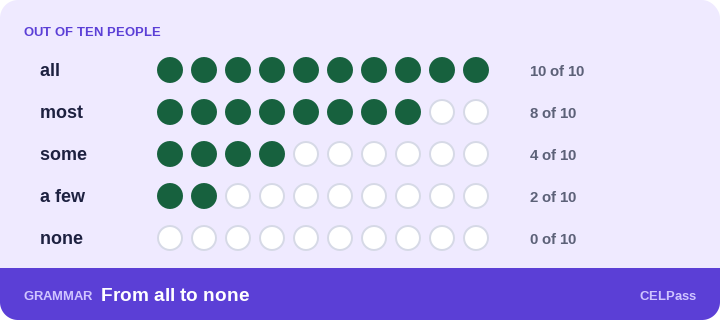
For people or things in general, put the quantifier straight before the noun: "Most people prefer the bus." "Some parents work evenings." For a group you name, add of + the, my, these or a pronoun: "Most of the parents in my building work evenings." "Some of my coworkers cycle." "All of them agreed." Never "most of people".
After of, the verb agrees with the noun: "Most of the equipment is new" (uncountable) but "Most of the chairs are new" (plural). With none of + a plural noun, a plural verb is normal and a singular verb sounds more formal; both are correct.
Check yourself: choose one answer
Survey answer: "___ in my area drive to work."
For people in general, most goes straight before the noun. Most of needs the, my or these after it, and the most is for superlatives.
3Both, either and neither
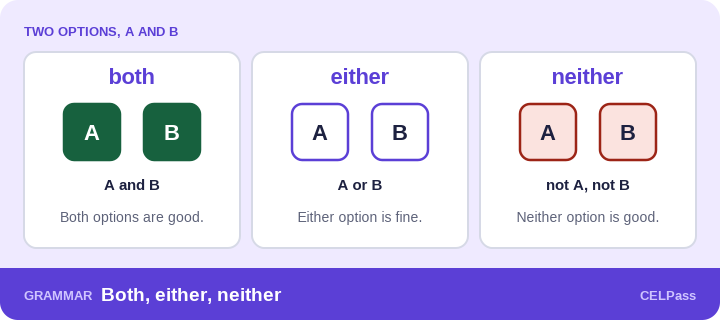
- Both means the two together, with a plural noun and verb: "Both options are expensive." "Both of my kids play hockey."
- Either means one or the other, with a singular noun: "You can take either bus." "Either Monday or Tuesday works for me."
- Neither means not one and not the other, with a singular noun: "Neither option is perfect." After neither of + a plural noun, use a singular verb in formal writing: "Neither of the apartments has parking."
- Survey answers often compare two choices, so these three words are worth getting exactly right.
Check yourself: choose one answer
Survey answer: "___ options would help families, but the second costs less."
Options is plural and the sentence says the two together would help, so both. Either and neither take a singular noun: either option.
4Each and every; how much and how many
Each and every take a singular noun and a singular verb: "Every unit has a balcony." "Each child needs a signed form." Use each when you think of the members one by one, or when there are only two; every when you mean all of a group. Only each works with of: "Each of the units has a balcony", never "every of".
For amounts, many and few go with plural nouns, much and little with uncountable ones, and a lot of with both, as the countable and uncountable nouns lesson explains: "many complaints", "much noise", "a lot of complaints and a lot of noise".
Check yourself: choose one answer
"___ of the apartments has a balcony."
Each can take of + a plural noun with a singular verb. Every never takes of, and all of the apartments would need have.
Key takeaways
- Some in positive sentences and offers; any in negatives and questions; no or none for zero, never with another negative.
- Most people for people in general; most of the people for a group you name. Never most of people.
- Both takes a plural noun; either and neither take a singular noun, and neither of takes a singular verb in formal writing.
- Each and every take a singular noun and verb; only each works with of.
- Many and few with plurals, much and little with uncountable nouns, a lot of with both.
Exercises
Type or choose your answers, then check them. The first ones start with a worked example; the last asks for your own sentences.
Write the word that fits: choose from the two in brackets.
There isn't any milk left in the fridge. (some / any)
- 2Could I have water, please? (some / any)
- 3I didn't get help from the front desk. (some / any)
- 4There are seats left on the 6 p.m. bus, so let's wait for the next one. (no / any)
- 5of the tenants came to the meeting, so it was cancelled. (No / None)
- 6We haven't had snow this month. (some / any)
Read the facts. Write one sentence that starts with the words in brackets.
There are two parks near my home. I like the first one and I like the second one. (I like both)
→ I like both parks.
- 2
Ten people work in my office. All ten take the bus. (All of)
- 3
Ten people work in my office. Eight of them drive. (Most of)
- 4
Ten people work in my office. Not one of them cycles. (None of)
- 5
I have two neighbours, and each one has a dog. (Both of)
- 6
Two buses go to my work, the 14 and the 22. Either one is fine for me. (I can take either)
Choose the correct word. In a formal email, use a singular verb after each, every and neither.
Every room in the shelter has two beds. (Every / All)
- 2
Most ___ volunteers at the food bank are students.
- 3
Neither of the apartments ___ parking.
- 4
Both of my kids ___ hockey.
- 5
We have ___ time before the train leaves, so let's get a coffee.
- 6
___ people came to the open house than last year.
- 7
There were ___ complaints about the noise last month.
Survey results in a community centre newsletter. Write the word that fits.
Thank you to every member who answered our survey. (every / all)
- 2the members want longer hours on weekends. (Most / Most of)
- 3member under 18 needs a parent's signature. (Each / All)
- 4We looked at two plans for the gym, and of them is perfect. (neither / none)
- 5of our ten instructors can work on Sundays, so we will stay closed that day. (None / Neither)
- 6There is money in this year's budget for a new pool. (no / none)
- 7We have spots left in the spring classes, so sign up soon. (a few / a little)
Write sentences for a Writing Task 2 survey answer. Use the words in brackets.
- 1
Say what most people in your area want (Most people… or Most of the…).
- 2
Compare the two options in a survey (both and neither).
- 3
Make a claim about every student, worker or tenant (every).
- 4
Say what there is too little or too few of where you live (too little, too few).
Practise with free questions
Free questions in the CELPIP format, with answers and no account needed. Try a few now, while the lesson is fresh.
CELPass is an independent practice platform and is not affiliated with Paragon Testing Enterprises. CELPIP is a trademark of Paragon Testing Enterprises. Check the official CELPIP website and IRCC for current test rules and requirements.