Unit 7: Punctuation and word choice · Lesson 30 of 38
Punctuation and Capitals in Emails
- 5 min read
- 1 diagram
- 3 quizzes
- 5 exercises · 20 questions
By CELPass Editorial Team · Updated
Punctuation is part of Readability. One missing capital won't change your level, but a whole email with a lower-case "i", no comma after the greeting and "it's" for "its" looks careless. These rules cover almost every slip that shows up in CELPIP emails and survey answers.
1Capital letters
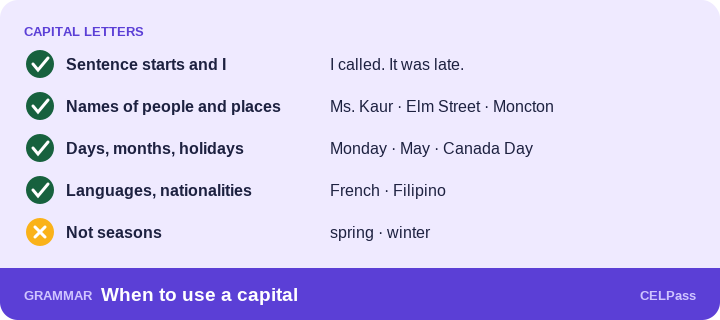
- Start every sentence with a capital, and always write I as a capital.
- Names of people, streets, cities, provinces and companies: Ms. Kaur, Elm Street, Moncton, Alberta, Canada Post.
- Days, months and holidays: Monday, October, Canada Day. Seasons stay small: spring, winter.
- Languages and nationalities: English, French, Filipino.
- A title before a name (Dr. Lee, Mayor Chen), but not on its own (the doctor, the mayor).
Check yourself: choose one answer
Which sentence uses capitals correctly?
The sentence start, I and the city take capitals; the season doesn't.
2Commas and sentence endings
| Rule | Example |
|---|---|
| After the greeting and the sign-off | Dear Ms. Tran, … Sincerely, |
| After an opening clause or phrase | When I arrived, the door was locked. |
| Before and, but or so joining two full sentences | The heater works, but the fan is loud. |
| Around extra information | My neighbour, who is a nurse, works nights. |
| Never a comma alone between two full sentences | The fan is loud. It keeps me awake. (not: The fan is loud, it keeps me awake.) |
| A direct question ends with ?; an indirect one doesn't | Could you call me? · I wonder whether you could call me. |
Check yourself: choose one answer
Which sentence is punctuated correctly?
Two full sentences need a joining word after the comma (so). A comma alone makes a comma splice.
3Apostrophes and email layout
An apostrophe shows a missing letter (it's = it is, don't = do not) or that something belongs to someone (the tenant's car, the tenants' cars). It never makes a plain plural: two apartments, not two apartment's.
| Belongs to it | It is / it has |
|---|---|
| The building raised its fees. | It's raining again. |
| The store changed its hours. | It's been a long week. |
- Put the greeting on its own line, with a comma.
- Leave a blank line between paragraphs.
- End with a closing line, then a sign-off with a comma, then your name on its own line.
Check yourself: choose one answer
Which sentence is correct?
"Its" shows belonging and has no apostrophe. "It's" always means it is or it has, and "its'" is never correct.
Key takeaways
- Capitals for sentence starts, I, names, places, days, months, holidays and languages; not for seasons.
- A comma after the greeting, the sign-off and an opening clause; a comma plus and, but or so between two full sentences.
- Its means belonging to it; it's means it is or it has. Plurals never take an apostrophe.
- Greeting on its own line, a blank line between paragraphs, the name on its own line.
Exercises
Type or choose your answers, then check them. The first ones start with a worked example; the last asks for your own sentences.
Choose the version with correct capital letters.
we moved here last july.
→ We moved here last July.
- 2
i start my new job at canada post on monday.
- 3
my daughter speaks english and tagalog.
- 4
we saw the doctor in the spring.
- 5
dr. singh moved to halifax, nova scotia.
Add the missing comma or commas. Type the whole sentence.
When the snow stopped we shovelled the driveway.
→ When the snow stopped, we shovelled the driveway.
- 2
If you have any questions please call me.
- 3
The pool is open but the sauna is closed.
- 4
My landlord who lives upstairs fixed the sink.
- 5
After the meeting I emailed the notes to everyone.
Each sentence joins two full sentences with only a comma. Choose the correct version.
The bus was late, I missed my appointment.
→ The bus was late, so I missed my appointment.
- 2
The heater is broken, it is very cold in my unit.
- 3
I called twice, nobody answered.
- 4
Thank you for your help, I really appreciate it.
- 5
Could you send me the form, I need it by Friday.
Choose the right word, with or without an apostrophe.
The manager's keys are on the hook. (they belong to the manager)
- 2
The building replaced ___ old windows.
- 3
___ been a pleasure working with you.
- 4
All three ___ on our floor are rented.
- 5
The ___ parking spots are behind the building. (they belong to all the tenants)
Write the parts of a formal email with correct punctuation and capitals.
- 1
A greeting to a manager whose name you know.
- 2
An opening sentence that starts with a time clause.
- 3
Two full sentences joined with a comma and but.
- 4
A closing line and a sign-off.
Practise with free questions
Free questions in the CELPIP format, with answers and no account needed. Try a few now, while the lesson is fresh.
CELPass is an independent practice platform and is not affiliated with Paragon Testing Enterprises. CELPIP is a trademark of Paragon Testing Enterprises. Check the official CELPIP website and IRCC for current test rules and requirements.