Unit 2: Nouns, articles and pronouns · Lesson 3 of 38
Articles: A, An and The
- 5 min read
- 1 diagram
- 4 quizzes
- 5 exercises · 24 questions
By CELPass Editorial Team · Updated
Articles are the most frequent small error in CELPIP answers. One missing a rarely changes the meaning, but ten of them make an email feel less fluent, so a few clear rules pay off quickly.

1Three questions
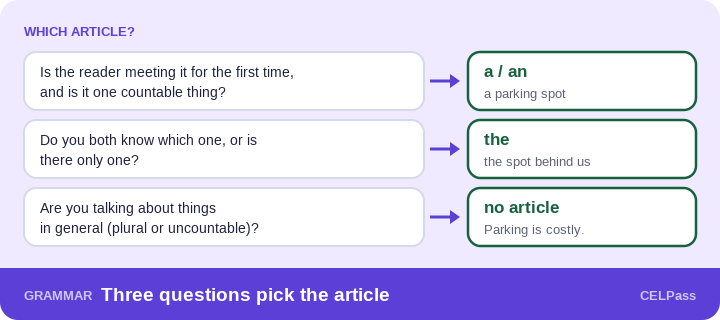
- Is it one countable thing that the reader is meeting for the first time? Use a or an: "I found a wallet in the lobby."
- Does the reader know exactly which one, because you mentioned it or there is only one? Use the: "The wallet has a library card in it."
- Are you talking about a plural or uncountable noun in general? Use no article: "Wallets are easy to lose." "Parking is free on Sundays."
A singular countable noun almost never stands alone. It needs a, an, the, or a word like my, this or every: "I live in an apartment", not "I live in apartment".
2A or an?
Choose by the first sound, not the first letter. Use an before a vowel sound: an email, an hour, an MRI. Use a before a consonant sound: a university, a one-bedroom unit, a European city.
Check yourself: choose one answer
"I have ___ appointment at ___ university clinic next week."
A and an follow the sound, not the letter. Appointment starts with a vowel sound, so an; university starts with a "yoo" sound, so a.
Check yourself: choose one answer
Which is correct?
Hour starts with a vowel sound (the h is silent), so an hour.
3The in CELPIP answers
- Second mention: "I ordered a desk. The desk arrived broken."
- Things everyone in the situation knows: the manager, the front desk, the elevator, the city (where you both live).
- Things followed by a description that picks one out: "the parcel that arrived on Monday".
- Superlatives and order: the best option, the first week, the same time.
- No the for general ideas: "Public transit is cheaper than driving", not "The public transit is cheaper".
Check yourself: choose one answer
Survey answer: "I prefer Option A because ___ exercise is important for ___ children."
Both are general statements: exercise in general (uncountable) and children in general (plural). No article.
4Fixed phrases
| No article | With the | With a |
|---|---|---|
| at work, at home, go to bed | in the morning, at the moment | once a week, twice a day |
| by bus, by car, on foot | on the weekend, the other day | a lot of, a few, a little |
| next week, last month | the city of Ottawa, the Rockies | have a look, make a decision |
Check yourself: choose one answer
Which sentence is correct?
At work, by bus and twice a week are fixed phrases: the first two take no article, and frequency takes a.
Key takeaways
- First mention of one countable thing: a or an. Known or only one: the. General plural or uncountable: no article.
- A singular countable noun needs a, an, the or a word like my or this.
- A or an depends on the first sound: an hour, a university.
- Learn fixed phrases whole: at work, by bus, once a week.
Exercises
Type or choose your answers, then check them. The first ones start with a worked example; the last asks for your own sentences.
Write a or an. Listen to the first sound, not the first letter.
I have an appointment on Monday.
- 2She works at university in Halifax.
- 3It's hour from here by bus.
- 4I'm looking for one-bedroom apartment.
- 5He made honest mistake on the form.
- 6The doctor ordered X-ray of my wrist.
Write a, an or the. If no article is needed, write – (a dash).
I found a wallet in the lobby this morning.
- 2I found a wallet in the lobby. wallet has a library card in it.
- 3public transit is cheaper than driving.
- 4I am writing to report problem with my heater.
- 5There is only one elevator in our building, and elevator is broken again.
- 6This is best café in my neighbourhood.
Choose the fixed phrase.
I go to work by bus. (by / by the)
- 2
I see my doctor once ___ year.
- 3
She is ___ work until six.
- 4
We met ___ other day at the library.
- 5
I'm busy ___ moment. Can I call you back?
- 6
I'll call you ___ Friday.
An email about parking. Four lines have an article error and one is correct. Write every line correctly.
I am writing about problem with my parking spot.
→ I am writing about a problem with my parking spot.
- 2
Last week someone parked in my spot. Car was there all day.
- 3
I called the front desk, but nobody answered.
- 4
I work nights, so I need car to get to work.
- 5
Parking is big problem in our building.
- 6
Could you send me copy of the parking rules?
Write about your home and routine, as in Speaking Task 2. Check every article.
- 1
Describe your home with a, then add a second sentence with the.
- 2
Make a general statement about transit or parking (no article).
- 3
Describe your week with two fixed phrases (by bus, at work, once a week).
- 4
Use an before a word that starts with a vowel sound.
Practise with free questions
Free questions in the CELPIP format, with answers and no account needed. Try a few now, while the lesson is fresh.
CELPass is an independent practice platform and is not affiliated with Paragon Testing Enterprises. CELPIP is a trademark of Paragon Testing Enterprises. Check the official CELPIP website and IRCC for current test rules and requirements.