Unit 3: Verbs and tenses · Lesson 13 of 38
Talking About the Future
- 4 min read
- 1 diagram
- 3 quizzes
- 5 exercises · 23 questions
By CELPass Editorial Team · Updated
Speaking Task 4 asks you to predict what will happen in a picture, and emails often describe plans. Choosing the future form by meaning makes you sound natural and precise.
1Four everyday future forms
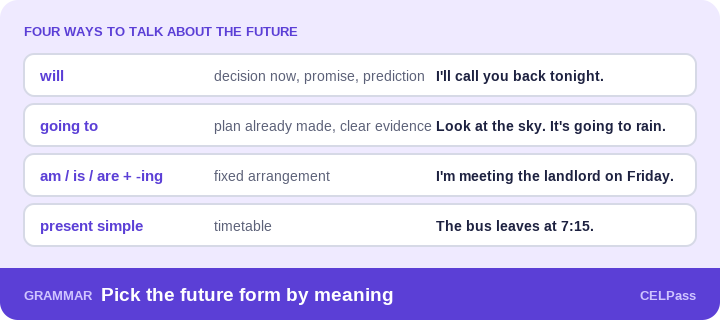
Will and going to often both work for predictions. Prefer going to when you can see the evidence, which is exactly the situation in Speaking Task 4: "The boy is leaning too far, so he's going to fall."
Check yourself: choose one answer
Your friend says the printer is out of paper. You reply at once:
A decision made at the moment of speaking takes will.
Check yourself: choose one answer
Which is best for a confirmed appointment in an email?
The present continuous is the natural choice for a fixed arrangement with a time.
2Future continuous and future perfect
- Will be + -ing: an action in progress at a future time. "At 10 tomorrow I'll be driving to work, so please call after 11."
- Will have + past participle: finished before a future time. "By the end of May, we will have finished the renovation."
Check yourself: choose one answer
"By the time you arrive, the movers ___ everything into the truck."
The loading is complete before a future moment, so use the future perfect.
3No will after when, if and before
In time and condition clauses about the future, use the present simple: "I'll call you when I arrive", not "when I will arrive". The will goes in the other half of the sentence.
| Wrong | Right |
|---|---|
| I will reply as soon as I will get the details. | I will reply as soon as I get the details. |
| If it will rain, the picnic will move indoors. | If it rains, the picnic will move indoors. |
Key takeaways
- Will: a decision now, a promise or a general prediction.
- Going to: a plan already made or a prediction from what you can see.
- Present continuous for arrangements; present simple for timetables.
- After when, if, before and as soon as, use the present simple, not will.
Exercises
Type or choose your answers, then check them. The first ones start with a worked example; the last asks for your own sentences.
Decisions, offers and promises: complete with will ('ll) and the verb in brackets.
The phone is ringing. Don't get up; I will answer (answer) it.
- 2You look cold. I (close) the window.
- 3That box looks heavy. I (help) you carry it.
- 4I promise I (not / be) late again.
- 5"We're out of milk." "OK, I (buy) some on my way home."
- 6I (call) you back in five minutes; I'm just finishing dinner.
Read each situation and write a sentence with going to, using the words in brackets.
You have decided to look for a bigger apartment. (I / look for)
→ I am going to look for a bigger apartment.
- 2
The man in the picture is leaning too far off the ladder. (he / fall)
- 3
Your sister has bought paint and brushes for her bedroom. (she / paint)
- 4
The sky over the soccer field is almost black. (it / rain)
- 5
You and your partner have decided to take the kids to Jasper in July. (we / visit)
Choose the best future form.
I'll call you when I get the results. (get / will get)
- 2
Please wait here until I ___ back.
- 3
If it ___ tomorrow, the barbecue will move indoors.
- 4
Don't call at 9 tomorrow morning. I ___ my driving test then.
- 5
By the end of June, we ___ the whole basement.
- 6
I ___ my landlord on Friday at 4; we agreed on the time yesterday.
An email to a friend about your move. Put each verb into the right future form.
My flight lands (land) at 6:30 on Saturday morning; that's the airline's schedule.
- 2I'll text you as soon as I (get) my bags.
- 3At 8 a.m. I (still / drive) to the hotel, so please don't call then.
- 4By the time you finish work, I (unpack) everything.
- 5If the weather (be) nice, we could walk along the river after dinner.
- 6Before I (start) my new job on Monday, I want to buy a bike.
Write your own sentences, as in Speaking Task 4 and in emails.
- 1
Picture task: a boy is running toward a pond with a big dog close behind him. Predict what is going to happen.
- 2
Your plans for next weekend (going to or the present continuous).
- 3
Something you will have done by the end of this year (will have + past participle).
- 4
Finish the sentence: "I will reply as soon as …"
Practise with free questions
Free questions in the CELPIP format, with answers and no account needed. Try a few now, while the lesson is fresh.
CELPass is an independent practice platform and is not affiliated with Paragon Testing Enterprises. CELPIP is a trademark of Paragon Testing Enterprises. Check the official CELPIP website and IRCC for current test rules and requirements.