Unit 8: Clauses and sentences · Lesson 37 of 38
Sentence Types and Sentence Variety
- 5 min read
- 1 diagram
- 3 quizzes
- 5 exercises · 21 questions
By CELPass Editorial Team · Updated
Readability rewards a range of sentence structures used accurately. A text where every sentence is short and simple stays around the middle levels, even with no errors. This lesson shows how to add variety safely.

1The four types
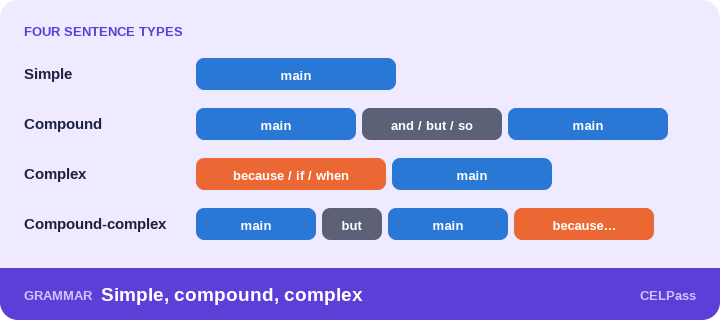
| Type | Example |
|---|---|
| Simple | The community garden needs more volunteers. |
| Compound | The garden is popular, but few people help on weekdays. |
| Complex | If we add an evening shift, more people could help. |
| Compound-complex | Many members work during the day, so I suggest an evening shift because it would suit them better. |
Check yourself: choose one answer
What type of sentence is this? "When the snow melts, the trail reopens."
It has one main clause (the trail reopens) and one dependent clause (when the snow melts).
2Why variety matters
Compare two versions of the same idea. The first is correct but flat; the second shows control of different structures, which is what separates CLB 8 from CLB 9 and above in Writing.
| Plain | Varied |
|---|---|
| I prefer Option A. It is cheaper. It is closer to my home. I can walk there. | I prefer Option A because it is cheaper. It is also close enough to my home that I could walk there, which would save me even more. |
Check yourself: choose one answer
Which version shows the most sentence variety while staying correct?
It combines a because clause, a main clause and a which clause, with correct punctuation. The last option is a chain of comma splices.
3Add variety safely
- Start some sentences with a dependent clause: Although…, When…, If….
- Use one relative clause per paragraph: …, which means…
- Keep some short sentences for emphasis: "That is a real risk."
- Only build long sentences you are sure of. Two correct short sentences beat one long broken one.
Check yourself: choose one answer
Which is the best way to vary a paragraph where every sentence starts with "I"?
Opening some sentences with a dependent clause changes the rhythm without adding risk.
Key takeaways
- Simple, compound, complex and compound-complex: aim to use all four in an answer.
- Variety used accurately is part of Readability at CLB 9 and above.
- Start some sentences with a dependent clause; add one relative clause per paragraph.
- Accuracy first: never trade a correct short sentence for a broken long one.
Exercises
Type or choose your answers, then check them. The first ones start with a worked example; the last asks for your own sentences.
What type of sentence is it: simple, compound, complex or compound-complex?
The library opens at nine.
→ Simple
- 2
The rink is free, so it is busy every weekend.
- 3
If the rain stops, we will finish the fence.
- 4
My daughter plays soccer and takes piano lessons.
- 5
Because the bus was late, I missed the start, but the teacher let me in.
- 6
The man who fixed our roof charged a fair price.
Combine the two sentences with the word in brackets.
My apartment is noisy. I study at the library. (because, start with it)
→ Because my apartment is noisy, I study at the library.
- 2
The festival was crowded. We enjoyed it. (although, start with it)
- 3
My neighbour is a nurse. She works nights. (who)
- 4
The bridge is closed. Traffic is heavy downtown. (so)
- 5
You leave before seven. You will miss the traffic. (if, start with it)
Choose the combined sentence that keeps the meaning and is correct.
"I bought a bike. It saves me money."
→ I bought a bike, which saves me money.
- 2
"The park is big. It has no washrooms."
- 3
"I moved here in 2020. I have made many friends."
- 4
"The course was online. It was easy to fit around my job."
- 5
"The café is popular. It opened last year."
Part of a Writing Task 2 answer, written only in short sentences. Rewrite each pair as one sentence with the word in brackets.
I prefer Option A. It is cheaper. (because)
→ I prefer Option A because it is cheaper.
- 2
The new centre would be next to the high school. The school has no gym. (which)
- 3
Some residents worry about the cost. The centre would pay for itself. (although, start with it)
- 4
Families need indoor space in winter. Most parks are covered in snow. (because)
- 5
The city builds the centre. Young people will have a safe place to go. (if, start with it)
Write one sentence of each type about your own neighbourhood, as in a Writing Task 2 answer.
- 1
A simple sentence.
- 2
A compound sentence. (and, but or so)
- 3
A complex sentence. (because, although, if or when)
- 4
A sentence with a relative clause. (who, which or where)
Practise with free questions
Free questions in the CELPIP format, with answers and no account needed. Try a few now, while the lesson is fresh.
CELPass is an independent practice platform and is not affiliated with Paragon Testing Enterprises. CELPIP is a trademark of Paragon Testing Enterprises. Check the official CELPIP website and IRCC for current test rules and requirements.