Unit 2: Nouns, articles and pronouns · Lesson 6 of 38
This, Who, Everyone: Other Pronouns
- 4 min read
- 1 diagram
- 4 quizzes
- 5 exercises · 24 questions
By CELPass Editorial Team · Updated
Pronouns like this, who and everyone help you link ideas without repeating yourself. Used carefully, they make an email flow; used loosely, they leave the reader unsure what you mean.

1This, that, these, those
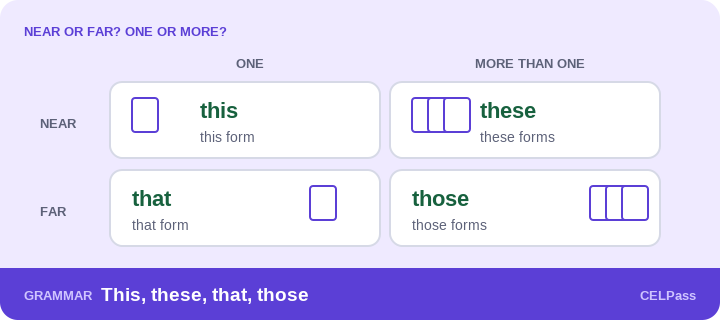
They also point in time and in text. This and these point to the present or to what comes next; that and those to the past or to what you already said: "These days I work from home." "In those years we lived in Regina."
In writing, follow this with a noun when it points back to an idea: "This delay cost me a day of work" is clearer than "This cost me a day of work."
Check yourself: choose one answer
"I've attached the receipts. ___ show the dates of each payment."
Receipts is plural and you are pointing to something you just attached, so these.
2Who, which, that
| Pronoun | Use for | Example |
|---|---|---|
| who | people | "The technician who came on Monday was very helpful." |
| which | things, animals | "The heater, which is ten years old, broke again." |
| that | people or things (no commas) | "The form that you sent was missing a page." |
| whose | belonging to a person or thing | "I have a neighbour whose dog barks all night." |
| where / when | places / times | "the café where we met", "the day when it opened" |
Check yourself: choose one answer
"I would like to thank the nurse ___ looked after my father."
The nurse is a person doing the action, so who (or that). Which is for things.
3Everyone, someone, nobody
Words ending in -one, -body and -thing are singular, even when they mean many people: everyone, somebody, nothing, anyone. They take is, has, does, likes. Each and every work the same way: "Each unit has a storage locker."
- "Everyone in my building is upset about the rent increase."
- "Nobody has replied to my email yet."
- "Something is wrong with the dryer."
- In negatives use any-, not no-, after not: "I didn't see anybody" (not "I didn't see nobody").
Check yourself: choose one answer
Which sentence is correct?
Everybody is singular, so the verb takes -s: wants.
Check yourself: choose one answer
"When I called, there wasn't ___ at the front desk."
After not, use any-: wasn't anybody. "There was nobody" is also correct, but not both negatives together.
Key takeaways
- This and these: near or one/many; that and those: far, past or already mentioned.
- Follow this with a noun when it refers to an idea: this delay, this change.
- Who for people, which for things, that for both, whose for possession.
- Everyone, nobody, something, each and every take a singular verb.
Exercises
Type or choose your answers, then check them. The first ones start with a worked example; the last asks for your own sentences.
Write this, that, these or those.
These shoes I'm wearing are new. (near, more than one)
- 2Can you see building over there? (far, one)
- 3days I work from home on Mondays. (now)
- 4In years we lived in Regina. (the past)
- 5I've attached a photo. photo shows the leak. (just attached)
- 6Could you pass me boxes on the top shelf? (far, more than one)
Write who, which, whose or where.
I'd like to thank the nurse who helped my father.
- 2The heater, is ten years old, broke again.
- 3I have a neighbour dog barks all night.
- 4This is the café we first met.
- 5The technician came on Monday was very helpful.
- 6The bus, was full, didn't stop for us.
Choose the correct word.
Everyone in my building is upset about the rent. (is / are)
- 2
Nobody ___ replied to my email yet.
- 3
When I called, I didn't speak to ___.
- 4
Each unit ___ a storage locker.
- 5
Something ___ wrong with the dryer.
- 6
We didn't buy ___ at the market.
A notice for tenants. Three lines have an error and two are correct. Write every line correctly.
This flyers were left in every mailbox.
→ These flyers were left in every mailbox.
- 2
Everyone in the building have to move their car on Monday.
- 3
Tenants which park on the street may get a ticket.
- 4
If you don't know nothing about the new rules, call the office.
- 5
Each of the units has a reserved spot.
- 6
This change will help the snowplows clear the lot.
Write sentences for a Writing Task 1 email or a Speaking answer. Use the word in brackets.
- 1
Point back to a problem you just described (this + noun).
- 2
Describe a person you know (who).
- 3
Describe a place you use (where).
- 4
Say something about everyone in your workplace or class (everyone).
Practise with free questions
Free questions in the CELPIP format, with answers and no account needed. Try a few now, while the lesson is fresh.
CELPass is an independent practice platform and is not affiliated with Paragon Testing Enterprises. CELPIP is a trademark of Paragon Testing Enterprises. Check the official CELPIP website and IRCC for current test rules and requirements.