Unit 5: Describing words and prepositions · Lesson 22 of 38
Describing Feelings and Degree: -ed/-ing, So, Such, Too, Enough
- 5 min read
- 2 diagrams
- 4 quizzes
- 5 exercises · 23 questions
By CELPass Editorial Team · Updated
Speaking Tasks 3 and 4 ask you to describe people in a picture, and many emails explain how a problem made you feel. A few small words decide how strong your description sounds, and mixing them up is one of the most common errors raters hear.

1-ed or -ing: the feeling or the cause
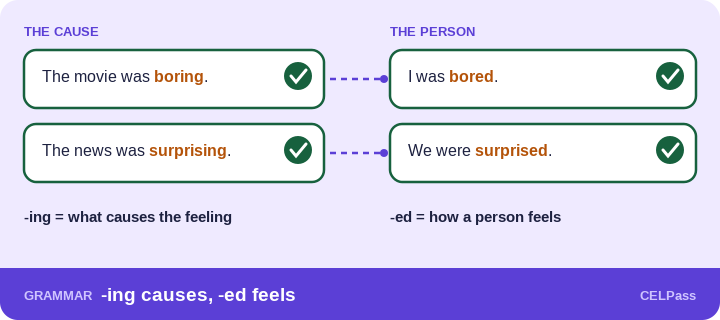
Many feeling adjectives come in pairs. The -ed form describes how a person feels; the -ing form describes the thing or situation that causes the feeling.
| The person feels | The cause is |
|---|---|
| interested | interesting |
| worried | worrying |
| annoyed | annoying |
| embarrassed | embarrassing |
| exhausted | exhausting |
| relaxed | relaxing |
| disappointed | disappointing |
"I am boring" means you make other people bored. In a picture description, the people are usually -ed ("the passengers look annoyed") and the situation is -ing ("the long delay is annoying").
Check yourself: choose one answer
Picture task: "The children are watching the fireworks. They look really ___."
The children feel the excitement, so use the -ed form; the fireworks would be exciting.
2So and such
- So + adjective or adverb: "The line was so long." "She spoke so quickly."
- Such + a/an + (adjective) + singular noun: "It was such a long line."
- Such + (adjective) + plural or uncountable noun: "They are such kind neighbours." "It was such bad weather."
- So much / so many + noun: "There was so much traffic." "There were so many people."
Add that to show the result: "The apartment was so cold that we wore coats inside." This is a quick way to join two ideas in one sentence in Writing.
Check yourself: choose one answer
"It was ___ windy day that the ferry was cancelled."
Day is a singular countable noun, so use such a + adjective + noun.
3Too and enough
Too means more than is good or possible, so it usually signals a problem: "The rent is too high." Very only makes a word stronger: "The rent is very high, but I can pay it." Enough means as much as you need. It goes after an adjective or adverb but before a noun.
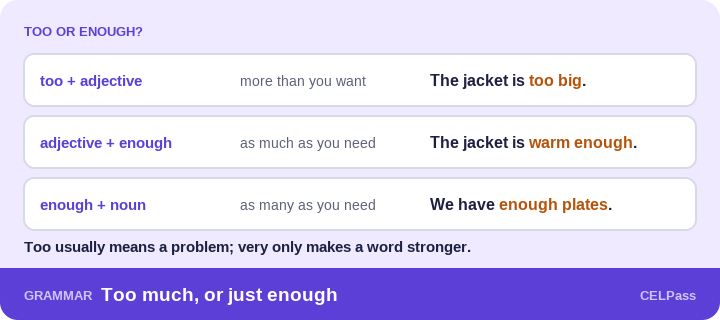
Both can take for + person and to + verb: "The box is too heavy for me to lift." "Is the water warm enough to swim in?"
Check yourself: choose one answer
Which sentence is correct?
Enough goes after an adjective: big enough.
4How strong? Quite, pretty, fairly and absolutely
Fairly is a little; quite and pretty are more (pretty is informal, so it suits Speaking); very and really are strong. Rather often adds a negative feeling: "The room was rather small." In Canadian English, quite often means very: "The view was quite amazing."
Some adjectives already mean very: freezing (very cold), exhausted (very tired), huge, tiny, packed, terrible, delicious, fantastic. Make them stronger with absolutely or really, not very: "absolutely freezing", not "very freezing".
Check yourself: choose one answer
Which sentence is correct?
Packed already means very full, so it takes absolutely; busy is an ordinary adjective that takes very.
Key takeaways
- -ed adjectives for how people feel, -ing adjectives for what causes it.
- So + adjective; such (a) + adjective + noun; add that for a result.
- Too means more than you want; adjective + enough, but enough + noun.
- Use absolutely or really, not very, with extreme adjectives like freezing and packed.
Exercises
Type or choose your answers, then check them. The first ones start with a worked example; the last asks for your own sentences.
Write the -ed or -ing form of the word in brackets.
The two-hour meeting was really boring (bore).
- 2I was (surprise) to see snow in May.
- 3The news about the layoffs is very (worry).
- 4My kids get (bore) on long car trips.
- 5Moving three times in one year was (exhaust).
- 6Are you (interest) in joining the book club?
Join the two sentences with so … that or such … that.
The coffee was very hot. I couldn't drink it.
→ The coffee was so hot that I couldn't drink it.
- 2
It was a beautiful day. We ate lunch in the park.
- 3
The line was very long. We gave up and went home.
- 4
They are very friendly neighbours. We often invite them for dinner.
- 5
There was a lot of traffic. I was late for work.
Choose the correct word.
This coat isn't warm enough for a Winnipeg winter. (enough / too)
- 2
The tea is ___ hot to drink right now. Let it cool down.
- 3
Is your son old ___ to stay home alone?
- 4
We don't have ___ for everyone at the party.
- 5
The view from the top of the hill was ___ beautiful, and we took lots of photos.
- 6
It's absolutely ___ outside; wear two pairs of gloves.
A Speaking Task 3 description of a busy market. Correct the mistake in each sentence. Two are already correct.
The market is such crowded that people can hardly move.
→ The market is so crowded that people can hardly move.
- 2
The children look very exciting about the balloons.
- 3
An old man is selling such delicious bread that there is a line at his stall.
- 4
His stall is enough big for only two customers at a time.
- 5
A woman is carrying a very enormous pumpkin.
- 6
It is a fairly warm day, so most people are wearing T-shirts.
Write your own sentences for Speaking Tasks 3 and 4 and for emails.
- 1
Describe people in a busy airport (one -ed and one -ing adjective).
- 2
A time you were very tired (so … that).
- 3
Your home, with one sentence using too and enough.
- 4
Today's weather, with quite, pretty or absolutely.
Practise with free questions
Free questions in the CELPIP format, with answers and no account needed. Try a few now, while the lesson is fresh.
CELPass is an independent practice platform and is not affiliated with Paragon Testing Enterprises. CELPIP is a trademark of Paragon Testing Enterprises. Check the official CELPIP website and IRCC for current test rules and requirements.