Unit 3: Verbs and tenses · Lesson 10 of 38
Past Simple, Past Continuous and Irregular Verbs
- 6 min read
- 2 diagrams
- 6 quizzes
- 5 exercises · 25 questions
By CELPass Editorial Team · Updated
Speaking Task 2 asks for a personal experience, and many emails explain something that went wrong. Both are stories in the past, and a story with the wrong tense is hard to follow.
1Past simple: finished events
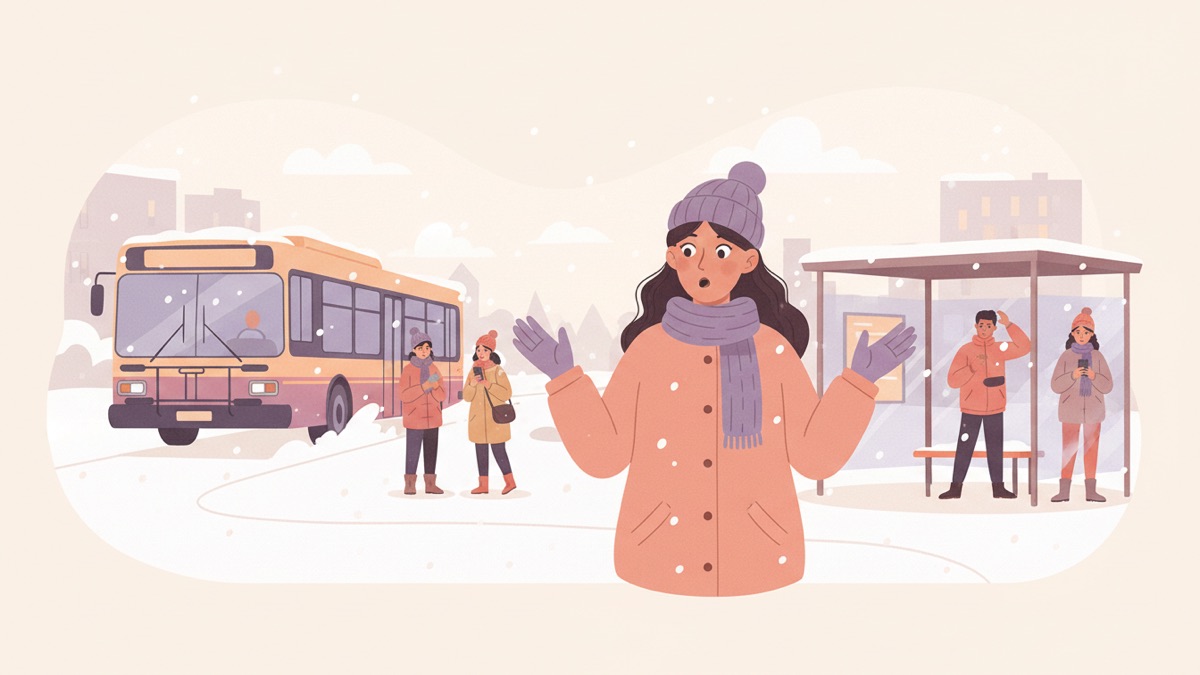
Use the past simple for actions that started and finished at a time in the past, often with yesterday, last week, in 2019, two days ago or when I was young. Regular verbs add -ed: called, moved, waited. Negatives and questions use did + the base verb: "I didn't receive it." "Did you get my message?"
Check yourself: choose one answer
"The courier ___ the parcel two days ago, but I ___ it."
Two days ago is a finished time, so past simple. After didn't, use the base form: receive, not received.
2Past continuous: the background
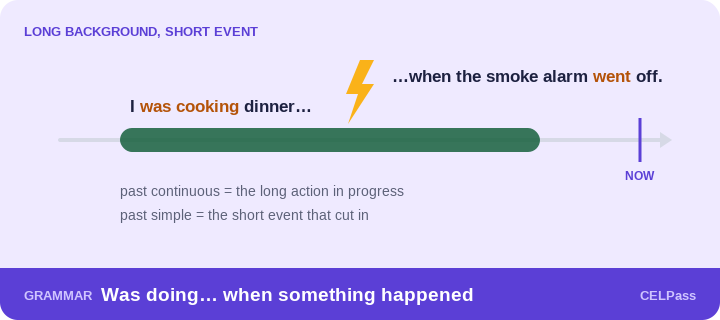
Use was or were + -ing for an action that was in progress at a moment in the past, often the background to a story: "It was raining and I was walking home." Then use the past simple for the event that happened in the middle of it.
- when + short event: "I was driving to work when my tire went flat."
- while + long action: "While I was driving to work, my tire went flat."
- Two actions in progress at the same time: "While I was cooking, my son was doing his homework."
Check yourself: choose one answer
"I ___ my groceries when someone ___ my name."
Paying is the longer background action (past continuous); someone calling your name is the short event (past simple).
3Used to, would and getting used to
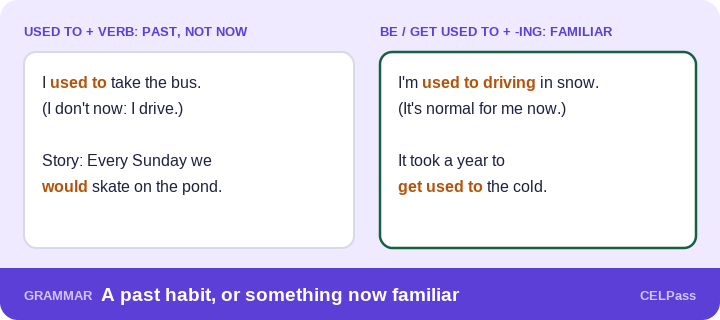
Used to + base verb tells the listener something was true in the past and is not true now: "I used to take the bus, but now I drive." The negative and question use did and drop the d: "I didn't use to like coffee." "Did you use to live downtown?" Would + verb also describes repeated past actions in a story ("Every Sunday my grandmother would make dumplings"), but not states: say "I used to live in Lagos", not "I would live in Lagos".
Be used to means something is familiar, so it no longer feels strange: "I'm used to the winters now." Get used to means it is becoming familiar: "It took me a year to get used to the cold." Here to is a preposition, so a verb after it takes -ing: "I'm used to driving in snow", not "used to drive". All three are useful in Speaking Task 2 when you compare life before and after a move.
| Form | Meaning | Example |
|---|---|---|
| used to + verb | past habit or state, not now | "We used to rent a basement suite." |
| would + verb | repeated past action in a story | "After school we would skate on the pond." |
| be used to + noun / -ing | familiar now | "She is used to working nights." |
| get used to + noun / -ing | becoming familiar | "You will get used to the bus schedule." |
Check yourself: choose one answer
"When I first moved to Winnipeg, I couldn't ___ the cold."
Becoming familiar with something is get used to + a noun: "I couldn't get used to the cold." Used to + verb is a past habit.
Check yourself: choose one answer
"As a child, I ___ in a small village, but now I live in Toronto."
Living somewhere is a state, so used to, not would. Was used to would need -ing and means something different: familiar.
4Irregular verbs to know cold
| Base | Past | Base | Past |
|---|---|---|---|
| buy | bought | bring | brought |
| think | thought | teach | taught |
| catch | caught | fall | fell |
| feel | felt | leave | left |
| lose | lost | pay | paid |
| choose | chose | break | broke |
| send | sent | spend | spent |
| take | took | tell | told |
Common errors: "buyed", "brang", "teached", "payed", and mixing brought (from bring) with bought (from buy). If you are unsure of a past form in a test, choose a regular verb with the same meaning: purchased instead of bought, phoned instead of rang.
Check yourself: choose one answer
"Last weekend we ___ a new couch and our friends ___ dessert for the housewarming."
Buy → bought; bring → brought. They look alike, so check which verb you mean.
Check yourself: choose one answer
Which sentence keeps the story in one time?
Once the story is set in the past (last year), keep every finished event in the past simple.
Key takeaways
- Past simple for finished events at a past time; did + base verb in negatives and questions.
- Past continuous (was/were + -ing) for the background action in progress.
- When + short event, while + long action.
- Learn the common irregular pasts; don't switch back to the present mid-story.
Exercises
Type or choose your answers, then check them. The first ones start with a worked example; the last asks for your own sentences.
Write the past simple of the verb in brackets.
Last weekend we bought (buy) a new couch.
- 2Our friends (bring) dessert to the housewarming.
- 3My teacher (teach) me how to write a formal email.
- 4I (pay) the rent late once, by mistake.
- 5We (leave) the party at eleven.
- 6I (not / know) about the schedule change.
Background or event? Put the verb in the past continuous or the past simple.
I was driving (drive) to work when my tire went flat.
- 2While I was cooking, the smoke alarm (go) off.
- 3It (rain) hard when we left the clinic.
- 4My phone rang while I (talk) to the pharmacist.
- 5When the power went out, we (watch) a movie.
- 6I (see) an accident while I was waiting for the bus.
Used to, would, be used to or get used to? Choose the correct form.
I used to take the bus, but now I drive. (used to / am used to)
- 2
After two winters here, I ___ driving in snow.
- 3
It took me a year to get used to ___ up so early.
- 4
I didn't ___ like coffee, but now I drink it every day.
- 5
When I was a child, my grandfather ___ tell us stories every Sunday.
- 6
We ___ live in a small town before we moved to Ottawa.
- 7
New staff usually need a few weeks to ___ the night shift.
A Speaking Task 2 story about a first winter. Write the verb in the form shown.
When I first arrived (arrive) in Canada, I didn't have a winter coat.
- 2One morning I (wait) for the bus in minus thirty.
- 3A woman next to me (notice) that I was shivering.
- 4She (give) me her scarf and told me where to buy a good coat.
- 5Back home, I (used to / wear) a light jacket all year.
- 6Now I (be used to) the cold, and I always carry a spare scarf.
Tell a short story about yourself, as in Speaking Task 2. Use the form in brackets.
- 1
Say when and where the story happened (past simple).
- 2
Set the scene (past continuous).
- 3
Something you did in your home country that you don't do now (used to).
- 4
Something that felt strange at first but is normal for you now (get used to).
Practise with free questions
Free questions in the CELPIP format, with answers and no account needed. Try a few now, while the lesson is fresh.
CELPass is an independent practice platform and is not affiliated with Paragon Testing Enterprises. CELPIP is a trademark of Paragon Testing Enterprises. Check the official CELPIP website and IRCC for current test rules and requirements.