Unit 4: Modals, voice and verb patterns · Lesson 19 of 38
Gerunds and Infinitives
- 4 min read
- 1 diagram
- 3 quizzes
- 5 exercises · 24 questions
By CELPass Editorial Team · Updated
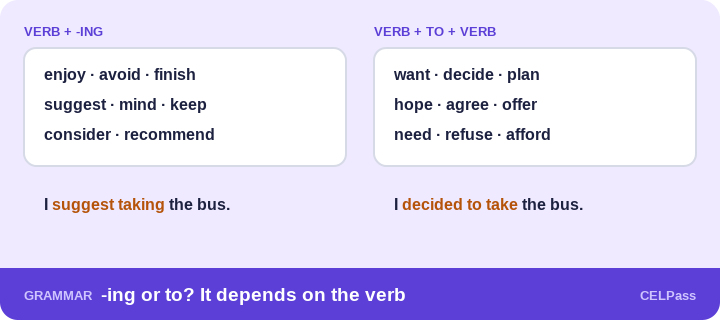
"I suggest to take" and "I look forward to hear" are two of the most common errors in CELPIP answers. The rule depends on the word that comes first, so learn the patterns in groups.

1The first verb decides
Check yourself: choose one answer
"Have you considered ___ a part-time course?"
Consider is followed by the -ing form.
Check yourself: choose one answer
"We can't afford ___ a second car right now."
Afford is followed by to + verb.
2After a preposition, always -ing
Any verb after a preposition (in, of, about, for, without, before) takes -ing: "interested in volunteering", "thank you for helping", "before signing". Watch out for to as a preposition in look forward to, be used to and object to.
| Wrong | Right |
|---|---|
| I look forward to hear from you. | I look forward to hearing from you. |
| I'm used to wake up early. | I'm used to waking up early. |
| Thank you for help me. | Thank you for helping me. |
Check yourself: choose one answer
Choose the correct email closing.
In look forward to, to is a preposition, so the verb takes -ing.
3Verbs that change meaning
- stop doing (quit) vs stop to do (pause in order to): "He stopped smoking." / "He stopped to buy coffee."
- remember doing (a memory) vs remember to do (not forget a task): "Remember to lock the door."
- try doing (as an experiment) vs try to do (make an effort): "Try restarting the router."
Key takeaways
- Learn verbs in two groups: + -ing (enjoy, avoid, suggest) and + to (want, decide, afford).
- After any preposition, use -ing.
- Look forward to, be used to and object to are followed by -ing.
- Stop, remember and try change meaning with -ing or to.
Exercises
Type or choose your answers, then check them. The first ones start with a worked example; the last asks for your own sentences.
Write the verb in brackets as -ing or to + verb.
We decided to move (move) closer to the school.
- 2I enjoy (walk) along the river after work.
- 3Have you finished (fill) out the application?
- 4We can't afford (buy) a new car this year.
- 5My manager agreed (give) me Friday off.
- 6Would you mind (send) me the details again?
Join the ideas with the words in brackets. The verb after a preposition takes -ing.
You helped me move. Thank you. (Thank you for …)
→ Thank you for helping me move.
- 2
I'm interested. I want to volunteer at the food bank. (I'm interested in …)
- 3
I will meet you on Friday. I'm happy about it. (I look forward to …)
- 4
Read the lease first. Then sign it. (Read the lease before …)
- 5
He left. He didn't say goodbye. (He left without …)
- 6
Driving in snow is normal for me now. (I'm used to …)
Choose -ing or to. Some verbs change meaning.
He stopped smoking two years ago and feels much healthier. (smoking / to smoke)
- 2
On the way home, I stopped ___ some bread.
- 3
Please remember ___ the door when you leave.
- 4
I remember ___ snow for the first time; I was so excited.
- 5
We're planning ___ to Banff in July.
- 6
She keeps ___ the same mistake in her emails.
An email about a community garden. Write each verb as -ing or to + verb.
Thank you for replying (reply) so quickly to my message.
- 2I am writing to ask about (join) the community garden.
- 3I would like (rent) a plot for the summer.
- 4I enjoy (grow) vegetables, and I have done it for years.
- 5I have already decided (plant) tomatoes and beans.
- 6I look forward to (hear) from you.
Write your own sentences.
- 1
Speaking Task 1: suggest an activity to a friend (Have you considered + -ing?).
- 2
Something you can't afford to do right now (afford + to).
- 3
Something you are used to doing now that was hard at first (be used to + -ing).
- 4
A closing line for a formal email (look forward to + -ing).
Practise with free questions
Free questions in the CELPIP format, with answers and no account needed. Try a few now, while the lesson is fresh.
CELPass is an independent practice platform and is not affiliated with Paragon Testing Enterprises. CELPIP is a trademark of Paragon Testing Enterprises. Check the official CELPIP website and IRCC for current test rules and requirements.