Unit 5: Describing words and prepositions · Lesson 23 of 38
Adverbs: Form and Position
- 3 min read
- 1 diagram
- 3 quizzes
- 5 exercises · 24 questions
By CELPass Editorial Team · Updated
Adverbs tell how, when, where and how often. Two errors are frequent in CELPIP answers: using an adjective where an adverb is needed, and putting the adverb between a verb and its object.

1Forming adverbs
- Most add -ly: quick → quickly, careful → carefully, polite → politely.
- -y becomes -ily: easy → easily, happy → happily.
- -le becomes -ly: possible → possibly, simple → simply.
- Irregular: good → well; fast, hard, late and early stay the same. (Hardly and lately mean something different.)
Check yourself: choose one answer
"She speaks French very ___."
Good is an adjective; the adverb that describes how she speaks is well.
2Adjective or adverb?
An adjective describes a noun; an adverb describes a verb, an adjective or another adverb. After linking verbs (be, seem, look, feel, sound) use an adjective: "The soup smells good", "I feel bad about the delay."
| Wrong | Right |
|---|---|
| The staff treated us very polite. | The staff treated us very politely. |
| The bus was extreme crowded. | The bus was extremely crowded. |
| I worked hardly all week. | I worked hard all week. |
Check yourself: choose one answer
Which sentence is correct?
Clearly describes how she explained, and it goes after the object, not between the verb and the object.
3Where adverbs go
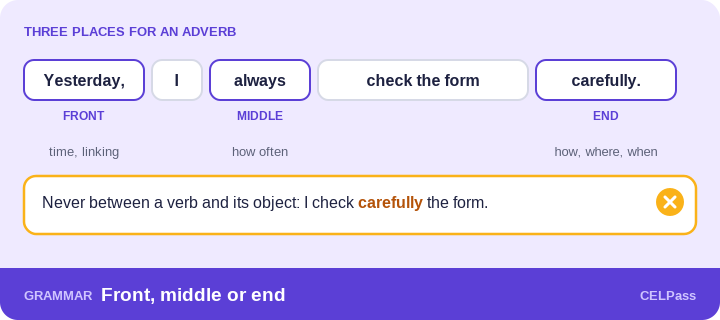
Frequency adverbs (always, usually, often, never) go before the main verb but after be: "I usually take the bus", "The office is always busy." With two verbs, they go after the first: "I have never seen…"
Check yourself: choose one answer
Choose the correct position.
Frequency adverbs come after be.
Key takeaways
- Most adverbs add -ly; good becomes well; hard and fast don't change.
- Use an adjective after be, seem, look, feel and sound.
- Frequency adverbs go before the main verb but after be.
- Never put an adverb between a verb and its object.
Exercises
Type or choose your answers, then check them. The first ones start with a worked example; the last asks for your own sentences.
Write the adverb form of the word in brackets.
Please drive carefully (careful) near the school.
- 2She speaks French very (good).
- 3The staff treated us very (polite).
- 4I (easy) found a parking spot near the arena.
- 5He works (hard) to support his family.
- 6The bus was (extreme) crowded this morning.
Rewrite each sentence with the adverb in brackets in the usual place.
I take the bus to work. (usually)
→ I usually take the bus to work.
- 2
The office is busy on Mondays. (always)
- 3
I have been to the Yukon. (never)
- 4
She checked the form. (carefully)
- 5
We eat out on weekends. (sometimes)
- 6
My manager is late. (rarely)
Adjective or adverb? Choose the correct word.
The soup smells good. (good / well)
- 2
I feel ___ about missing your party.
- 3
The children behaved ___ during the trip.
- 4
I've been very busy ___.
- 5
She ___ ever takes a day off.
- 6
Your plan sounds ___ to me.
A complaint to a delivery company. Correct the adverb in each sentence. Two are already correct.
I always am happy with your service.
→ I am always happy with your service.
- 2
However, last week your driver delivered my package very late.
- 3
He left careless the box in the rain.
- 4
The items inside were complete ruined.
- 5
I would appreciate it if you could reply quick.
- 6
I have never had a problem like this before.
Write your own sentences.
- 1
How often you do something (always, usually, often, sometimes, never).
- 2
Speaking Task 3: how a person in a picture is doing something (an adverb of manner).
- 3
A complaint email sentence with an adverb before an adjective (extremely, completely).
- 4
Something you did well or badly recently.
Practise with free questions
Free questions in the CELPIP format, with answers and no account needed. Try a few now, while the lesson is fresh.
CELPass is an independent practice platform and is not affiliated with Paragon Testing Enterprises. CELPIP is a trademark of Paragon Testing Enterprises. Check the official CELPIP website and IRCC for current test rules and requirements.