Unit 4: Modals, voice and verb patterns · Lesson 14 of 38
Modal Verbs for Advice and Requests
- 4 min read
- 1 diagram
- 3 quizzes
- 5 exercises · 22 questions
By CELPass Editorial Team · Updated
Speaking Task 1 is all about advice, and most Writing Task 1 emails make a request. Modal verbs set how strong and how polite you sound, which raters notice.

1Modals have one simple form
- Modal + base verb: "You should call", not "should to call" or "should calls".
- No -s for he, she or it: "She must sign", not "she musts".
- Questions and negatives without do: "Could you…?", "You shouldn't…".
Check yourself: choose one answer
Choose the correct sentence.
A modal is followed by the base verb with no to, and it never takes -s.
2Advice: choose the strength
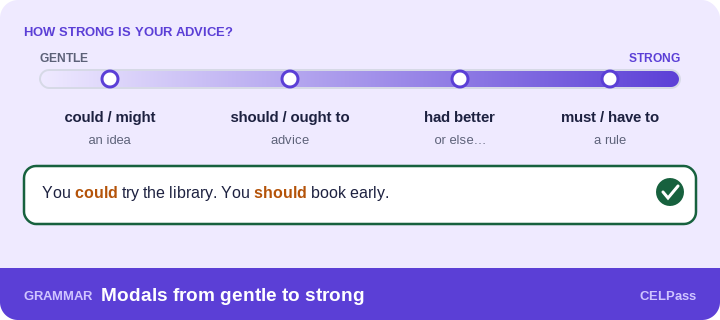
Good Task 1 answers mix strengths: an idea with could, the main advice with should, and a warning with had better. Using must for everything sounds bossy; using only maybe sounds unsure.
Check yourself: choose one answer
Which sentence gives a warning about a consequence?
Had better ('d better) suggests something bad will happen if you don't act.
3Polite requests in emails
| Too direct | Polite |
|---|---|
| Fix my heater. | Could you please arrange for someone to fix my heater? |
| I want a refund. | I would appreciate it if you could refund the full amount. |
| Tell me the date. | Would you mind letting me know the date? |
After would you mind, use -ing: "Would you mind sending…", not "to send".
Check yourself: choose one answer
Which request suits an email to a building manager you don't know?
Could you please… is polite and clear; must and a bare command sound rude to someone you don't know.
Key takeaways
- Modal + base verb: no to, no -s, no do.
- Mix strengths: could for ideas, should for advice, had better for warnings, must for rules.
- Make email requests with could you, would you mind or I would appreciate it if.
- Would you mind is followed by -ing.
Exercises
Type or choose your answers, then check them. The first ones start with a worked example; the last asks for your own sentences.
Write the modal and the verb in the correct form.
You should ask (should / ask) your doctor about it.
- 2She (can / not / come) to the meeting on Friday.
- 3(could / you) send me the invoice again?
- 4He (must / sign) the lease before he moves in.
- 5You (should / not / leave) your bike outside overnight.
- 6Would you mind (wait) a few minutes?
A friend tells you about a problem. Give advice with the words in brackets.
Your friend wants to spend less on groceries. (could / buy in bulk)
→ You could buy in bulk.
- 2
Your friend's lease ends next month and rents are rising. (should / start looking now)
- 3
Your coworker keeps missing the bus. (had better / leave earlier)
- 4
Your neighbour wants to build a fence, and the city requires a permit. (have to / get a permit)
- 5
Your friend can't choose a gym. (might / try a free class first)
Choose the modal that fits the meaning.
This is a rule: all visitors must sign in at the front desk. (must / could)
- 2
It's just an idea: you ___ ask the library about free English classes.
- 3
You ___ take an umbrella, or you'll get soaked.
- 4
Students ___ bring a lunch; the school gives everyone a free one.
- 5
You ___ park here. It's a fire lane.
- 6
___ you mind if I opened the window?
An email to a building manager. Make each request polite with the words in brackets.
Fix the light in the hallway. (Could you please …?)
→ Could you please fix the light in the hallway?
- 2
Send me a copy of my lease. (Would you mind …?)
- 3
Tell me when the plumber is coming. (Could you let me know …?)
- 4
Call me before you enter my unit. (I would be grateful if …)
- 5
I want the repair done this week. (I would appreciate it if …)
Write your own sentences for Speaking Task 1 and a work email.
- 1
Your friend wants to improve their English quickly. Give an idea (could).
- 2
Give your main advice (should).
- 3
Give a warning (had better).
- 4
Ask your manager politely for a day off (Would it be possible …?).
Practise with free questions
Free questions in the CELPIP format, with answers and no account needed. Try a few now, while the lesson is fresh.
CELPass is an independent practice platform and is not affiliated with Paragon Testing Enterprises. CELPIP is a trademark of Paragon Testing Enterprises. Check the official CELPIP website and IRCC for current test rules and requirements.