Unit 8: Clauses and sentences · Lesson 35 of 38
Reported Speech: Say, Tell and Asked
- 6 min read
- 1 diagram
- 4 quizzes
- 5 exercises · 24 questions
By CELPass Editorial Team · Updated
Emails and stories are full of what other people said: the manager told me the repair would take a week; the agent asked whether I had a receipt. Reporting it correctly keeps your account clear and exact, which is what a complaint email or a Speaking Task 2 story needs.

1Say or tell?
Both verbs report words, but they take different patterns. Tell needs a person right after it; say does not. If you want to name the person after say, add to. That after either verb is optional.
| Verb | Pattern | Example |
|---|---|---|
| tell | tell + person (+ that) + clause | The manager told me (that) the pool was closed. |
| say | say (+ that) + clause | The manager said (that) the pool was closed. |
| say … to | say something to a person | She said goodbye to everyone at the party. |
| tell (fixed phrases) | tell the truth, tell a story, tell a joke | He told us a funny story about his first winter. |
Check yourself: choose one answer
Choose the correct sentence.
Tell needs a person right after it (told me). Say cannot be followed directly by a person, and the last option has no complete verb (was cancelled).
2Move the tense one step back
When the speaking happened in the past, the verb in the report usually moves one step back in time. Pronouns change too: "I" becomes he or she.
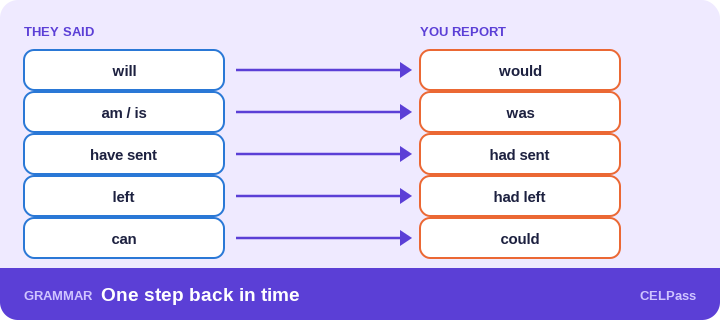
| They said | You report |
|---|---|
| "The repair will take a week." | He said the repair would take a week. |
| "I'm working late." | She said she was working late. |
| "We have sent the refund." | They said they had sent the refund. |
| "The bus left early." | He said the bus had left early (or: left early). |
| "I can help on Friday." | She said she could help on Friday. |
You don't have to move the tense back when the fact is still true now: "The landlord said the rent is going up in May" is fine while May is still ahead. In a story about the past, moving it back is always safe.
Check yourself: choose one answer
In March your landlord said: "The rent goes up in July." It is now April. Which report is correct?
The rise is still ahead, so the tense can stay (went up would also be correct). Told needs a person after it, and had go is not a verb form.
3Reporting questions
A reported question uses statement order, like the indirect questions in the noun clauses lesson. Yes/no questions take if or whether; other questions keep their question word. The sentence ends with a full stop, not a question mark.
| Question | Reported |
|---|---|
| "Do you have the receipt?" | She asked if I had the receipt. |
| "Where did you buy it?" | She asked where I had bought it. |
| "Can you come back tomorrow?" | He asked whether I could come back the next day. |
Check yourself: choose one answer
Which sentence is correct?
A reported question uses statement order (I lived), no did, and a full stop. Say cannot take me directly.
4Requests, advice and suggestions
| Pattern | Example |
|---|---|
| ask / tell + person + to + verb | The manager asked me to fill in a form. |
| ask / tell + person + not to + verb | The doctor told me not to lift anything heavy. |
| advise + person + to + verb | The travel agent advised us to book early. |
| suggest + -ing, or suggest that + clause | My friend suggested taking the ferry. / She suggested that we take the ferry. |
When you report later, time and place words often change too: today becomes that day, tomorrow becomes the next day, yesterday becomes the day before, next week becomes the following week, and here becomes there.
Check yourself: choose one answer
Choose the correct sentence.
Suggest takes an -ing form (or that + clause), never a person + to.
Key takeaways
- Tell + a person; say + (that) + a clause, or say something to a person.
- Move the tense one step back: will → would, is → was, have done → had done, can → could.
- The tense can stay when the fact is still true now.
- Reported questions: if/whether or the question word, statement order, a full stop.
- Ask or tell someone to do; advise someone to do; suggest doing.
Exercises
Type or choose your answers, then check them. The first ones start with a worked example; the last asks for your own sentences.
Complete with said or told.
The receptionist told me the doctor was running late.
- 2My coworker she could cover my shift.
- 3Our landlord us that the water would be off for two hours.
- 4He goodbye to everyone and left.
- 5The mechanic the car needed new brakes.
- 6I the police officer exactly what happened.
Report what each person said last week. Start with the words in brackets and move the tense back.
"The repair will take a week." (The manager said …)
→ The manager said the repair would take a week.
- 2
"I'm looking for a new job." (My sister said …)
- 3
"We have already sent your refund." (The store told me …)
- 4
"I can't come to the meeting." (Omar said …)
- 5
"Our office will be closed on Monday." (The clinic told us …)
- 6
"I lost my keys yesterday." (Ana said …)
Choose the correct way to report each question.
"Do you have a receipt?" → She asked if I had a receipt. (if I had a receipt / did I have a receipt)
- 2
"Where do you live?" → The officer wanted to know ___.
- 3
"Can you work on Saturday?" → My manager asked ___.
- 4
"Why are you late?" → The teacher asked ___.
- 5
"Have you seen my glasses?" → Grandpa asked ___.
- 6
"How much does it cost?" → I asked ___.
An email to a building manager about a broken oven. Put the words in brackets into the right reported form.
When I moved in, you told (tell) me that all the appliances were new.
- 2Last Monday I called your office and asked (when / the technician / come).
- 3Your assistant said that the technician (visit) on Wednesday.
- 4She also asked me (not / use) the oven until then.
- 5On Wednesday nobody came, so I asked her (if / the visit / be / cancelled).
- 6She suggested (call) the emergency line, but nobody answered.
Report a real conversation, as in a Speaking Task 2 story or a Writing Task 1 email. Use the words in brackets.
- 1
Something a manager or teacher told you. (told me that)
- 2
A question someone asked you recently. (asked me if)
- 3
Advice you were given. (advised me to)
- 4
Something a friend suggested. (suggested + -ing)
Practise with free questions
Free questions in the CELPIP format, with answers and no account needed. Try a few now, while the lesson is fresh.
CELPass is an independent practice platform and is not affiliated with Paragon Testing Enterprises. CELPIP is a trademark of Paragon Testing Enterprises. Check the official CELPIP website and IRCC for current test rules and requirements.