Unit 8: Clauses and sentences · Lesson 36 of 38
Parallel Structure and Misplaced Modifiers
- 6 min read
- 1 diagram
- 3 quizzes
- 5 exercises · 21 questions
By CELPass Editorial Team · Updated
Two slips make a careful answer harder to read: a list whose items change form halfway ("cooking, to clean and the laundry"), and a word or phrase that sits next to the wrong part of the sentence. Both are quick to spot once you know what to look for, and both are easy points in Readability.
1Keep lists in the same form
When you list two or more things, give every item the same form: all -ing words, all base verbs, all adjectives or all nouns. The reader then sees the list as one idea with several parts.
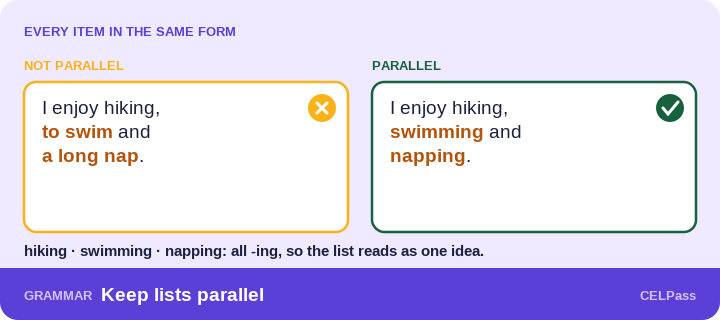
| Not parallel | Parallel |
|---|---|
| The job involves answering calls, to book rooms and the handling of complaints. | The job involves answering calls, booking rooms and handling complaints. |
| I want to save money, being closer to work and a bigger kitchen. | I want to save money, live closer to work and have a bigger kitchen. |
| The new park is safe, quiet, and it has lots of shade. | The new park is safe, quiet and shady. |
Check yourself: choose one answer
Which sentence is parallel?
All three activities are -ing forms after "like". The other options switch between -ing and to + verb inside one list.
2Pairs and comparisons: both… and, not only… but also, than
Words that come in pairs need the same form after each half. Look at what comes straight after both, either, neither or not only, and use that same form after and, or, nor or but also. A comparison works the same way: put the same form on each side of than or as.
| Unbalanced | Balanced |
|---|---|
| Option B is both cheaper and it saves time. | Option B is both cheaper and faster. |
| You can either pay online or by cash at the desk. | You can pay either online or in cash at the desk. |
| The plan would not only help parents but also the teachers. | The plan would help not only parents but also teachers. |
| Taking the bus is cheaper than to drive downtown. | Taking the bus is cheaper than driving downtown. |
Check yourself: choose one answer
Which sentence is correct?
An adjective follows each half: not only free, but also online. Adding "it is" after but also breaks the balance.
3Put modifiers next to what they describe
Words like only, almost, nearly and just change the meaning depending on where they go. Put them right before the word they limit. A describing phrase works the same way: keep it next to the noun it describes.
| Misplaced (says something else) | Clear |
|---|---|
| I almost drove my kids to school every day this year. (so you never drove them?) | I drove my kids to school almost every day this year. |
| She nearly spent three hours on hold. (so she didn't?) | She spent nearly three hours on hold. |
| The landlord gave a lease to the new tenant with a two-year term. | The landlord gave the new tenant a lease with a two-year term. |
A phrase at the start of a sentence must describe the subject that comes right after the comma. If it doesn't, it dangles: see the lesson on participle phrases.
Check yourself: choose one answer
Which sentence says the writer drove to work on most days?
"Almost" limits "every day", so it goes right before it. In the first option it limits "drove", which suggests the writer never quite drove.
Key takeaways
- Give every item in a list the same form: all -ing, all base verbs, all adjectives or all nouns.
- After both, either, neither and not only, repeat the same form after the second half.
- Put only, almost, nearly and just right before the word they limit.
- Keep a describing phrase next to the noun it describes.
Exercises
Type or choose your answers, then check them. The first ones start with a worked example; the last asks for your own sentences.
Choose the word or phrase that keeps the list parallel.
The apartment is bright, quiet and spacious.
- 2
My duties include greeting guests, answering the phone and ___ the mail.
- 3
Before we move out, we need to pack, clean and ___ the keys.
- 4
The ideal candidate is reliable, friendly and ___.
- 5
The workshop showed us how to write a resume, prepare for interviews and ___.
Rewrite the sentence so the list or pair is parallel.
I like swimming, to hike and camping.
→ I like swimming, hiking and camping.
- 2
The class is fun, cheap, and it is close to my home.
- 3
You can either call the office or an email.
- 4
The plan would help both the students and their teachers would benefit.
- 5
Working from home is less tiring than to commute every day.
- 6
She enjoys reading, painting and to garden.
Choose the sentence that says what the writer means.
Meaning: the bus was late by a little under an hour.
→ The bus was nearly an hour late.
- 2
Meaning: on most days, not every day.
- 3
Meaning: the bill was a little under $200.
- 4
Meaning: two people were missing, no more.
- 5
Meaning: the lease has a two-year term.
Move the misplaced word or phrase so the sentence says what the writer means.
We nearly waited two hours for the plumber.
→ We waited nearly two hours for the plumber.
- 2
I almost called the office ten times last week.
- 3
She nearly spent all her savings on the car repair.
- 4
I sent a photo to the manager of the broken window.
- 5
I bought a desk for my son with three drawers.
Write sentences for a Writing Task 2 answer that use parallel structure and well-placed modifiers.
- 1
A list of three benefits of your choice, all in the same form.
- 2
A sentence with both … and.
- 3
A sentence with not only … but also.
- 4
A sentence with almost or nearly right before the word it limits.
Practise with free questions
Free questions in the CELPIP format, with answers and no account needed. Try a few now, while the lesson is fresh.
CELPass is an independent practice platform and is not affiliated with Paragon Testing Enterprises. CELPIP is a trademark of Paragon Testing Enterprises. Check the official CELPIP website and IRCC for current test rules and requirements.