Unit 4: Modals, voice and verb patterns · Lesson 17 of 38
Wishes and Preferences: Wish, Would Rather, Prefer
- 5 min read
- 2 diagrams
- 4 quizzes
- 5 exercises · 24 questions
By CELPass Editorial Team · Updated
Speaking Task 5 asks you to choose one option and persuade someone, Task 7 asks for your opinion, and Task 2 stories often end with a regret. Wish, would rather and prefer let you say what you want and what you regret, but each one takes a verb form that surprises many learners.
1Wish about now and about other people
To wish that something were different now, use wish + past simple, even though you mean the present: "I wish I lived closer to work" (but I don't). For an ability, use could: "I wish I could speak French." In writing, were is preferred after I, he, she and it: "I wish my office were closer."
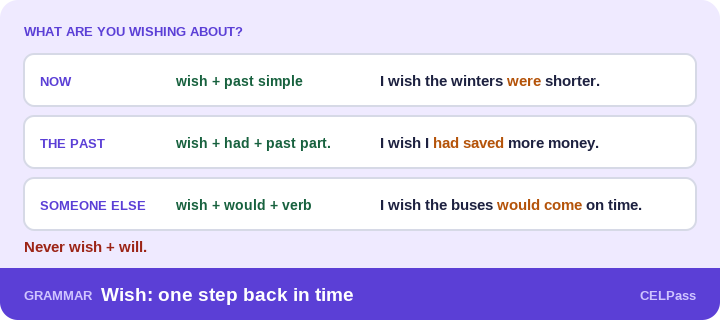
To complain about someone else's behaviour, or something you want to change, use wish + would: "I wish my neighbours would turn the music down." Never use will after wish.
Check yourself: choose one answer
Your apartment has no balcony, and you would like one. Which sentence is correct?
A wish about the present takes the past simple: had, not has or will have.
Check yourself: choose one answer
Your roommate leaves dirty dishes in the sink every day, and you want that to change.
Wish + would is used for someone else's behaviour that you would like to change.
2Wish and if only about the past
For a regret about the past, use wish + had + past participle: "I wish I had studied more before the test." If only is a stronger way to say the same thing: "If only I had checked the date!" Speaking Task 2 stories often end with a sentence like this.
| Wrong | Right |
|---|---|
| I wish I didn't sell my car last year. | I wish I hadn't sold my car last year. |
| I wish I would know the answer. | I wish I knew the answer. |
| I wish it will stop snowing. | I wish it would stop snowing. |
Check yourself: choose one answer
You didn't buy concert tickets early, and now they are sold out. Which sentence fits?
A regret about the past takes wish + had + past participle.
3Would rather and prefer
Would rather ('d rather) is followed by the base verb with no to, and than introduces the other choice: "I'd rather take the train than drive." When you want someone else to do something, use would rather + person + past: "I'd rather you didn't park in front of my garage."
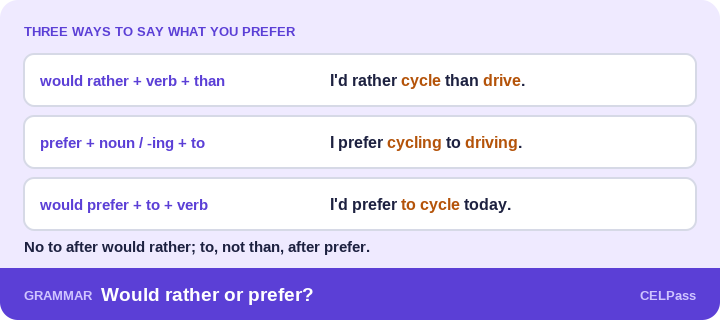
- Prefer + noun or -ing + to: "I prefer tea to coffee." "I prefer walking to driving." (Not "than".)
- Prefer to + verb + rather than + verb: "I prefer to cook at home rather than eat out."
- Would prefer + to + verb is polite for one choice: "I would prefer to meet in the morning."
Check yourself: choose one answer
"I'd rather ___ a small apartment downtown than a big house far from work."
Would rather is followed by the base verb, with no to.
4Using them in Speaking Task 5
In Task 5 you choose one option and persuade someone who may like the other. These forms let you admit the other side and still state your choice: "I know you'd prefer the house with the big yard, but I'd rather live close to work than spend two hours a day in traffic." Use one or two of them, not one in every sentence.
Key takeaways
- Wish + past simple (or could) for the present: I wish I lived closer.
- Wish + had + past participle for a regret: I wish I had saved more.
- Wish + would for someone else's behaviour; never wish + will.
- Would rather + base verb + than; prefer X to Y; would prefer to + verb.
Exercises
Type or choose your answers, then check them. The first ones start with a worked example; the last asks for your own sentences.
Write the verb in brackets in the right form after wish.
I don't have a car. I wish I had (have) a car.
- 2It's minus 30 again. I wish it (be) warmer.
- 3I can't swim. I wish I (can / swim).
- 4I didn't book a hotel early. I wish I (book) one earlier.
- 5My neighbour plays loud music at night. I wish he (turn) it down.
- 6I went to bed at 2 a.m. I wish I (not / stay) up so late.
Read each situation and write a sentence that starts with I wish.
You don't know anyone in your new city.
→ I wish I knew someone in my new city.
- 2
Your job is very stressful.
- 3
You didn't bring an umbrella, and now it's pouring.
- 4
Your roommate never takes out the recycling.
- 5
You can't afford a new laptop.
- 6
You missed your friend's birthday party last week.
Choose the correct word or form.
I'd rather take the bus than drive downtown. (take / to take)
- 2
I prefer tea ___ coffee.
- 3
I'd rather you ___ smoke near the door.
- 4
I'd rather walk ___ wait 30 minutes for the bus.
- 5
She prefers ___ at home to eating out.
- 6
If only I ___ the warning before I signed the contract!
A Speaking Task 5 answer. Complete each sentence.
I know you'd prefer the house in the suburbs, but I'd rather live (live) downtown.
- 2Honestly, I'd rather walk to work spend two hours a day in traffic.
- 3I prefer small apartments big houses because they are easier to clean.
- 4Last year I lived far from the city, and I wish I (choose) a place closer to transit.
- 5I'd prefer (spend) our money on travel, not on a second car.
- 6If only we (can / try) both places for a month before we decide!
Write your own sentences for Speaking Tasks 2, 5 and 7.
- 1
Say which of two options you would rather choose and why (would rather … than).
- 2
A wish about your life now (wish + past simple).
- 3
A regret about the past (wish + had + past participle).
- 4
Tell a coworker politely which meeting time you prefer (would prefer).
Practise with free questions
Free questions in the CELPIP format, with answers and no account needed. Try a few now, while the lesson is fresh.
CELPass is an independent practice platform and is not affiliated with Paragon Testing Enterprises. CELPIP is a trademark of Paragon Testing Enterprises. Check the official CELPIP website and IRCC for current test rules and requirements.