Unit 6: Linking ideas · Lesson 27 of 38
Because, Although, Unless: Subordinating Conjunctions
- 5 min read
- 1 diagram
- 4 quizzes
- 5 exercises · 23 questions
By CELPass Editorial Team · Updated
Reasons, contrasts and conditions are the heart of a survey response and of Speaking Tasks 5 and 7. Subordinating conjunctions let you put the idea and its reason in one well-built sentence.
1What they do
A subordinating conjunction starts a clause that cannot stand alone: "because the bus is faster" is not a sentence until you attach it to a main clause: "I prefer the bus because it is faster."
| Job | Words | Example |
|---|---|---|
| Reason | because, since, as | Since the library is free, more families use it. |
| Contrast | although, even though, while, whereas | Although the car is cheaper, the bus is less stressful. |
| Condition | if, unless, as long as, provided that | I can cover your shift as long as I finish by six. |
| Time | when, while, before, after, as soon as, until | Please call me as soon as the parts arrive. |
| Purpose | so that | I left early so that I could find parking. |
Check yourself: choose one answer
Choose the best word: "I will attend the meeting ___ it finishes before five."
As long as gives a condition: I will attend only if it finishes before five.
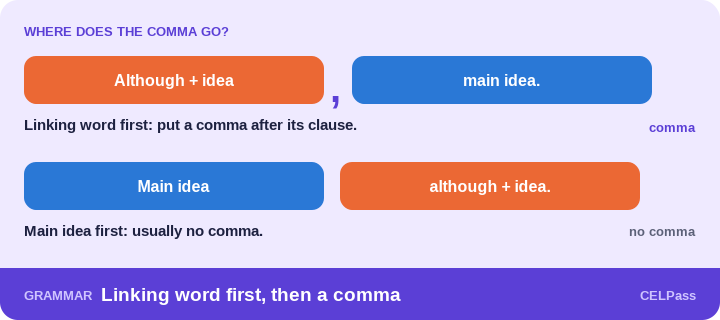
2Where the comma goes
Check yourself: choose one answer
Which sentence is punctuated correctly?
When the because clause comes first, put one comma at the end of it.
3Traps with these words
- Don't double up: "Although it rained, but we went" is wrong. Use although or but, not both.
- Unless already means "if not": "Unless you don't hurry" says the opposite of what you mean. Write "Unless you hurry …".
- No will after if, when, unless and as soon as about the future: "when the parts arrive", not "when the parts will arrive".
- Because + clause, because of + noun: because it snowed / because of the snow.
Check yourself: choose one answer
Which sentence is correct?
Although already shows the contrast, so you cannot add but as well.
Check yourself: choose one answer
Complete: "I'll text you as soon as I ___ home."
After time words like as soon as and when, use the present for a future event.
Key takeaways
- Because, since and as give reasons; although, while and whereas give contrasts; if, unless and as long as give conditions.
- Subordinate clause first: comma after it. Main clause first: usually no comma.
- Never although … but, and never unless … not.
- Present tense for the future after if, when, unless and as soon as.
Exercises
Type or choose your answers, then check them. The first ones start with a worked example; the last asks for your own sentences.
Choose the word that gives the right meaning: reason, contrast, condition, time or purpose.
I can cover your shift as long as I finish by six. (as long as / although)
- 2
___ the bus is slower, it is less stressful than driving.
- 3
Please call me ___ the parts arrive.
- 4
You won't get a campsite ___ you book early.
- 5
I left early ___ I could find parking.
- 6
___ the library is free, many families use it.
Put the verb in brackets in the right form. There is no will after if, when, unless, before or as soon as.
I'll send you the report when I finish (finish) it.
- 2If it (rain) tomorrow, we will move the picnic indoors.
- 3Unless the landlord (fix) the heater, we will call the city.
- 4As soon as the parts (arrive), the mechanic will call you.
- 5We'll start the meeting when everyone (be) here.
- 6Before you (leave), please lock the back door.
Correct the mistake in each sentence. One sentence is already correct.
Although the course is short, but it is very useful.
→ Although the course is short, it is very useful.
- 2
Unless you don't hurry, you will miss the bus.
- 3
I will call you when I will arrive.
- 4
The game was cancelled because the rain.
- 5
Even though it was late, we stayed to help.
- 6
Because of the store was closed, we went home.
A survey answer about a new bus route. Join each pair with the word in brackets.
I support the new route. It would connect my area to downtown. (because)
→ I support the new route because it would connect my area to downtown.
- 2
The route would be expensive. It would save many people time. (although, start with it)
- 3
The city adds more buses. The route will be crowded. (unless, start with it)
- 4
The route opens. I will stop driving to work. (as soon as, start with it)
- 5
Buses should run until midnight. Shift workers can use them. (so that)
Finish each sentence for a Writing Task 2 or Speaking Task 7 answer.
- 1
I would support a four-day work week as long as ...
- 2
Although online shopping is convenient, ...
- 3
Unless the city builds more housing, ...
- 4
I always plan my week on Sunday so that ...
Practise with free questions
Free questions in the CELPIP format, with answers and no account needed. Try a few now, while the lesson is fresh.
CELPass is an independent practice platform and is not affiliated with Paragon Testing Enterprises. CELPIP is a trademark of Paragon Testing Enterprises. Check the official CELPIP website and IRCC for current test rules and requirements.