Unit 2: Nouns, articles and pronouns · Lesson 2 of 38
Countable and Uncountable Nouns
- 4 min read
- 1 diagram
- 4 quizzes
- 5 exercises · 25 questions
By CELPass Editorial Team · Updated
Words like advice, information and equipment have no plural in English, and they come up in almost every CELPIP email and Speaking Task 1. Getting them right removes some of the most frequent small errors.

1Two kinds of noun
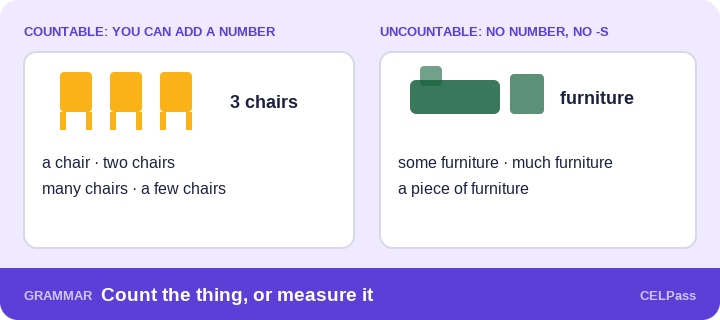
A countable noun is something you can count one by one: one appointment, two appointments. An uncountable noun is something you measure or treat as a whole: water, traffic, time. Uncountable nouns take a singular verb and never take a or an.
| Countable | Uncountable |
|---|---|
| a suggestion, two suggestions | advice (a piece of advice) |
| a fact, some facts | information |
| a tool, many tools | equipment |
| a job, several jobs | work |
| a bag, three bags | luggage, baggage |
| a dollar, ten dollars | money |
2The nouns that cause most errors
These are uncountable in English even if they are countable in your language: advice, information, equipment, furniture, homework, feedback, research, evidence, knowledge, news, traffic, luggage, software. Say "some advice", "a lot of feedback" or "a useful piece of information", never "an advice" or "informations".
News looks plural but is singular: "The news is good." People and police are the opposite: always plural. "The police are investigating."
Check yourself: choose one answer
Which sentence is correct?
Information is uncountable: no -s and no a or an. Use some, any or a piece of.
Check yourself: choose one answer
Your friend asks for help in Speaking Task 1. Which opening is correct?
Advice is uncountable, so to count it, use a piece of advice. You could also say "My first suggestion is…", because suggestion is countable.
3Much or many, few or little
| With countable (plural) | With uncountable | With both |
|---|---|---|
| many, a few, few, several, a number of | much, a little, little, an amount of | a lot of, some, any, plenty of, no |
| fewer complaints | less noise | more time, more buses |
In everyday writing, much sounds natural mainly in questions and negatives ("There isn't much space"). In positive sentences, a lot of is more natural: "There is a lot of space."
Check yourself: choose one answer
"Since the new bus route opened, there is ___ traffic on our street."
Traffic is uncountable, so it takes less. Fewer goes with plural countable nouns: fewer cars.
Check yourself: choose one answer
Which sentence is correct?
Furniture is uncountable, so it has no -s and takes a singular verb: is.
Key takeaways
- Uncountable nouns have no plural and no a or an: advice, information, equipment, furniture, feedback.
- Count them with a piece of, an item of, some, a lot of.
- Many and fewer go with plural nouns; much and less go with uncountable ones.
- News is singular; people and police are plural.
Exercises
Type or choose your answers, then check them. The first ones start with a worked example; the last asks for your own sentences.
Countable or uncountable? Write a or some.
Could you give me some advice about my lease? (a / some)
- 2I need information about the swimming classes. (a / some)
- 3She gave me useful suggestion. (a / some)
- 4We bought new furniture for the lobby. (a / some)
- 5I'm looking for part-time job. (a / some)
- 6The teacher gave us homework for the long weekend. (a / some)
Make the noun plural if it can be plural. If it can't, write it unchanged.
We need more chairs (chair) for the meeting room.
- 2Thank you for all the (information).
- 3The gym has some new (equipment).
- 4I have two (suggestion) for the committee.
- 5Several (resident) complained about the snow removal.
- 6My (luggage) was lost at the airport.
Choose the right word.
How many people came to the meeting? (much / many)
- 2
There is ___ traffic on Sundays.
- 3
We had ___ complaints this year than last year.
- 4
I don't have ___ time before work.
- 5
Only ___ students signed up for the evening class.
- 6
Could you add ___ milk to my coffee?
- 7
The news ___ good for local families.
An email from a community centre volunteer. Four lines have an error and one is correct. Write every line correctly.
We need some volunteers and some equipments for the fair.
→ We need some volunteers and some equipment for the fair.
- 2
Could you send me an information about the date?
- 3
We received many feedback after last year's event.
- 4
The furniture in the hall is old.
- 5
There were less people than we expected.
- 6
The police is going to close the street that day.
Give advice and describe things, as in Speaking Task 1. Use the word in brackets correctly.
- 1
Give a friend one tip about finding an apartment (advice).
- 2
Describe the equipment at your gym or workplace (equipment).
- 3
Say what a newcomer to your city needs to know (information).
- 4
Compare two neighbourhoods (fewer and less).
Practise with free questions
Free questions in the CELPIP format, with answers and no account needed. Try a few now, while the lesson is fresh.
CELPass is an independent practice platform and is not affiliated with Paragon Testing Enterprises. CELPIP is a trademark of Paragon Testing Enterprises. Check the official CELPIP website and IRCC for current test rules and requirements.