Unit 8: Clauses and sentences · Lesson 34 of 38
Noun Clauses and Indirect Questions
- 5 min read
- 1 diagram
- 3 quizzes
- 5 exercises · 24 questions
By CELPass Editorial Team · Updated
Polite requests in CELPIP emails often ask for information: "Could you tell me when the repairs will start?" Indirect questions like this use statement word order, and getting it right sounds both correct and courteous.

1What a noun clause is
A noun clause is a whole clause doing the job of a noun: "I think that the plan is fair", "What I need is more time", "I'm not sure whether the store is open". It starts with that, a question word (what, when, where, why, how, who) or if/whether.
| Start | Example |
|---|---|
| that | I believe (that) the library should open on Sundays. |
| what | What surprised me was the price. |
| how / why / when | Please explain why the payment was declined. |
| if / whether | I'd like to know whether the deposit is refundable. |
Check yourself: choose one answer
Complete the yes/no request: "Could you let me know ___ the class is still available?"
A yes/no question becomes whether (or if) inside a sentence.
2Indirect questions: statement order
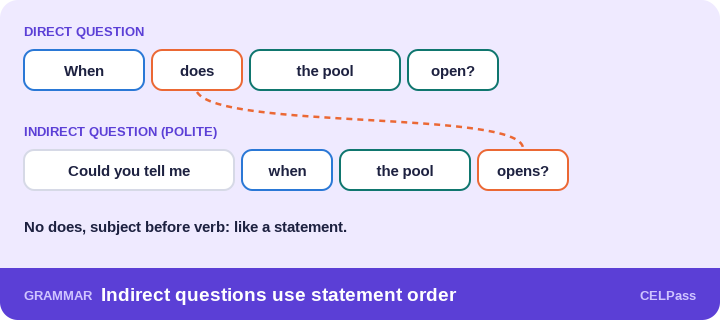
| Direct | Indirect (polite) |
|---|---|
| How much is the parking pass? | Could you tell me how much the parking pass is? |
| When did you send the cheque? | I'd like to know when you sent the cheque. |
| Is the room accessible? | Do you know if the room is accessible? |
Check yourself: choose one answer
Which polite question is correct?
After could you tell me, use statement order: subject (the office) then verb (is).
Check yourself: choose one answer
Which sentence is correct?
Drop did and use the past form, and end with a full stop because the whole sentence is a statement.
3Reported speech in Speaking stories
When you tell a story in Speaking Task 2, you often report what someone said. Move the tense one step back when the speaking happened in the past: "She said she was tired", "He asked if I had a key", "They told us the road was closed".
Key takeaways
- Noun clauses start with that, a question word, or if/whether.
- Indirect questions use statement order: subject, then verb, no do/does/did.
- Yes/no questions become if or whether.
- End with a question mark only if the main sentence is a question.
Exercises
Type or choose your answers, then check them. The first ones start with a worked example; the last asks for your own sentences.
Choose the word that starts the noun clause.
I'm not sure whether the store is open on holidays. (whether / that)
- 2
I believe ___ the library should open on Sundays.
- 3
___ surprised me most was the price.
- 4
Please tell me ___ I need to bring my own equipment.
- 5
Could you explain ___ the payment was declined?
- 6
I don't know ___ the meeting will start.
Complete each polite question in statement order: subject, then verb, with no do, does or did.
Where is the nearest pharmacy? → Could you tell me where the nearest pharmacy is?
- 2When does the pool open? → Could you tell me when ?
- 3How much is the parking pass? → Do you know how much ?
- 4Did you receive my cheque? → I'd like to know if .
- 5Why was the class cancelled? → Could you explain why ?
- 6How long will the repairs take? → Please let me know how long .
Choose the indirect question with the right word order.
Could you tell me what time the bus leaves? (what time the bus leaves / what time does the bus leave)
- 2
I'd like to know ___.
- 3
Do you know ___?
- 4
Can you tell me ___?
- 5
Please explain ___.
- 6
I'm not sure ___.
An email to a college. Turn each direct question into a polite one, starting with the words in brackets.
When does the fall term start? (Could you tell me …)
→ Could you tell me when the fall term starts?
- 2
Is the evening program still open? (I would like to know …)
- 3
How much does the textbook cost? (Could you let me know …)
- 4
Where should I send my transcripts? (Please tell me …)
- 5
Can I pay the fees in two parts? (I am wondering …)
- 6
Why did my application take so long? (Could you explain …)
Write polite questions or statements for a Writing Task 1 email. Use the opening in brackets.
- 1
Ask a landlord about a repair date. (Could you let me know when …)
- 2
Ask a store about a refund. (I would like to know whether …)
- 3
Say what you think about a new rule. (I believe that …)
- 4
Say what you need from your manager. (What I need is …)
Practise with free questions
Free questions in the CELPIP format, with answers and no account needed. Try a few now, while the lesson is fresh.
CELPass is an independent practice platform and is not affiliated with Paragon Testing Enterprises. CELPIP is a trademark of Paragon Testing Enterprises. Check the official CELPIP website and IRCC for current test rules and requirements.