Unit 3: Verbs and tenses · Lesson 12 of 38
Past Perfect and the Perfect Continuous
- 5 min read
- 2 diagrams
- 4 quizzes
- 5 exercises · 23 questions
By CELPass Editorial Team · Updated
Stories in Speaking Task 2 and complaint emails in Writing Task 1 often mention two past events. The past perfect shows which came first, and the perfect continuous shows how long a problem has lasted.

1The past perfect: the earlier past event
Form it with had + past participle: had called, had left, had finished. Use it only when you are already talking about the past and need to step further back.
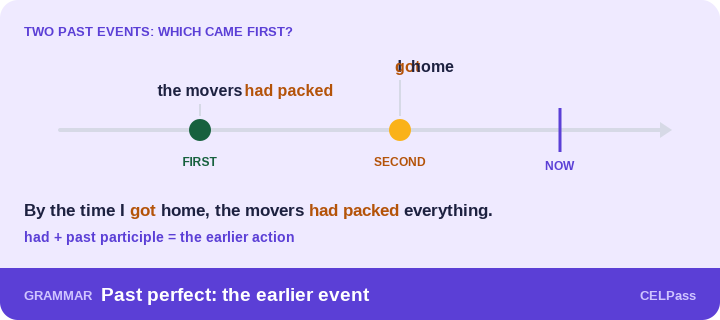
| Wrong | Right |
|---|---|
| When the manager arrived, the meeting already started. | When the manager arrived, the meeting had already started. |
| I realized I left my wallet at the café. | I realized I had left my wallet at the café. |
Check yourself: choose one answer
Choose the correct sentence.
The damage happened first, so it takes the past perfect; the later action, fixed, stays in the past simple.
2Don't overuse it
If events are told in the order they happened, the past simple is enough: "I booked a room, packed and drove to Banff." Words like before and after already show the order, so the past perfect is optional there.
Check yourself: choose one answer
Which sentence uses the past perfect where it is not needed?
The events are listed in order, so the past simple reads better: I woke up, showered and left.
3The perfect continuous: how long
Have/has been + -ing shows an activity that started in the past and is still going on, often with for or since. Had been + -ing does the same for a time in the past.
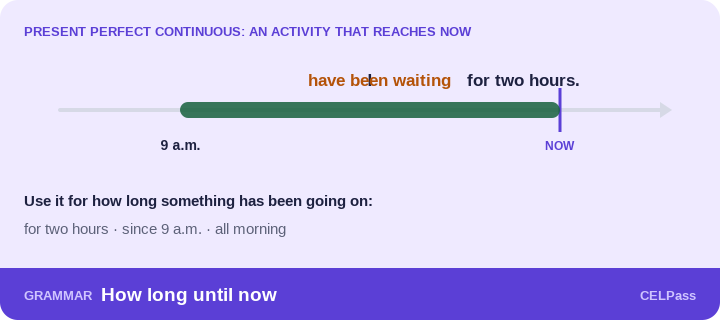
- "The tap has been dripping since Monday." (still dripping: good for a complaint email)
- "We had been living in Halifax for a year when I got the job." (a period before another past event)
- Verbs of state (know, own, believe) don't take -ing: "I have known him for years", not "have been knowing".
Check yourself: choose one answer
Complete the email: "The elevator ___ out of order for nine days."
Be is a state verb, so use the present perfect has been with for, not a continuous form.
Check yourself: choose one answer
Choose the best sentence for a complaint about noise that continues today.
The noise started in June and is still happening, so the present perfect continuous fits.
Key takeaways
- Had + past participle marks the earlier of two past events.
- If events are told in order, the past simple is enough.
- Have been + -ing with for or since shows how long something has been going on.
- State verbs like know, own and be don't take the continuous.
Exercises
Type or choose your answers, then check them. The first ones start with a worked example; the last asks for your own sentences.
Write the past perfect (had + past participle) of the verb in brackets.
When we arrived at the theatre, the show had started (start).
- 2I couldn't get into the building because I (forget) my key card.
- 3The last bus (leave) by the time I reached the stop.
- 4She (not / see) snow before she moved to Winnipeg.
- 5We (already / pay) the deposit when the landlord changed his mind.
- 6By the time the storm hit, the hardware store (sell) every snow shovel.
Join the two events in one sentence. Start with the words given and use the past perfect for the earlier event.
First the movie started. Then we got to the cinema. → When we got to the cinema, …
→ When we got to the cinema, the movie had already started.
- 2
First my phone battery died. Then I tried to call a taxi. → When I tried to call a taxi, …
- 3
First the clinic closed. Then I arrived. → By the time I arrived, …
- 4
First someone took my parking spot. Then I came home. → When I came home, …
- 5
First Tomas lived in Moncton for ten years. Then he moved to Toronto. → Before he moved to Toronto, …
Choose the past simple, the past perfect or a perfect continuous form.
The tap has been dripping since Monday, and it is still dripping. (dripped / has been dripping)
- 2
When I got to the station, the train ___, so I waited an hour for the next one.
- 3
I ___ at this company for six years, and I still enjoy it.
- 4
We ___ for 40 minutes when the bus finally came.
- 5
I ___ my neighbour for years, so I trust her.
- 6
Yesterday I ___ up at six, made breakfast and caught the early bus.
A story for Speaking Task 2. Put each verb into the past simple, the past perfect or the present perfect continuous.
Last winter I decided (decide) to try skating for the first time.
- 2I (never / be) on ice skates before that day.
- 3When we got to the rink, my friend Mei (already / rent) skates for both of us.
- 4I (fall) three times in the first ten minutes.
- 5By the end of the afternoon, I (learn) to stop without falling.
- 6Since then, I (go) skating almost every weekend.
Write about yourself, as in Speaking Task 2. Use the form in brackets.
- 1
Something that had already happened when you arrived somewhere (by the time / when + past perfect).
- 2
Something you had never done before you came to Canada (had never).
- 3
Something you have been doing for a long time (have been + -ing, for or since).
- 4
A problem that has been going on in your home or street (has been + -ing).
Practise with free questions
Free questions in the CELPIP format, with answers and no account needed. Try a few now, while the lesson is fresh.
CELPass is an independent practice platform and is not affiliated with Paragon Testing Enterprises. CELPIP is a trademark of Paragon Testing Enterprises. Check the official CELPIP website and IRCC for current test rules and requirements.