Unit 8: Clauses and sentences · Lesson 32 of 38
Sentence Parts and Word Order
- 4 min read
- 1 diagram
- 3 quizzes
- 5 exercises · 23 questions
By CELPass Editorial Team · Updated
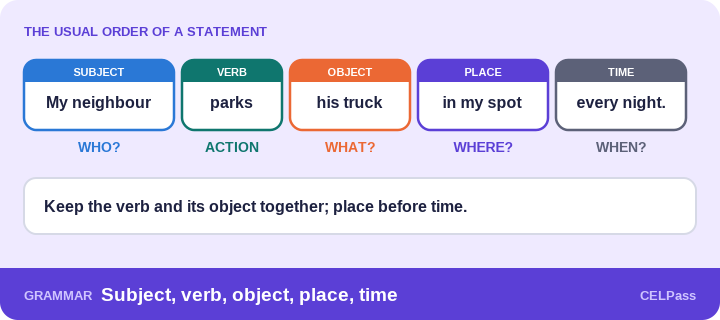
English depends on word order much more than many other languages. Putting the parts in the expected order lets a rater or listener follow you without effort, which is what Readability and Listenability measure.

1The parts
- Subject: who or what the sentence is about. Every sentence needs one, even if it is only it or there.
- Verb: the action or state (parks, is, has been waiting).
- Object: who or what receives the action (his truck). Some verbs have two: "I sent the landlord a photo."
- Complement: what describes the subject after be, seem or become ("The hallway is dark").
- Adverbials: how, where, when, why (carefully, in my spot, every night, because of the snow).
2Rules that catch learners
| Rule | Wrong | Right |
|---|---|---|
| Nothing between the verb and its object | I like very much this park. | I like this park very much. |
| Place before time | I'll meet you at noon at the café. | I'll meet you at the café at noon. |
| Every sentence needs a subject | Is very important to recycle. | It is very important to recycle. |
| There is / there are for new things | Have many parks in my city. | There are many parks in my city. |
Check yourself: choose one answer
Which sentence has the correct word order?
Keep the verb and its object together (speaks English), then add how (very well).
Check yourself: choose one answer
Choose the correct sentence for a survey response.
English sentences need a subject, so add it before is.
3Two objects and questions
With give, send, show, offer and lend you can say "send the manager the report" or "send the report to the manager". With explain, describe and suggest, only the to pattern works: "explain the problem to the manager", never "explain the manager the problem".
In questions, the helper verb comes before the subject: "When does the office open?", "Have you sent the form?" If there is no helper, add do, does or did.
Check yourself: choose one answer
Which sentence is correct?
Explain takes the thing first and the person after to: explain the policy to me.
Key takeaways
- Usual order: subject, verb, object, then place, then time.
- Never put an adverb between a verb and its object.
- Every sentence needs a subject: use it or there when nothing else fits.
- Explain, describe and suggest something to someone.
Exercises
Type or choose your answers, then check them. The first ones start with a worked example; the last asks for your own sentences.
Put the words in the usual order: subject, verb, object, then place, then time.
I / every morning / at the gym / work out
→ I work out at the gym every morning.
- 2
speaks / very well / French / my daughter
- 3
on Saturdays / at the farmers' market / we / vegetables / sell
- 4
the photos / I / the landlord / sent
- 5
is / it / to find parking downtown / not easy
- 6
carefully / the instructions / read / please
Choose the words that complete the sentence in the right order.
We enjoyed the concert a lot. (the concert a lot / a lot the concert)
- 2
Could you explain ___?
- 3
Please send ___ by Friday.
- 4
___ many good restaurants in my area.
- 5
___ very cold in our apartment at night.
- 6
He described ___ in detail.
Write the question that the answer replies to. Start with the word in brackets.
The office opens at 8 a.m. (When)
→ When does the office open?
- 2
I sent the form yesterday. (When)
- 3
The parking pass costs $60. (How much)
- 4
Maria works at the hospital. (Where)
- 5
Yes, I have finished the report. (Have)
An email to a neighbour. Correct the word order or add the missing subject. One sentence is already correct.
Is very noisy in my bedroom after midnight.
→ It is very noisy in my bedroom after midnight.
- 2
You play loudly music most nights.
- 3
I explained you the problem last month.
- 4
Have many families with small children in this building.
- 5
I start work at six every morning.
- 6
We could talk tomorrow evening about it.
Write about your home and your week, as in Speaking Task 1 or 2. Keep the usual order: subject, verb, object, place, time.
- 1
What you usually do on Saturday mornings.
- 2
Something someone sent or gave you recently. (send or give + two objects)
- 3
Something you had to explain to someone. (explain … to)
- 4
Something your city has a lot of. (There are)
Practise with free questions
Free questions in the CELPIP format, with answers and no account needed. Try a few now, while the lesson is fresh.
CELPass is an independent practice platform and is not affiliated with Paragon Testing Enterprises. CELPIP is a trademark of Paragon Testing Enterprises. Check the official CELPIP website and IRCC for current test rules and requirements.