Unit 4: Modals, voice and verb patterns · Lesson 15 of 38
The Passive Voice
- 5 min read
- 1 diagram
- 4 quizzes
- 5 exercises · 23 questions
By CELPass Editorial Team · Updated
The passive lets you focus on what happened rather than who did it, which is common in formal emails and survey answers. Used now and then, it adds variety; used everywhere, it makes writing vague.

1How the passive works
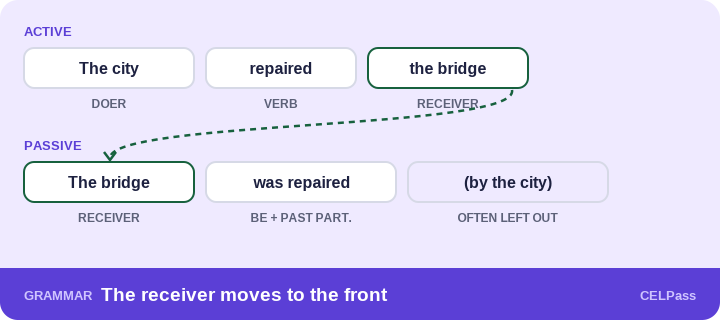
| Tense | Passive form |
|---|---|
| Present simple | The garbage is collected on Tuesdays. |
| Past simple | My package was delivered to the wrong address. |
| Present perfect | The pool has been closed for repairs. |
| Future / modal | The fee will be refunded. / Forms must be signed. |
| Continuous | The parking lot is being repainted. |
Check yourself: choose one answer
Make it passive: "Someone damaged my car in the parking lot."
The passive needs both a form of be (was) and the past participle (damaged).
2When the passive helps
- The doer is unknown: "My bike was stolen last night."
- The doer is obvious or unimportant: "The road will be closed on Sunday."
- You want a polite, less personal tone in a complaint: "I was charged twice" instead of "You charged me twice".
Check yourself: choose one answer
Which sentence is the most natural?
The doer isn't important, so a simple passive with no by-phrase is best.
3Have something done, and formal passives
When you pay or ask someone else to do a job for you, use have + object + past participle: "I had the furnace checked last fall." "We're having the roof repaired next week." In speaking, get works the same way: "I need to get my hair cut." The same pattern describes something bad that happened to you: "I had my bike stolen from the rack."
| You did it yourself | Someone did it for you |
|---|---|
| I cleaned the carpets. | I had the carpets cleaned. |
| I'm going to paint the fence. | I'm going to have the fence painted. |
| She fixed her phone screen. | She got her phone screen fixed. |
Formal emails and survey answers often report what people say or expect without naming them: "It is expected that rents will rise" or "Rents are expected to rise." Other verbs work the same way: it is said, believed, reported, hoped. Use them now and then for a neutral, formal tone.
Check yourself: choose one answer
You paid a mechanic to put on your winter tires. Which sentence says that?
Have + object + past participle shows that someone else did the job; "I had put on" is the past perfect and means you did it yourself.
4Common passive errors
| Wrong | Right |
|---|---|
| The meeting was cancel. | The meeting was cancelled. |
| The accident was happened at 6 p.m. | The accident happened at 6 p.m. |
| The rent is pay on the first. | The rent is paid on the first. |
Verbs with no object, such as happen, arrive, die and seem, have no passive. Keep most of your sentences active and use the passive only where the receiver matters more.
Check yourself: choose one answer
Which sentence is correct?
Arrive has no object, so it cannot be passive.
Key takeaways
- Passive = be in the right tense + past participle.
- Use it when the doer is unknown, obvious or best left unnamed.
- Happen, arrive and seem cannot be passive.
- Have + object + past participle when someone else does a job for you: I had the furnace checked.
- Keep most sentences active; the passive is for variety and focus.
Exercises
Type or choose your answers, then check them. The first ones start with a worked example; the last asks for your own sentences.
Write the verb in brackets in the passive, in the tense shown.
The garbage is collected (collect, present simple) every Tuesday.
- 2My package (deliver, past simple) to the wrong address.
- 3The pool (close, present perfect) for repairs since June.
- 4The results (announce, will) on Monday.
- 5The parking lot (repaint, present continuous) this week.
- 6All permission forms (must / sign) by a parent.
Rewrite each sentence in the passive. Leave out the doer.
Someone stole my bike last night.
→ My bike was stolen last night.
- 2
They are building a new school near my house.
- 3
The city has cancelled the fireworks.
- 4
They will send the test results by email.
- 5
Somebody charged me twice for the same order.
Choose the correct form.
The accident happened at 6 p.m. (happened / was happened)
- 2
My flight ___ two hours late.
- 3
The meeting ___ because the manager was sick.
- 4
I paid a mechanic, so I ___ my brakes fixed.
- 5
The new bridge ___ to open next spring.
- 6
It ___ that the storm will reach Halifax tonight.
An email to an insurance company. Use the passive, or have + object + past participle where shown.
On March 3, my car was damaged (damage) in the mall parking lot.
- 2The back door (scratch) and the side mirror was broken.
- 3The next day I (have / the mirror / replace) at a garage on Main Street.
- 4Next week I am going to (have / the door / repaint).
- 5Both receipts (attach) to this email.
- 6I believe the repair costs (cover) by my policy.
Write your own sentences for emails and survey answers.
- 1
Something you have had done recently (have + object + past participle).
- 2
Something in your city that is being built or changed right now.
- 3
A complaint that uses the passive so you don't sound like you are blaming someone.
- 4
A survey answer with is expected to.
Practise with free questions
Free questions in the CELPIP format, with answers and no account needed. Try a few now, while the lesson is fresh.
CELPass is an independent practice platform and is not affiliated with Paragon Testing Enterprises. CELPIP is a trademark of Paragon Testing Enterprises. Check the official CELPIP website and IRCC for current test rules and requirements.