Unit 8: Clauses and sentences · Lesson 33 of 38
Relative Clauses: Who, Which and That
- 5 min read
- 1 diagram
- 3 quizzes
- 5 exercises · 24 questions
By CELPass Editorial Team · Updated
Relative clauses let you add detail without starting a new sentence: "the neighbour who lives above me", "the park, which opened last year". Used well, they are one of the clearest signs of a higher level in Writing and Speaking.
1Which word?
| Word | Use for | Example |
|---|---|---|
| who | people | The volunteer who organized the event deserves an award. |
| which | things, animals, ideas | The bus, which comes every ten minutes, is always full. |
| that | people or things (no commas) | The form that you sent was missing a page. |
| whose | possession | A coworker whose car broke down needs a ride. |
| where | places | This is the café where we first met. |
| when | times | I remember the winter when the power went out for days. |
Check yourself: choose one answer
Complete: "I am writing about the parcel ___ was delivered to the wrong address."
A parcel is a thing, so use which (or that).
2Commas: defining or extra?
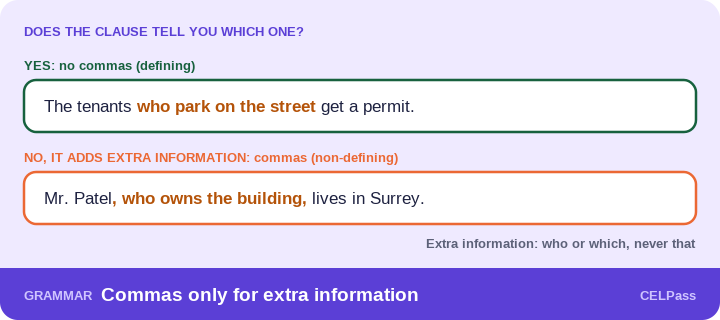
Ask yourself: if I remove the clause, do we still know which one I mean? If yes, the clause is extra information and needs commas on both sides. That never starts a clause with commas.
Check yourself: choose one answer
Which sentence is punctuated correctly?
If you have one sister, the clause adds extra information, so it needs a comma on both sides, and that cannot be used.
3Common slips
- Don't repeat the object: "the jacket that I bought it" → "the jacket that I bought".
- You may drop who, which or that when it is the object: "the jacket (that) I bought". Not when it is the subject: "the man who called".
- The verb agrees with the noun before who or which: "residents who have pets", "a resident who has a pet".
Check yourself: choose one answer
Which sentence is correct?
Don't repeat the object with it, and use which or that (or nothing) for a thing, never who.
Key takeaways
- Who for people, which for things, that for either (no commas), whose for possession, where for places.
- Commas on both sides when the clause adds extra information; never with that.
- Don't repeat the object inside the clause.
- The verb in the clause agrees with the noun it describes.
Exercises
Type or choose your answers, then check them. The first ones start with a worked example; the last asks for your own sentences.
Choose who, which, whose or where.
This is the café where we first met. (where / which)
- 2
The man ___ lives next door is a firefighter.
- 3
I lost the umbrella ___ my sister gave me.
- 4
We need a volunteer ___ car can carry six people.
- 5
Jasper is the town ___ we spent our first holiday in Canada.
- 6
The report, ___ is due on Friday, needs two more pages.
Join the two sentences with who, which, that, whose or where. Add commas only for extra information.
I called the plumber. He fixed our sink last year.
→ I called the plumber who fixed our sink last year.
- 2
We bought a sofa. It was on sale.
- 3
I met a nurse. Her son goes to my daughter's school.
- 4
This is the rink. My kids learned to skate there.
- 5
Ms. Chen owns the bakery on our corner. She is very kind.
- 6
The jacket was too small. I ordered it online.
The commas have been left out. Does the clause add extra information, so it needs commas, or does it tell you which one, so it needs none?
My mother who lives in Victoria visits us every summer.
→ Commas needed
- 2
Students who arrive late must sign in at the office.
- 3
Lake Louise which is in Banff National Park is always busy in July.
- 4
The form that you sent was missing a page.
- 5
My grandmother who is 92 still walks to the market every day.
- 6
The apartments that face the street are noisier.
An email to a hiring manager. Each sentence has one mistake in its relative clause, except one. Write each sentence correctly.
I am the applicant which called you on Monday.
→ I am the applicant who called you on Monday.
- 2
The job that I saw it on your website interests me a lot.
- 3
My last manager, that trained me for two years, can give a reference.
- 4
I worked at a store where sells outdoor equipment.
- 5
Customers who was unhappy with a product often asked for me.
- 6
I have attached a letter that explains my experience.
Finish each sentence with a relative clause, as in a Speaking Task 2 story or a Writing Task 1 email.
- 1
The best teacher I ever had was someone who ...
- 2
I still remember the day when ...
- 3
My favourite place in my city is a park where ...
- 4
I am writing about the blender which ...
Practise with free questions
Free questions in the CELPIP format, with answers and no account needed. Try a few now, while the lesson is fresh.
CELPass is an independent practice platform and is not affiliated with Paragon Testing Enterprises. CELPIP is a trademark of Paragon Testing Enterprises. Check the official CELPIP website and IRCC for current test rules and requirements.