Unit 5: Describing words and prepositions · Lesson 24 of 38
Prepositions of Time and Place
- 6 min read
- 2 diagrams
- 4 quizzes
- 5 exercises · 28 questions
By CELPass Editorial Team · Updated
Every email to a landlord, manager or neighbour has a time and a place in it. Small slips like "on the morning" or "in 7 p.m." are easy to fix and stand out to a rater when you leave them.
1Big to exact
Think of in, on and at as three sizes. In is for the largest units of time and space, on is for a day or a surface, and at is for one exact point.
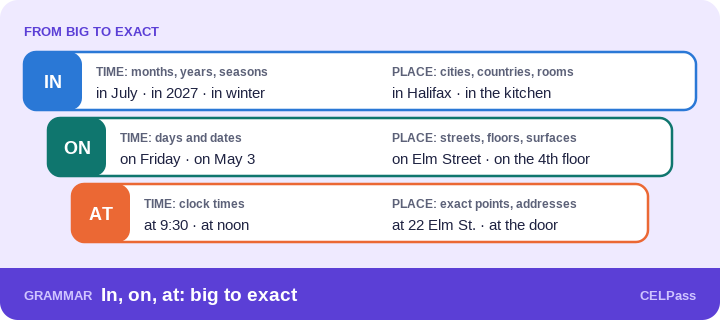
| Time | Place | |
|---|---|---|
| in | in March, in 2026, in the summer, in the evening | in Winnipeg, in Canada, in the lobby, in my car |
| on | on Monday, on June 12, on Canada Day, on my birthday | on Main Street, on the third floor, on the bus |
| at | at 6:45, at lunchtime, at the end of the month | at 140 Queen Street, at the front desk, at work |
Check yourself: choose one answer
Choose the correct sentence for your email to the building manager.
A day takes on (on Thursday), and a part of the day takes in (in the afternoon).
2The exceptions people miss
- at night, at the weekend (British) but on the weekend (Canadian): use on the weekend on CELPIP.
- in the morning, but on Monday morning: once a day is named, use on.
- No preposition before this, next, last, every, today, tomorrow or yesterday: "I'll call you next Tuesday", not "on next Tuesday".
- Transport: in a car or a taxi (you sit inside), on a bus, a train or a plane (you can stand and walk).
- Arrive in a city or country, arrive at a building. Never "arrive to".
Check yourself: choose one answer
Which sentence is correct?
Next, last, this and every replace the preposition, so no in, on or at is needed.
Check yourself: choose one answer
Complete: "My flight lands ___ Toronto ___ 9 p.m."
A city takes in, and a clock time takes at.
3By, until, for or since?
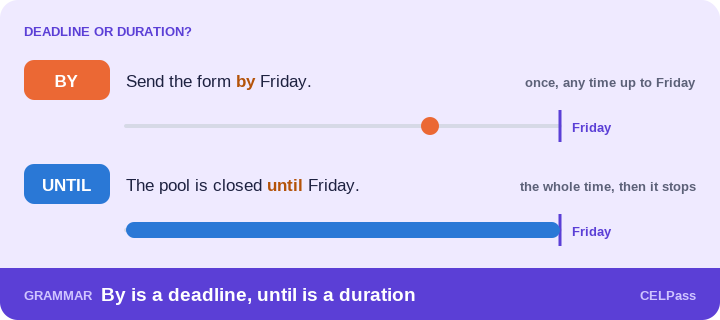
Deadlines come up in almost every Writing Task 1 email. By means "no later than": the action happens once, at some point before the time. Until means "all the time up to": the situation continues and then stops.
| Sentence | Meaning |
|---|---|
| Please send the form by Friday. | Any time before or on Friday. |
| The pool is closed until Friday. | Closed every day, then open on Friday. |
| I have lived here for three years. | For + a length of time. |
| I have lived here since 2023. | Since + the starting point. |
4During, while, by the time, on time and in time
Three more pairs cause most of the remaining time errors. During and while both mean "in the time that something happens", but during goes before a noun and while before a subject and a verb. By the time starts a clause and works like by: the other action is already finished at that point.
| Pair | Use | Example |
|---|---|---|
| during / while | during + noun; while + subject and verb | The power went out during the storm. / The power went out while we were cooking. |
| for / during | for: how long; during: when | I stayed in Kelowna for two weeks during the summer. |
| by the time | by the time + clause: the other action is already done | By the time the plumber arrived, the kitchen floor was wet. |
| on time / in time | on time: at the planned time; in time: early enough for something | The train left on time. / We got to the station in time to buy a coffee. |
Check yourself: choose one answer
Complete: "My phone rang three times ___ the job interview."
The job interview is a noun, so use during. While needs a subject and a verb: while I was in the interview.
Key takeaways
- In for months, years, cities and rooms; on for days, dates and streets; at for clock times and exact places.
- No preposition before next, last, this, every, today or tomorrow.
- By is a deadline; until is a situation that continues and then stops.
- For a length of time, since a starting point.
- During + noun, while + subject and verb; on time is as planned, in time is early enough.
Exercises
Type or choose your answers, then check them. The first ones start with a worked example; the last asks for your own sentences.
Complete with in, on or at.
Our lease ends in June.
- 2My cousin was born 1998.
- 3The meeting starts 7:30 sharp.
- 4Our apartment is the fifth floor.
- 5I'll be Vancouver for a conference next week.
- 6We're meeting the main entrance at noon.
- 7The clinic is closed Canada Day.
Choose the right option. Sometimes no preposition is needed.
I'll call you no word next Tuesday. (on / no word)
- 2
She called me ___ yesterday afternoon.
- 3
We moved here ___ last spring.
- 4
My sister arrives ___ Calgary tonight.
- 5
I read a book ___ the bus every morning.
- 6
I study best ___ night, when the house is quiet.
- 7
The gym is busy ___ every evening after six.
Choose the word that fits the meaning: by or until, during, while or for, on time or in time.
Please return the signed lease by Friday. (by / until)
- 2
The library is closed for renovations ___ March 3.
- 3
I fell asleep ___ the movie.
- 4
Someone took my bike ___ I was at work.
- 5
We lived in Moncton ___ six years.
- 6
The bus was late, but I still got to the office ___ for the meeting.
- 7
Trains on this line almost always leave ___.
An email to a community centre. Fill each gap with one preposition, or with by the time.
I signed my daughter up for swimming lessons in January.
- 2The lessons take place Saturday mornings at the main pool.
- 3Last week the class started late, 10:20 instead of 10:00.
- 4the instructor arrived, most parents had already left.
- 5My daughter waited alone forty minutes.
- 6Could you reply Friday so that I can plan next week?
- 7Please also tell me if the pool will be closed the winter break.
Answer in one sentence each, as in a Writing Task 1 email or Speaking Task 2. Use the word in brackets.
- 1
When do you usually do your grocery shopping? (on or at)
- 2
Ask a landlord to fix something before a deadline. (by)
- 3
Describe something that happened while you were busy with something else. (while)
- 4
Explain how you arrived for an appointment or a flight. (in time or on time)
Practise with free questions
Free questions in the CELPIP format, with answers and no account needed. Try a few now, while the lesson is fresh.
CELPass is an independent practice platform and is not affiliated with Paragon Testing Enterprises. CELPIP is a trademark of Paragon Testing Enterprises. Check the official CELPIP website and IRCC for current test rules and requirements.