Unit 4: Modals, voice and verb patterns · Lesson 16 of 38
Conditionals, Commands and the Subjunctive
- 4 min read
- 1 diagram
- 3 quizzes
- 5 exercises · 23 questions
By CELPass Editorial Team · Updated
Speaking Task 8 asks what you would do in an unusual situation, and survey answers weigh what would happen under each option. Conditionals let you reason about results clearly.

1Real and unreal conditions
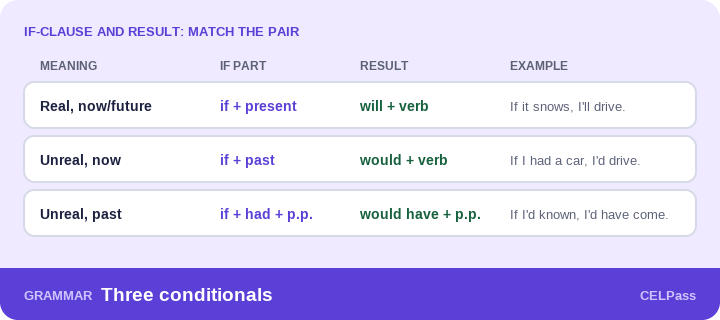
Never put will or would in the if-part. The comma goes after the if-part when it comes first: "If the city builds a pool, families will use it."
Check yourself: choose one answer
Survey answer: "If the city ___ a new community centre, teenagers would have somewhere to go."
The result uses would, so this is an unreal (imagined) condition: if + past simple.
Check yourself: choose one answer
Choose the correct sentence about the past.
An unreal past condition takes if + had + past participle, with would have in the result.
2Commands (the imperative)
The imperative is the base verb with no subject: "Bring a warm jacket." "Don't forget your ID." It is fine for friends and instructions, but in a formal email soften it: "Please let me know…" or "Could you…?"
Check yourself: choose one answer
Which is the correct negative command?
Negative imperatives use don't + base verb.
3The subjunctive after suggest and recommend
After suggest, recommend, insist and it is important that, formal English uses the base verb for every subject: "I recommend that he apply early", "It is essential that she be on time." A safe alternative is should: "I suggest that he should apply early."
| Wrong | Right |
|---|---|
| I suggest him to take the bus. | I suggest that he take the bus. / I suggest taking the bus. |
| If I was the manager, I would hire more staff. | If I were the manager, I would hire more staff. (were is preferred in writing) |
Key takeaways
- If + present → will; if + past → would; if + had + past participle → would have.
- No will or would in the if-part.
- Soften commands in formal emails with please or could you.
- After suggest or recommend: that + subject + base verb, or suggest + -ing.
Exercises
Type or choose your answers, then check them. The first ones start with a worked example; the last asks for your own sentences.
Real conditions: write the verb in brackets in the present simple or with will.
If it snows (snow) tonight, I'll take the bus tomorrow.
- 2If you (book) early, you will get a better price.
- 3The picnic will move indoors if it (rain).
- 4If the city builds a dog park, more people (use) it.
- 5If I (not / hear) from you by Friday, I will call your office.
- 6We (miss) the bus if we don't leave now.
Unreal conditions. Finish each sentence about the situation.
I don't have a car, so I can't drive to work. → If I had a car, …
→ If I had a car, I could drive to work.
- 2
The library is closed on Sundays, so I can't study there. → If the library were open on Sundays, …
- 3
I didn't see the sign, so I parked in the wrong place. → If I had seen the sign, …
- 4
We didn't know about the sale, so we paid full price. → If we had known about the sale, …
- 5
My apartment is too small to have friends over. → If my apartment were bigger, …
Choose the correct form.
If I were the manager, I would hire more staff. (were / will be)
- 2
If the city ___ a new pool, families would use it all summer.
- 3
If I had known about the meeting, I ___.
- 4
I recommend that she ___ a doctor about her back.
- 5
___ forget to bring your health card.
- 6
If you ___ any questions, please call me.
A survey answer about an empty lot. Write each verb in the correct form.
If the city turned (turn) the empty lot into a park, children would have a safe place to play.
- 2If that (happen), parents would not need to drive to the next neighbourhood.
- 3Last year the council chose a parking lot instead. If they (choose) the park, we would already have one.
- 4I strongly recommend that the council (approve) the park this time.
- 5If the council (approve) the plan this spring, the park will be ready next summer.
- 6(not / let) this chance pass us by again.
Write your own sentences, as in Speaking Task 8 and survey answers.
- 1
What would you do if you found a wallet on the bus?
- 2
What would you change if you were the mayor of your city?
- 3
Something you would have done differently in the past (if + had + past participle).
- 4
A recommendation for a friend, with suggest or recommend that.
Practise with free questions
Free questions in the CELPIP format, with answers and no account needed. Try a few now, while the lesson is fresh.
CELPass is an independent practice platform and is not affiliated with Paragon Testing Enterprises. CELPIP is a trademark of Paragon Testing Enterprises. Check the official CELPIP website and IRCC for current test rules and requirements.