Unit 6: Linking ideas · Lesson 26 of 38
And, But, So: Joining Sentences Without Run-ons
- 5 min read
- 1 diagram
- 3 quizzes
- 5 exercises · 23 questions
By CELPass Editorial Team · Updated
A comma between two complete sentences, with nothing else, is the most common sentence error in CELPIP Writing. It makes an answer look rushed. The fix takes one word or one full stop.
1The joining words
Seven short words can join two complete sentences: for, and, nor, but, or, yet, so. In CELPIP answers you will mostly need and (adds), but and yet (contrast), so (result) and or (choice).
| Word | Meaning | Example |
|---|---|---|
| and | adds a similar idea | The gym is close, and it opens early. |
| but | contrast | The gym is close, but it is expensive. |
| yet | surprising contrast | The gym is expensive, yet it is always full. |
| so | result | The gym opens early, so I can go before work. |
| or | choice | We could meet at the library, or you could come to my place. |
Check yourself: choose one answer
Choose the word that shows a result: "The elevator was broken, ___ we carried the sofa up the stairs."
So introduces a result: because the elevator was broken, they used the stairs.
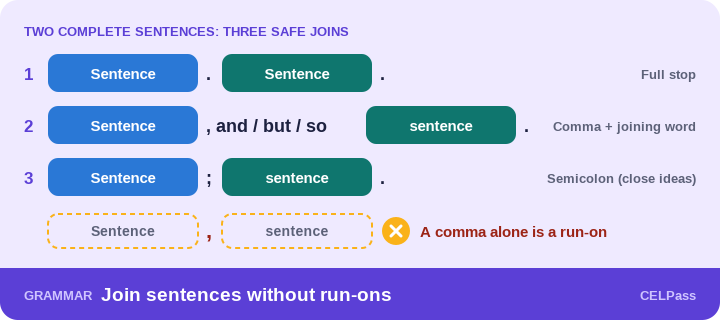
2Three safe ways to join, and one unsafe one
| Problem | Wrong | Fixed |
|---|---|---|
| Comma splice | My shift ends at six, I can meet you after that. | My shift ends at six, so I can meet you after that. |
| Run-on (no punctuation) | The heater is old it makes a loud noise at night. | The heater is old. It makes a loud noise at night. |
| Fragment | Because the parking lot is full. I take the bus. | Because the parking lot is full, I take the bus. |
Check yourself: choose one answer
Which sentence is punctuated correctly?
Two complete sentences need a comma plus a joining word (or a full stop). The comma goes before and, not after it.
3When there is no comma
Use the comma only when both sides are complete sentences with their own subject. If the second part shares the subject, leave the comma out: "I called the office and left a message."
Check yourself: choose one answer
In which sentence does and join two verbs with the same subject, so no comma is used?
In the first sentence, we does both actions (cleaned … and planted), so there is no second subject and no comma. The others join two complete sentences, each with its own subject; a comma before and is usual there, though short ones can skip it.
In Speaking, the danger is the opposite: one endless sentence joined with and … and … and. Stop, finish the sentence, and start a new one with a clear linking word.
Key takeaways
- Two complete sentences: full stop, comma + and/but/so/or/yet, or a semicolon.
- Never join two complete sentences with a comma alone.
- No comma when the second part shares the subject.
- In Speaking, avoid long chains of and; finish one idea, then start the next.
Exercises
Type or choose your answers, then check them. The first ones start with a worked example; the last asks for your own sentences.
Choose the joining word that fits the meaning.
The café is close to my office, but it is too expensive for every day. (and / but)
- 2
It was snowing heavily, ___ the school closed early.
- 3
You can pay by card, ___ you can pay in cash at the front desk.
- 4
The apartment is small, ___ it has a big balcony.
- 5
The tickets were expensive, ___ the concert sold out in an hour.
- 6
I cleaned the kitchen, ___ my partner did the laundry.
Is each sentence correct, a comma splice (two sentences joined by a comma alone) or a run-on (two sentences with nothing between them)?
My shift ends at six, I can meet you after that.
→ Comma splice
- 2
The heater is old it makes a loud noise at night.
- 3
We cleaned the yard and planted two trees.
- 4
The gym is close, but it is expensive.
- 5
I missed the bus, I was late for my interview.
- 6
Prices went up last year they will probably go up again.
Join the two sentences into one with the word in brackets. Put a comma before it.
The meeting room is too small. We need a bigger space. (so)
→ The meeting room is too small, so we need a bigger space.
- 2
The trail was muddy. We finished the hike. (but)
- 3
You can take the train. You can share a ride with me. (or)
- 4
The library is quiet. I study there every evening. (so)
- 5
The rent is high. The location is perfect. (yet)
- 6
The parking lot is full. I take the bus. (so)
Part of a Writing Task 2 answer about a new community pool. Each sentence is a comma splice or a run-on. Rewrite it with and, but, so or or.
The new pool is closer to my home, I prefer it.
→ The new pool is closer to my home, so I prefer it.
- 2
The old pool is cheaper it is always crowded.
- 3
The new pool has a hot tub, it has a large sauna.
- 4
My children love swimming, they would use it every week.
- 5
We could buy a family pass, we could pay for each visit.
Write two-part sentences for a Speaking Task 5 or Writing Task 2 answer. Use the word in brackets, with a comma before it.
- 1
Compare two places to live. (but)
- 2
Give the result of a fact about your home. (so)
- 3
Offer a friend two options. (or)
- 4
Add a second benefit of a habit. (and)
Practise with free questions
Free questions in the CELPIP format, with answers and no account needed. Try a few now, while the lesson is fresh.
CELPass is an independent practice platform and is not affiliated with Paragon Testing Enterprises. CELPIP is a trademark of Paragon Testing Enterprises. Check the official CELPIP website and IRCC for current test rules and requirements.