Unit 1: Getting started · Lesson 1 of 38
How Grammar Is Scored in CELPIP
- 6 min read
- 1 diagram
- 3 quizzes
- 5 exercises · 24 questions
By CELPass Editorial Team · Updated
CELPIP has no grammar section, but grammar runs through two of the four skills. Raters judge whether your writing is easy to read and your speech easy to follow, and grammar errors are the most common reason it is not.
1Where grammar counts
| Skill | Dimension | What the rater asks |
|---|---|---|
| Writing | Readability | Can I read this without stopping to work out what the writer meant? |
| Speaking | Listenability | Can I follow this without effort, or do errors and restarts slow me down? |
| Both | Vocabulary and Content | Are the ideas joined clearly? Linking words and clauses are grammar too. |
Listening and Reading do not mark your grammar, but knowing how sentences are built helps you see who did what, which event came first, and whether a sentence says not or only. Those details decide many answers.
2Errors that block meaning, and small slips
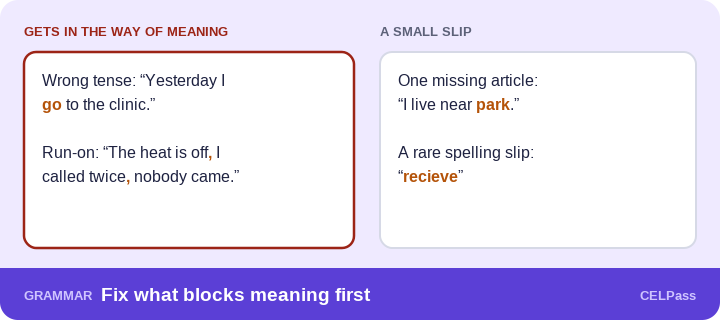
Raters do not count errors one by one. They notice how much the errors get in the way. A wrong tense can change when something happened, and a run-on sentence makes the reader go back and split it. A missing article in a clear sentence is noticed but rarely changes the meaning.
- Most costly: wrong tense, sentences with no clear end, a verb that doesn't match its subject, a missing verb.
- Costly when frequent: articles, plural -s, prepositions, word order in questions.
- Small alone: one spelling slip or one missing comma in an otherwise clear text.
Check yourself: choose one answer
Which error is most likely to confuse a rater?
Complain and changes are present tense in a story about last month, so the reader cannot tell what happened when. The other two are small slips in clear sentences.
3Accuracy and range go together
Short, correct sentences are safe but plain, and plain writing does not reach the top levels. Raters reward a mix: simple sentences for key points, plus longer ones with because, although, which or if. The aim is control: use the longer structures you can get right, and practise the ones you can't yet.
Check yourself: choose one answer
A learner writes only short, correct sentences like "I like the park. It is big. It is green." What would most improve the grammar side of the score?
Joining ideas with because, which or although shows range. More of the same sentences adds length but not variety.
Check yourself: choose one answer
In Speaking, you start a sentence with the wrong tense. What is the best thing to do?
One quick correction shows control. Restarting or correcting everything breaks your fluency, which hurts Listenability more than the original slip.
4How to use this course
- Read lessons 1 to 10 in order if tenses and agreement feel shaky. Otherwise start with the lesson for your most common error.
- Answer each quick question before you press Check.
- Do the exercise on paper, then compare with the answers.
- Write or say one timed CELPIP answer that uses the lesson's grammar, then check that point only.
- Use the final lesson's checklist in the last minutes of every Writing task.
Key takeaways
- Grammar is judged in Writing (Readability) and Speaking (Listenability).
- Errors that change or hide the meaning cost the most: tense, run-ons, agreement, missing verbs.
- Range matters too: mix simple sentences with longer, correct ones.
- In Speaking, correct once and move on.
Exercises
Type or choose your answers, then check them. The first ones start with a worked example; the last asks for your own sentences.
Does the error get in the way of the meaning, or is it a small slip?
I am writing about the noise from apartment upstairs.
→ small slip
- 2
I live in building on Elm Street.
- 3
The rent went up I can't afford it I need to move.
- 4
Last month I complain to the manager, but nothing changes.
- 5
Thank you for you help.
- 6
My neighbour very noisy every night.
- 7
The clinic is open untill 8 p.m.
Each sentence has an error that gets in the way of the meaning. Write it correctly.
Yesterday the elevator stop working and I wait for one hour.
→ Yesterday the elevator stopped working and I waited for an hour.
- 2
Last winter the pipes freeze and the water stop.
- 3
My manager she always change the schedule.
- 4
The new bus route very useful for students.
- 5
When I arrive in Canada in 2019, I don't speak English well.
- 6
The heat is off I called twice nobody came.
Choose the sentence that is correct and also shows range.
A survey answer about two parks: (a) "I like Park A. It is big." (b) "I like Park A because it is bigger."
→ (b)
- 2
A reason in a survey answer:
- 3
Describing the library:
- 4
Admitting the other side:
- 5
Talking about a result:
An email to a property manager. Four lines have an error and one is correct. Write every line correctly.
Dear Ms. Lee, I am writing to complain about noise from apartment above me.
→ Dear Ms. Lee, I am writing to complain about noise from the apartment above me.
- 2
Every night the music start at midnight.
- 3
Last Friday I knock on their door, but nobody answer.
- 4
My children can't sleep, they are tired at school.
- 5
Could you remind the tenants of the quiet hours?
- 6
I am looking forward to hear from you.
Write about a plan for your city, as in a Writing Task 2 survey answer. One sentence of each kind.
- 1
A short, simple sentence that gives your choice.
- 2
A longer sentence with because that gives a reason.
- 3
A sentence with although that admits the other side.
- 4
A sentence with if about a result.
Practise with free questions
Free questions in the CELPIP format, with answers and no account needed. Try a few now, while the lesson is fresh.
CELPass is an independent practice platform and is not affiliated with Paragon Testing Enterprises. CELPIP is a trademark of Paragon Testing Enterprises. Check the official CELPIP website and IRCC for current test rules and requirements.