Unit 3: Verbs and tenses · Lesson 8 of 38
Subject–Verb Agreement
- 4 min read
- 1 diagram
- 4 quizzes
- 5 exercises · 24 questions
By CELPass Editorial Team · Updated
A verb that doesn't match its subject is one of the errors raters notice most, because it makes the reader check who the sentence is about. Most agreement errors come from long subjects and from forgetting the -s.

1The basic rule
In the present tense, a singular subject (he, she, it, one person or thing) takes a verb with -s; a plural subject does not: "The bus leaves at 8." "The buses leave every ten minutes." Be and have change form: is/are, was/were, has/have.
In Speaking, the -s on he/she/it verbs is easy to drop when you speak fast. "My friend work downtown" is heard immediately. Slow down slightly on verbs after he, she and a person's name.
Check yourself: choose one answer
"My sister ___ in Halifax and ___ two kids."
My sister is one person, so both verbs need the singular form: lives, has.
2Find the real subject
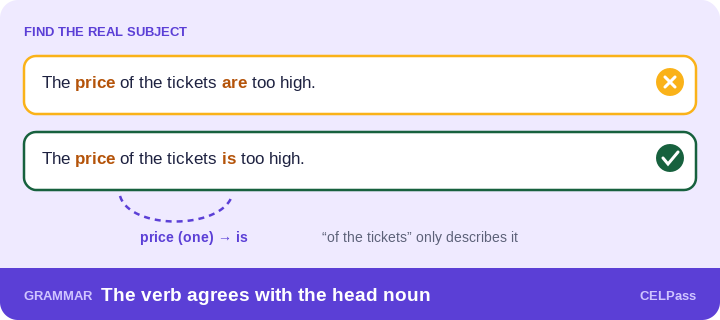
When a phrase comes between the subject and the verb, the verb still agrees with the main noun. Cross out the phrase starting with of, in, with or for, and look at what is left.
| Wrong | Right | Real subject |
|---|---|---|
| "The list of repairs are long." | "The list of repairs is long." | list |
| "The tenants in unit 4 complains often." | "The tenants in unit 4 complain often." | tenants |
| "One of the windows don't close." | "One of the windows doesn't close." | one |
Check yourself: choose one answer
"The number of cars on our street ___ doubled."
The subject is the number (one number), so has. Compare "A number of residents have complained", where a number of means many.
3There is, there are
After there, the verb agrees with the noun that follows: "There is a problem." "There are two problems." In speech, "there's" with a plural is common, but in writing use there are.
Check yourself: choose one answer
"In my neighbourhood, there ___ not enough places for children to play."
The noun after the verb is places (plural), so there are.
4Tricky subjects
- Two subjects joined by and are plural: "My wife and my son are…"
- Each, every, everyone, nobody are singular: "Every room has a window."
- Uncountable nouns are singular: "The information is on the website."
- A gerund subject is singular: "Taking the bus saves money."
- Amounts as one quantity are singular: "Two hundred dollars is too much for a deposit."
Check yourself: choose one answer
Survey answer: "Living close to work ___ me a lot of time."
The subject is the activity living close to work, which is singular, so saves.
Key takeaways
- He, she, it and singular nouns take -s in the present: lives, has, doesn't.
- Cross out of- and in- phrases to find the real subject.
- There is + singular, there are + plural.
- Each, every, everyone, gerunds and uncountable nouns are singular.
Exercises
Type or choose your answers, then check them. The first ones start with a worked example; the last asks for your own sentences.
Write the verb in brackets in the present simple.
My neighbour parks (park) in front of my garage every night.
- 2The buses on this route (come) every ten minutes.
- 3Nobody in my building (know) the new manager.
- 4My son (not / like) the school lunch program.
- 5The clinic (have) appointments on Saturday mornings.
- 6(do) your landlord live in the building?
Find the real subject, then choose the verb.
The list of summer courses is online. (is / are)
- 2
The keys to the storage room ___ missing.
- 3
One of my coworkers ___ to work every day, even in winter.
- 4
The people who live upstairs ___ very friendly.
- 5
The cost of the repairs ___ higher than we expected.
- 6
Everyone in my English class ___ a different first language.
Complete with there is, there are, there was or there were.
There was a problem with my order last week.
- 2only two parking spots for visitors.
- 3a lot of noise from the construction site every morning.
- 4several reasons why I prefer the first option.
- 5Last year no fees for the swimming pool.
- 6When I arrived, already a long line outside the office.
Some of these sentences have a mistake with the verb. Write each sentence correctly. Two are already correct.
My manager always ask for updates.
→ My manager always asks for updates.
- 2
The equipment in the gym are very old.
- 3
Each of the apartments has a balcony.
- 4
Walking to work and cooking at home helps me save money.
- 5
The news about the new clinic is good.
- 6
Neither of the options are perfect, but the second one costs less.
Finish each sentence about your own neighbourhood, as you might in a Writing Task 2 answer. Check the verb agrees with the subject.
- 1
The main problem in my area ...
- 2
There are not enough ...
- 3
Everyone in my building ...
- 4
The number of cars on my street ...
Practise with free questions
Free questions in the CELPIP format, with answers and no account needed. Try a few now, while the lesson is fresh.
CELPass is an independent practice platform and is not affiliated with Paragon Testing Enterprises. CELPIP is a trademark of Paragon Testing Enterprises. Check the official CELPIP website and IRCC for current test rules and requirements.