Unit 4: Modals, voice and verb patterns · Lesson 20 of 38
Participle Phrases and Appositives
- 5 min read
- 1 diagram
- 3 quizzes
- 5 exercises · 24 questions
By CELPass Editorial Team · Updated
Participle phrases and appositives pack extra information into a sentence without and…and…and. They add the sentence variety that Readability rewards, as long as the phrase points to the right noun.

1Participle phrases
An -ing phrase describes an action of the subject: "Living near the station, I can walk to the train." An -ed phrase has a passive meaning: "Built in 1950, the arena needs repairs."
| Two sentences | One sentence |
|---|---|
| I checked my account. I noticed a double charge. | Checking my account, I noticed a double charge. |
| The park was designed for families. It has three playgrounds. | Designed for families, the park has three playgrounds. |
Check yourself: choose one answer
Join the ideas: "The report was written in a hurry. It contained several errors."
The report was written (passive meaning), so use -ed, and the report must come right after the comma.
2Avoid the dangling participle
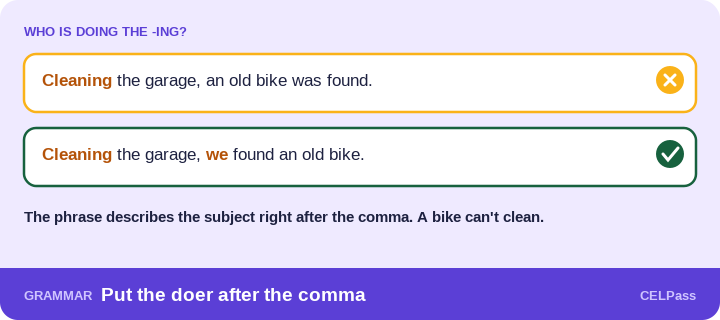
Check yourself: choose one answer
Which sentence is correct?
Only a person can wait for the bus, so I must be the subject after the comma.
3Appositives: a noun that renames a noun
An appositive sits next to a noun and tells us more about it: "Ms. Patel, the building manager, replied the next day." Use commas when the extra information could be removed; no commas when it identifies which one: "My friend Ana lives in Surrey" (I have several friends).
Check yourself: choose one answer
Where do the commas go? "Kelowna a city in the Okanagan Valley is known for its lakes."
The appositive "a city in the Okanagan Valley" is extra information, so commas go on both sides of it.
Key takeaways
- -ing phrases show the subject's action; -ed phrases have a passive meaning.
- The noun right after the comma must be the one doing or receiving the action.
- Appositives rename a noun; put commas around extra information.
- Use these structures a few times per answer, not in every sentence.
Exercises
Type or choose your answers, then check them. The first ones start with a worked example; the last asks for your own sentences.
Complete with the -ing or -ed form of the verb in brackets.
Living (live) near the station, I can walk to the train.
- 2(build) in 1950, the arena needs a new roof.
- 3(check) my bank statement, I noticed a double charge.
- 4(design) for families, the park has three playgrounds.
- 5(feel) tired after her shift, she went to bed early.
- 6(make) by hand, these mittens are warmer than the ones in stores.
Combine the two sentences in the way shown in brackets.
I opened the door. I saw water on the floor. (-ing phrase)
→ Opening the door, I saw water on the floor.
- 2
The bakery opened last month. It is already busy. (-ed phrase)
- 3
I walked to work. I noticed a new café. (-ing phrase)
- 4
The letter was written in French. It was hard for me to read. (-ed phrase)
- 5
Mr. Lee is our building manager. He fixed the door. (appositive)
- 6
Gatineau is a city across the river from Ottawa. It has a great museum. (appositive)
Choose the ending that keeps the right doer after the comma.
Driving home last night, I saw a moose (I saw a moose / a moose appeared)
- 2
Waiting at the clinic, ___
- 3
Built in 1912, ___
- 4
Looking out the window, ___
- 5
Tired after the long shift, ___
- 6
Having finished the report, ___
Sentences from an email to a neighbour. Fix the commas or the doer. Two sentences are already correct.
Ms. Patel the building manager replied the next day.
→ Ms. Patel, the building manager, replied the next day.
- 2
Located on the third floor, I find the gym hard to reach.
- 3
The pool, closed since June, is finally open again.
- 4
Hoping for a quick answer, the email was sent on Monday.
- 5
Our new neighbour a retired teacher offered to help my daughter with math.
- 6
Signed by both tenants, the lease is now complete.
Write your own sentences.
- 1
Your morning, with an -ing phrase.
- 2
A building in your city, with an -ed phrase.
- 3
A person you know, introduced with an appositive.
- 4
A survey answer that joins a reason and an opinion with a participle phrase.
Practise with free questions
Free questions in the CELPIP format, with answers and no account needed. Try a few now, while the lesson is fresh.
CELPass is an independent practice platform and is not affiliated with Paragon Testing Enterprises. CELPIP is a trademark of Paragon Testing Enterprises. Check the official CELPIP website and IRCC for current test rules and requirements.