Unit 3: Verbs and tenses · Lesson 9 of 38
Present Simple and Present Continuous
- 4 min read
- 1 diagram
- 4 quizzes
- 5 exercises · 25 questions
By CELPass Editorial Team · Updated
The present tenses carry most of your Speaking Task 3 picture description and every sentence about your daily routine. Choosing the right one tells the listener whether something is a habit or is happening now.
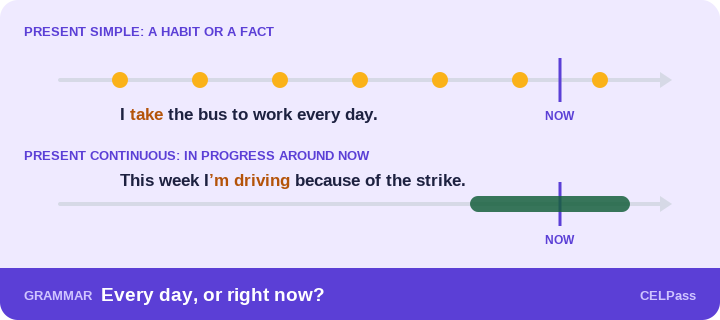
1Habit or happening now?
| Present simple | Present continuous |
|---|---|
| Habits and routines: "I work from home on Fridays." | Happening now: "I'm working from home today." |
| Facts: "The library opens at 10." | Temporary situations: "I'm staying with my cousin until I find a place." |
| Schedules: "The train leaves at 6:40." | Changes in progress: "Rents are going up every year." |
| Signal words: always, usually, every week, often | Signal words: now, right now, this week, these days, at the moment |
Check yourself: choose one answer
"Sorry, I can't talk right now. I ___ dinner for my kids."
Right now shows the action is in progress at this moment, so present continuous: am making.
Check yourself: choose one answer
"My husband usually ___ the kids to school, but this week I ___ it."
Usually is a habit (drives); this week is a temporary change (am doing).
2Describing a picture
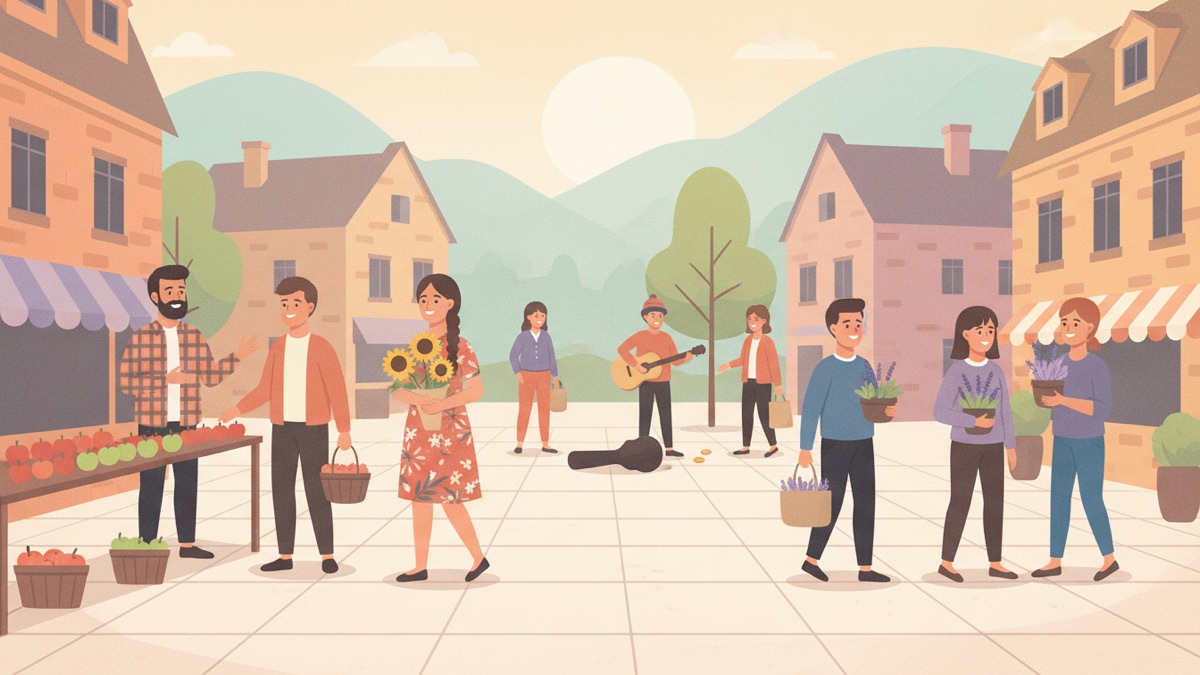
In Speaking Task 3 (describing a scene), use the present continuous for what people are doing and the present simple for what is always true about the scene: "A man is carrying a box up the stairs. The stairs lead to a small apartment." Mix in there is and there are for things you see.
Check yourself: choose one answer
Which is the best sentence for describing a picture?
In a picture the action is happening in the moment shown, so the present continuous is the natural choice.
3Verbs that stay simple
Verbs for states, not actions, are rarely used in the continuous: know, believe, understand, mean, need, want, prefer, like, love, belong, own, seem, cost. Say "I need a bigger apartment", not "I am needing", and "I prefer Option A", not "I am preferring".
Some change meaning: "I think it's a good idea" (opinion, simple) but "I'm thinking about moving" (considering, continuous). "I have a car" (own) but "I'm having lunch" (eating).
Check yourself: choose one answer
Survey answer: "I ___ Option B because it is cheaper."
Prefer is a state verb, so it stays in the present simple.
Key takeaways
- Present simple: habits, facts and schedules.
- Present continuous: now, temporary situations and changes in progress.
- Use the present continuous for people's actions in a picture.
- State verbs (know, need, prefer, own, cost) stay simple.
Exercises
Type or choose your answers, then check them. The first ones start with a worked example; the last asks for your own sentences.
Write the present continuous (am/is/are + -ing) of the verb in brackets.
Sorry, I can't talk right now. I am driving (drive).
- 2Look outside! It (snow) again.
- 3We (look) for a bigger apartment at the moment.
- 4My son (not / sleep) well these days.
- 5In the picture, two men (carry) a sofa up the stairs.
- 6The kids (play) in the backyard right now.
Habit or happening now? Choose the present simple or the present continuous.
The library opens at 10 on weekdays. (opens / is opening)
- 2
I usually ___ the bus, but this week I'm driving.
- 3
I ___ with my cousin until I find a place.
- 4
The train ___ at 6:40 every morning.
- 5
Food prices ___ quickly these days.
- 6
My daughter ___ to swimming lessons every Saturday.
State or action? Put the verb in the present simple or the present continuous.
I need (need) a bigger apartment.
- 2I (think) about moving to Kelowna next year.
- 3I (think) the second option is better.
- 4This jacket (belong) to my brother.
- 5We (have) lunch now. Can I call you back?
- 6I (not / understand) why the bill is so high.
- 7This phone plan (cost) $40 a month.
A Speaking Task 3 picture description. Put each verb in the present simple or the present continuous.
In this picture, a family is having (have) a picnic in a park.
- 2The father (cook) burgers on a small barbecue.
- 3Two children (throw) a ball to their dog.
- 4A path (lead) from the parking lot to a small lake.
- 5Behind them, a woman (sell) ice cream from a cart.
- 6I (think) it is a holiday, because the park is full.
Talk about your life now, as in Speaking Tasks 2 and 3. Use the tense in brackets.
- 1
Your weekday routine (present simple with usually).
- 2
Something temporary in your life (present continuous with this month or these days).
- 3
What one person is doing in a picture of a busy street (present continuous).
- 4
A preference in a survey answer (a state verb such as prefer or need).
Practise with free questions
Free questions in the CELPIP format, with answers and no account needed. Try a few now, while the lesson is fresh.
CELPass is an independent practice platform and is not affiliated with Paragon Testing Enterprises. CELPIP is a trademark of Paragon Testing Enterprises. Check the official CELPIP website and IRCC for current test rules and requirements.