Unit 4: Modals, voice and verb patterns · Lesson 18 of 38
Phrasal Verbs
- 4 min read
- 1 diagram
- 3 quizzes
- 5 exercises · 24 questions
By CELPass Editorial Team · Updated
Phrasal verbs make Speaking sound natural and fluent, and the right one in a friendly email shows real vocabulary. The grammar question is where the object goes.

1Verb + particle = a new meaning
| Phrasal verb | Meaning | Example |
|---|---|---|
| put off | delay | We put off the move until spring. |
| look into | investigate | Could you look into the billing error? |
| run out of | have none left | The shelter has run out of blankets. |
| get along with | have a good relationship | I get along with my roommates. |
| turn down | refuse | She turned down the offer. |
Check yourself: choose one answer
"The landlord promised to ___ the noise complaint." (investigate)
Look into means investigate; look after means take care of.
2Where the object goes
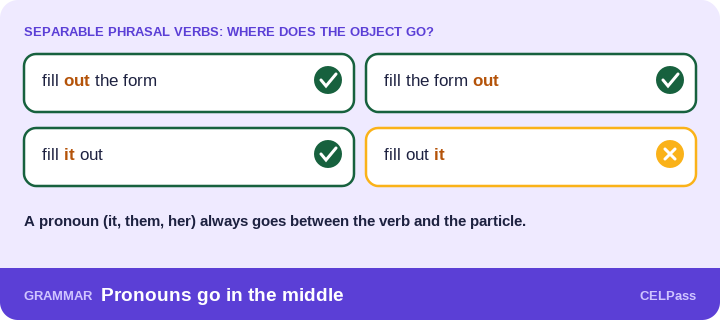
Some phrasal verbs can't be split at all, such as look into, look after, get over and run into: "I ran into my old teacher", never "ran my old teacher into". A dictionary marks which kind each verb is.
Check yourself: choose one answer
Choose the correct sentence.
With a pronoun object, the pronoun goes between the verb and the particle: turned it down.
Check yourself: choose one answer
Which sentence is correct?
Look after cannot be split, so the object comes after the whole phrasal verb.
3Formal or informal?
Phrasal verbs are perfect for Speaking and for emails to friends. In a formal email, a one-word verb can sound more polished: postpone (put off), investigate (look into), cancel (call off), submit (hand in). Either is correct; match the tone to the reader.
Key takeaways
- A phrasal verb's meaning is often not the sum of its words: learn it as one item.
- With a pronoun, put it in the middle: fill it out, turn them down.
- Inseparable verbs (look into, look after, run into) keep the object after the particle.
- Use one-word verbs for a more formal tone.
Exercises
Type or choose your answers, then check them. The first ones start with a worked example; the last asks for your own sentences.
Complete with the phrasal verb that matches the meaning in brackets.
We had to put off (delay) the move until spring.
- 2Could you (investigate) the billing error on my account?
- 3My neighbour (takes care of) my cat when I travel.
- 4We've (have none left) of coffee, so I'll buy some.
- 5She (refused) the job offer because the hours were too long.
- 6Please (complete) this form and bring it to your appointment.
Rewrite each sentence with the pronoun in brackets in the right place.
Please fill out the form. (it)
→ Please fill it out.
- 2
Can you pick up the kids at five? (them)
- 3
I'll hand in the report tomorrow. (it)
- 4
She turned down the offer. (it)
- 5
My aunt looks after my son on Fridays. (him)
- 6
Could you turn off the lights when you leave? (them)
Choose the correct phrasal verb or word order.
I ran into my old teacher at the grocery store yesterday. (ran into my old teacher / ran my old teacher into)
- 2
The landlord promised to ___ the leak.
- 3
I get ___ well with my roommates.
- 4
The TV is too quiet. Could you ___?
- 5
I need to ___ early tomorrow for my shift.
- 6
Please ___ your application by Friday.
Make this email more formal. Replace each phrasal verb in brackets with one word.
Could you investigate (look into) the missing payment?
- 2We have had to (put off) the meeting until next week.
- 3Please (hand in) the signed forms by May 1.
- 4The company (turned down) my request for a refund.
- 5We have had to (call off) the open house because of the storm.
- 6Parking fees have (gone up) by 10 percent this year.
Write your own sentences with phrasal verbs.
- 1
Speaking Task 2: say how you dealt with a problem, using two phrasal verbs.
- 2
An informal note asking a neighbour to look after something.
- 3
A formal sentence for an email using postpone or cancel.
- 4
A sentence with a pronoun between the verb and the particle.
Practise with free questions
Free questions in the CELPIP format, with answers and no account needed. Try a few now, while the lesson is fresh.
CELPass is an independent practice platform and is not affiliated with Paragon Testing Enterprises. CELPIP is a trademark of Paragon Testing Enterprises. Check the official CELPIP website and IRCC for current test rules and requirements.